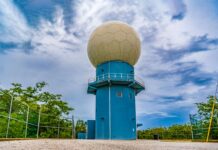
The problem with Cayman’s weather radar, which has been down since March, has been identified and a replacement part has been ordered, according to National Weather Service Director General John Tibbetts.
Speaking on the 3 May episode of the Cayman Compass weekly talkshow ‘The Resh Hour’, Tibbetts says his team is working with the radar manufacturer to get it up and running again ahead of hurricane season, which officially starts 1 June.
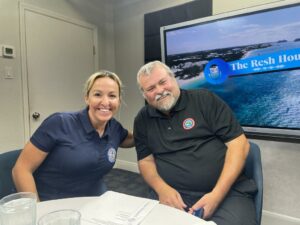
“The part is now ready, [but] be reminded the part is in Germany,” he said. “Be also reminded that the manufacturing company itself does not do the shipping. So we’re coordinating right now to get a company to ship the radar parts from there to Grand Cayman, after which we’re hoping it will be a short period of [down] time,” he said.
Tibbetts said installation is not an issue; it’s getting the part on island. Though he is unable to confirm a timeframe for its arrival in Cayman, the part is now with the courier in Germany.
Even if there is some delay in getting the radar up, Hazard Management Cayman Islands Director Danielle Coleman, who appeared on the show with Tibbetts, added that her team also has a monitoring station, data from which is shared with the weather service.
“We’ve got a lot of situational awareness of what’s happening on the island,” she said, adding that during activation of the National Emergency Operations Centre, they monitor such sources as local CCTV footage, the NWS website, the United States Geological Survey for earthquakes, the US Hurricane Center and the Windy forecasting website.
The Kearney Gomez Doppler Radar, located in High Rock, East End, was out of action for nine months when it was damaged in Tropical Storm Grace in October 2021. It was repaired in July last year, but went offline again in March.
Tibbetts agreed that the radar has been out of operation quite often, but said that it is now in its 11th year of service, and the concern is that when one problem is flagged, it may mask another issue.
“When you’re looking at a radar that is that old, you can develop some problems with it… these are some of the problems that we’re having right now… What I try to pay attention to is the type of problems we’re having,” he said, pointing to recent troubles with back-up generators which were not an actual radar problem.
For the present case, however, the issue is a faulty part.
Case for new radar?
Asked whether it’s time to replace the system entirely, Tibbetts said that will more than likely require a conversation with the manufacturer to look at the radar and its components to gauge how well they are doing.
“If the problems are not with the main components, then probably it just needs some extra maintenance here and there, and replace a part or two here and there,” he said, adding that if it is decided to replace the radar, the manufacturing company would come to Cayman and may quote replacements for five or six main components which would be sufficient for continued service.
“Otherwise, you could buy a bunch of new radar components that you really didn’t need to do,” he said.
For right now, he said the NWS is fixing the current radar to keep it up and running.
Tibbetts added that people only notice the radar is down when they need it.
“They don’t take into consideration that ‘Hey, the radar’s been up six or eight months’ or whatever prior to that. It’s just, at that particular time, that’s when you need the data. Of course, the argument would be that’s why you bought the radar in the first place,” he said.
In the absence of the radar, Tibbetts said, there are tools available to the weather service to forecast conditions over the islands, including weather models and satellite pictures.
He said NWS is also working on its network of automatic weather stations to collect data that can assist in forecasting.
Speaking to projections for the upcoming Atlantic hurricane season, Tibbetts said forecasts call for a below-average season thanks to a helping hand from El Niño conditions.
However, with the prediction, as of April, for 13 named storms, six hurricanes and two major hurricanes, Tibbetts and Coleman both agree that preparations have to be made for the upcoming hurricane season.
Coleman encouraged the community to make the necessary checks at their homes as 1 June is not very far away.
Related Videos