

Several community and environmental groups have expressed concerns over unanimous parliamentary support for immediate work to take place on the much-delayed East-West Arterial extension.
It comes after MPs voted in favour of a private member’s motion asking for a section of that extension to be built without an environmental impact assessment.
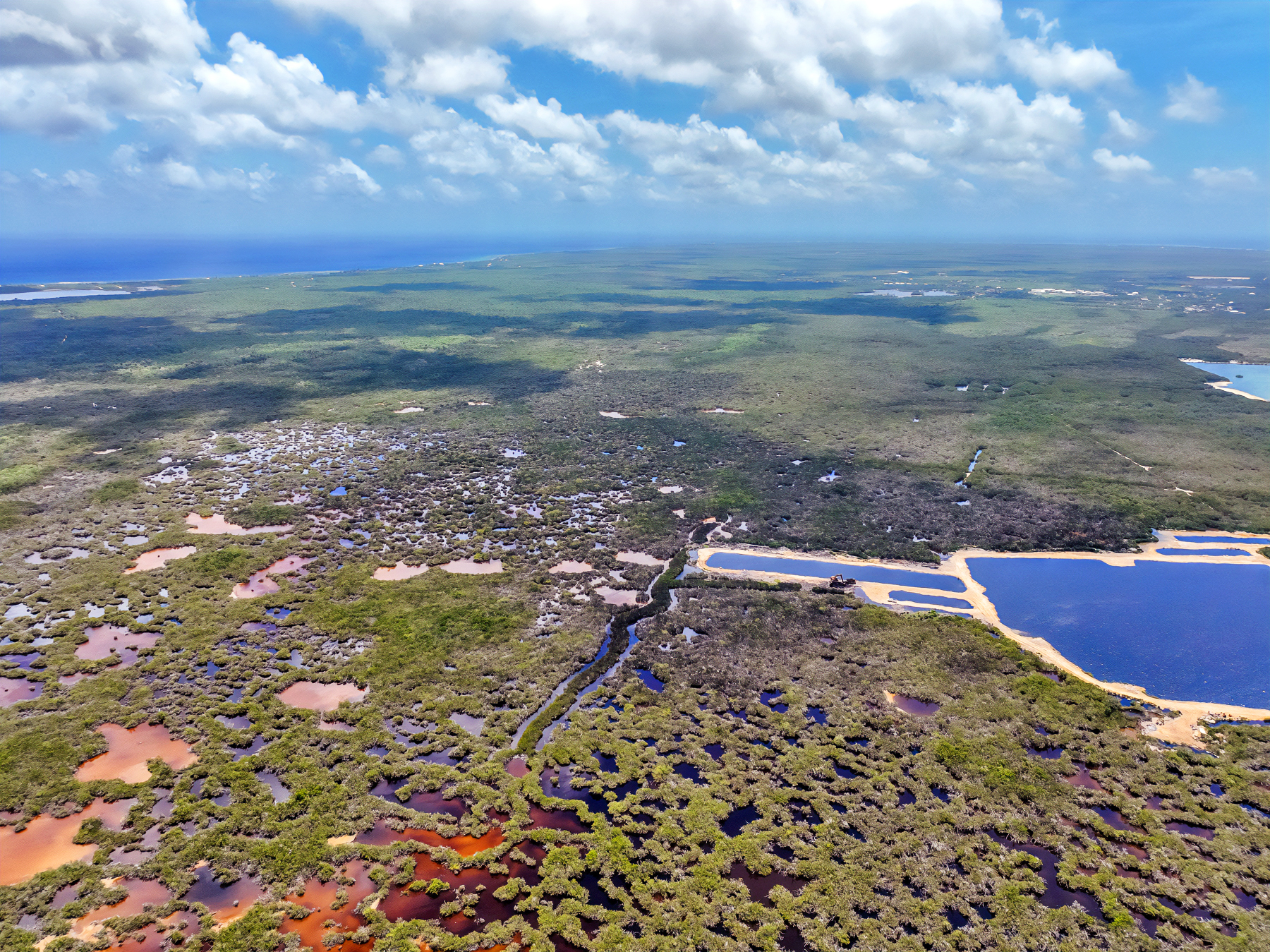
The groups said completing the green study is extremely important before works go ahead through parts of “the largest intact mangrove system in the Cayman Islands and Caribbean”.
While an urgent and effective long-term solution to the traffic problem is vital, they added in a statement, the road must be designed and constructed in accordance with the law.
They believe this will lead to the effective reduction of traffic congestion, minimal impact on the mangrove wetlands, and will help avoid potential flooding of nearby communities.
“We are collectively asking that the government continue with the full scope of works for the environmental impact assessment… so that informed decisions can be made,” they said.
A national issue
West Bay West MP McKeeva Bush presented his motion on the issue to Parliament on 27 April.
He said Cabinet had gazetted the road in 2005, but a lack of urgency has led to an increasing number of Caymanians who are “past frustrated” with the continued traffic congestion.
“These constituents are struggling to maintain a decent lifestyle,” he said, speaking of eastern district residents who travel west in heavy traffic for work or school.
The National Conservation Act 2013 says the National Conservation Council may require an environmental impact assessment if there is a threat to a protected area or critical habitat.
But Bush argued the first strip from Hirst Road to Lookout Gardens is less environmentally sensitive than other sections of the planned 10-mile extension and not in need of an EIA.
A lengthy debate saw most members speak in favour of the motion with only Premier Wayne Panton defending the legal process, saying things must be done “in the right way”.
At the close of the debate, all 17 MPs present voted for the motion. The government will now decide what steps to take going forward.
‘Extremely concerned’
Amplify Cayman, the Cayman Islands Mangrove Rangers, CPR Cayman, Protecting Paradise, Sustainable Cayman and Plastic Free Cayman joined together to express their worries.
In their statement, issued on 1 May, the groups said they are “extremely concerned” over the lack of an assessment to look at the road’s environmental, socio-economic and health impacts.
They said it undermines the government’s commitments to rely on scientific integrity and public participation in the evaluation and development of major infrastructure projects.
The government “can and must” follow international good-governance practices to ensure major infrastructural projects undergo robust scrutiny before they proceed, the groups said.
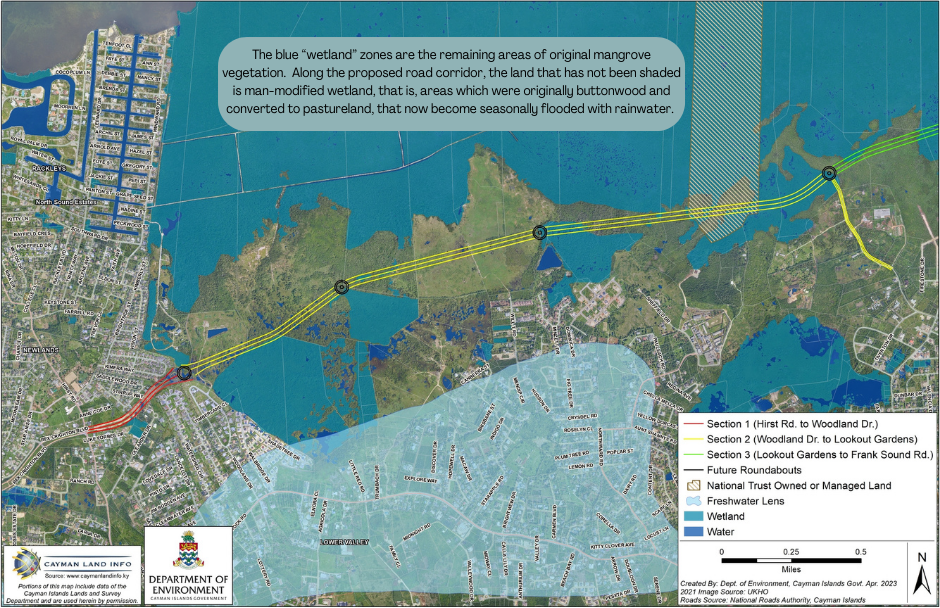
One of their major fears is that irreversible damage will be done to the Central Mangrove Wetlands, and they say the study will help minimise impact.
They also think the multi-lane road, if built too soon, could lead to flooding of the communities along the road in Bodden Town.
Grand Cayman’s water and food security is another concern, as the highway could result in more cars “streaming through” an important agricultural and wetland area.
Contaminants, runoff, construction debris, oil, gas and litter may be carried by water flow into the wetlands, the surrounding community and the North Sound, the statement added.
The groups said flash floods pose a threat to life and property without proper modelling assessments.
“Presently, the southern wetland basin acts as a natural solution for storm water drainage and filters the water that replenishes our nationally important water lens in Savannah,” the groups noted.
A ‘dangerous course’
In the statement, the groups said they recognise that a new Climate Change Policy is being worked on but said the current adaptation policy comprises “mainly symbolic” measures.
They called the measures “ineffective” in improving resilience to the major climate change-related issues of coastal erosion and increased storm intensity.
“The lack of formal adoption of policies is resulting in dangerously slow progress for climate change adaptation,” they said.
Changes in planning regulations provide opportunities for improving resilience to climate change, the statement argued, adding “but these have yet to be realised”.
“We submit that building a six-lane highway through sensitive land areas contributes to the climate change problems we are trying to mitigate,” the groups said.
They urged anyone who agrees with these views to write to the governor, premier, their MPs, the National Roads Authority, the Department of Environment, and local radio stations.
“We care deeply about our home and we are angry with this unprecedented attack and dangerous course,” they said.
Related Videos









There are more important impacts than the environment alone. Why are the environmentalists not fighting this hard to provide shelter, food, medical care, jobs to Caymanians. Quality of life is suffering without infrastructure.