The smell of freshly burnt swamp grass carried along by the evening breeze along Eastern Avenue is swiftly followed by the sight of a thin haze of grey smoke rising on the horizon – a backyard fire has been lit as residents try to chase away potential dengue-carrying mosquitoes.
“Boy, I do what I can to keep them away because, trust me, they get real bad, real quick,” said Glendon Cole, who operates a quaint mechanic shop off School Road.
His efforts to keep the pests at bay are supplementary to that of the Mosquito Research and Control Unit – whose increased activity has caught the attention of the public.
Each evening, for the past three weeks, the MRCU plane has flown overhead delivering a thin mist of adulticide across Grand Cayman, while its fleet of vehicles travels along main roads, subdivisions, back alleys, and assorted nooks and crannies, leaving a trail of white fog in their wake.
Harder-to-reach places, such as landlocked swamps and mangrove fringes, are treated with larvicide tablets which are deployed by staff on foot.
“This is a part of our routine operations as well as responses to requests for spraying,” MRCU Director Allan Wheeler told the Cayman Compass.
“We also conduct visits and spray locations whenever we get a call out from the Public Health Department after any case of a mosquito-borne illness such as dengue, Zika or chikungunya is recorded,” he added.
Up until 2019, any announcement of Zika, chikungunya or, to a lesser extent, dengue ,in the community was enough to spark concern.

In fact, during 2019, when an outbreak of Zika occurred, town hall meetings were held across each of the major districts.
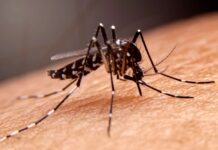
A combined effort from the MRCU, the Department of Environmental Health and Public Health was needed to educate residents on howc to thwart the Aedes aegypti mosquito, which carries various pathogens.
But, fast forward to 2020, when Cayman and the wider world closed their borders, locally, mosquito-borne illnesses were quickly snuffed out, despite a sustained prevalence in the wider Caribbean.
With the removal of dengue, Zika and chikungunya from the community, health officials were also able to stem the fear of the pathogens.
That fear was eventually replaced by an even greater degree of anxiety over COVID-19, which spread through the community.
Now that the borders have been reopened, new cases of dengue are popping up in Cayman.
According to Chief Medical Officer Dr. Nick Gent., Cayman has had “two small outbreaks” of dengue in the past 20 years, and now that the borders have reopened a third, equally small, outbreak has begun.
“We’ve got transmission going from person to mosquito to person, and while those numbers are relatively small at about seven cases, we have had quite a few imported cases,” said Gent, while speaking on the Cayman Compass lunchtime talk show ‘The Resh Hour’.
Since September, there have been several dozen suspected cases of dengue.
The new cases sparked a travel advisory for the US where a total of 794 cases in 44 states were reported at the end of September.
However, residents like Cole, who have no immediate plans for travel, say they are no longer concerned about the threats posed by mosquito-borne illnesses.
“I am not afraid of mosquito sicknesses like dengue and Zika, I just can’t handle the bites,” said Cole, as he pointed to his land’s boundary where a small pond provides a steady supply of fresh water.
“Don’t be fooled, I once saw a man put the entire arm of a big excavator in it, and it didn’t hit the bottom,” said Cole. “I have been here for years, and no matter how dry it gets it never dries up, and this is what is breeding the mosquitoes.”
But with more and more cases being reported, residents are now being urged to take the necessary steps to protect themselves from the mosquitoes.
Prevention efforts
Local health officials say the best way to prevent the transmission of dengue fever is by preventing mosquito bites.
“I encourage residents to familiarise themselves with the public health advice for travel and local prevention,” Gent said. “And, as always, early diagnostic testing is paramount, so if showing symptoms please contact your physician or the Public Health Department on 244-2648.”
According to Public Health, typical symptoms of dengue include:
- high fever
- severe headache
- backache
- joint and eye pain
- nausea and vomiting
- muscle and or bone pain
- a rash may sometimes be visible two to five days after the onset of fever
- nausea or vomiting (sometimes)
- signs of bleeding (such as pinpoint red or purple spots on the skin, nosebleeds, bleeding gums, blood in urine or stool or vaginal bleeding) is seen in a severe form of the disease known as dengue haemorrhagic fever, severe dengue or dengue shock syndrome.
Most people recover without any complications, using pain relievers and bed rest. Once a patient has developed a fever, the infectious period lasts for one week only.
Related Videos