In the Florida Keys, a disease called ‘white pox’ almost wiped out the elkhorn coral on local reefs in the 1990s and 2000s, before a team of scientists proved that a human pathogen, spread through improperly treated effluent, was the cause, and politicians and the local community took a stand to save the coral and improve the quality of the coastal waters.
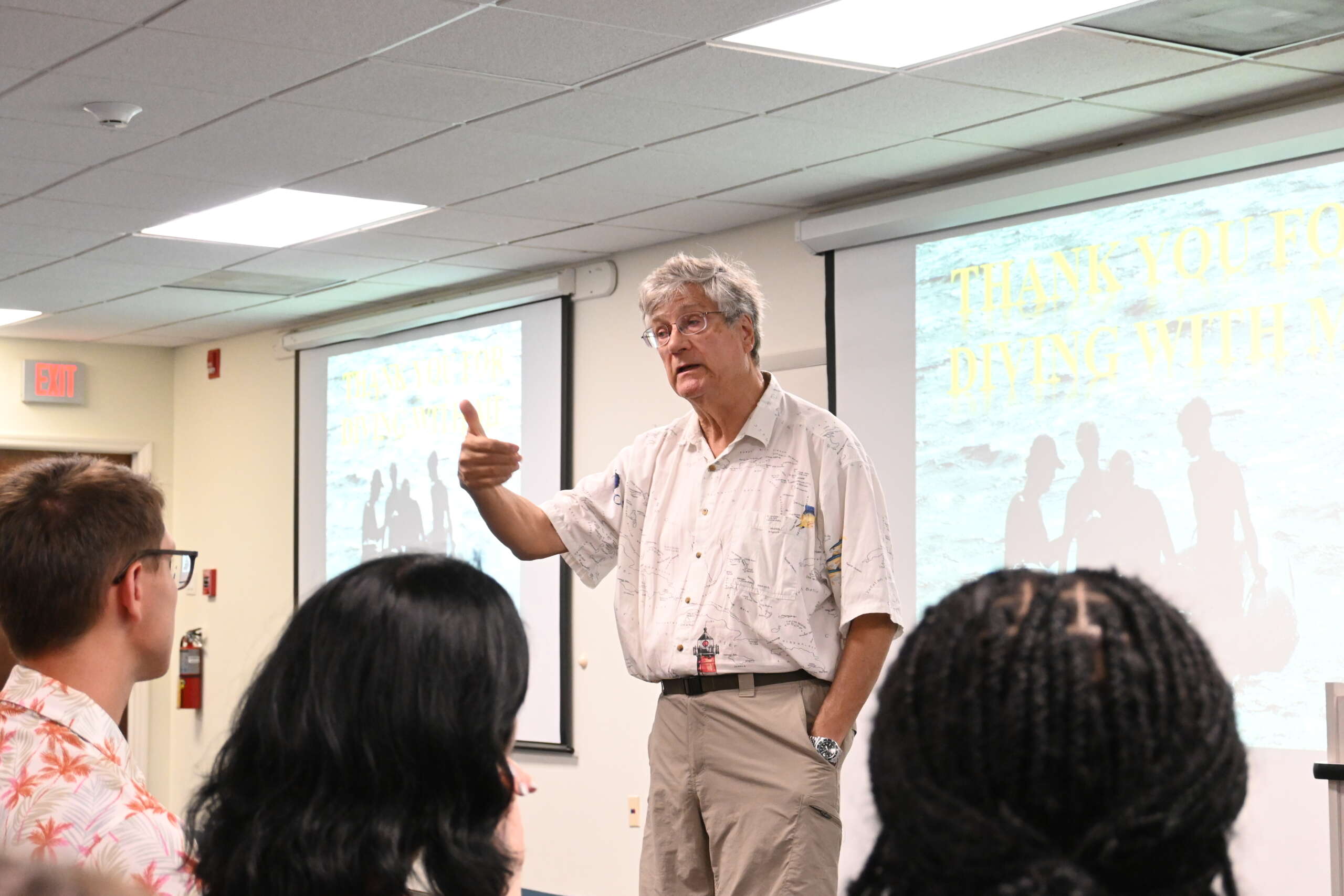
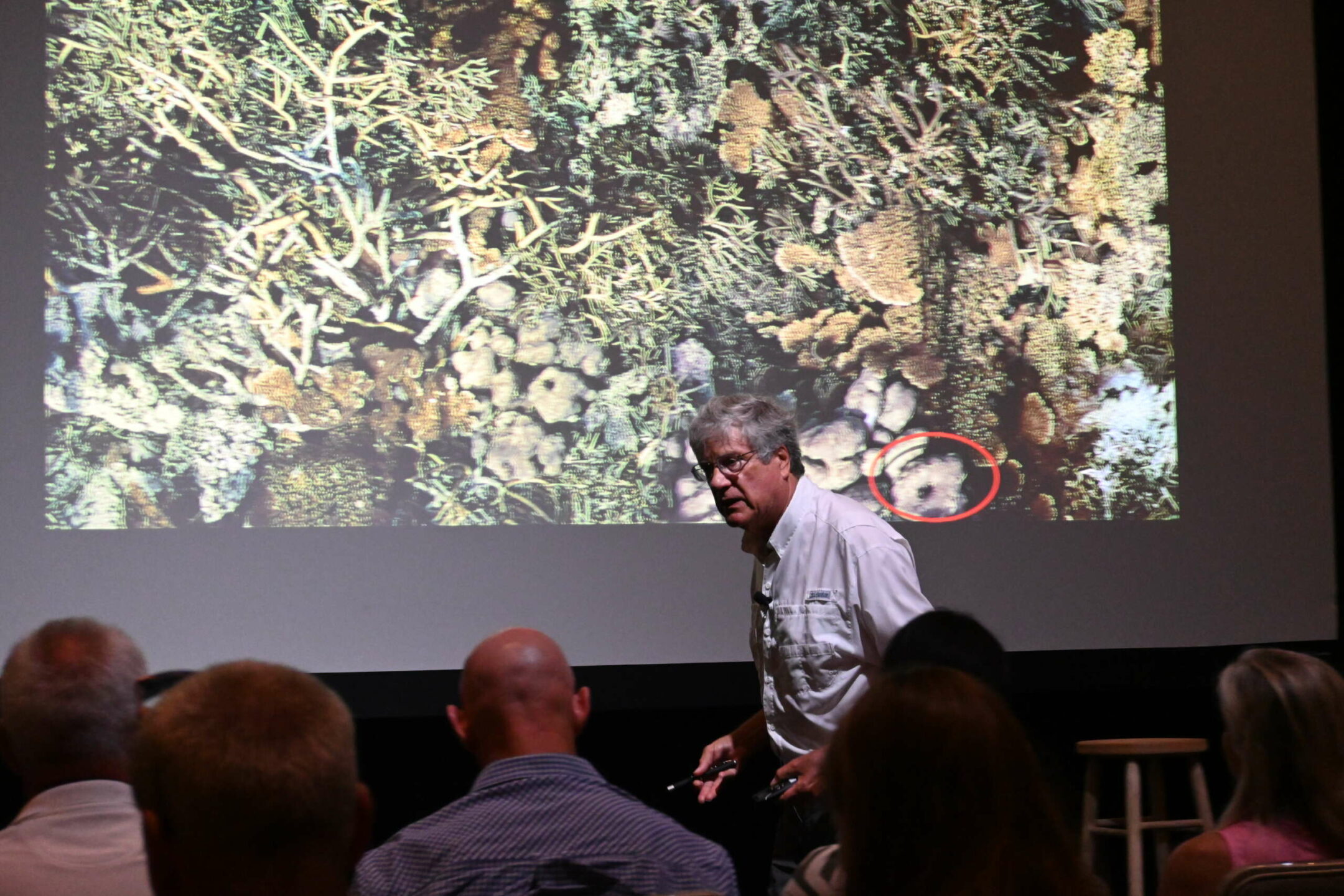
That battle, and the issue of improperly treated sewage, its impact on the marine environment and potential solutions, was the subject of a presentation given earlier this month by renowned ecologist James Porter, who led the team that discovered what was killing the Florida Keys coral.
Porter and researchers from the University of Georgia and Florida’s Rollins College, in 2011, identified a pathogen in human faeces, called Serratia marcescens, as the key factor in the decline of the elkhorn coral population.
Porter, who is Josiah Meigs Distinguished Professor of Ecology, Emeritus, at the University of Georgia, and was chief scientific advisor and a cast member on the Netflix documentary ‘Chasing Coral’, was in Cayman in early September for a screening of that movie and to give a talk to St. Matthew’s University students.
In his talk, he gave a detailed account of what had happened with improperly treated sewage entering the marine environment in Florida and the damage it caused to coral.
“Every time I say the words Florida Keys, you can think ‘Grand Cayman’, because everything I’m going to be showing you now relates to the same species of organisms and the same challenges that are here in Grand Cayman,” he told the audience.
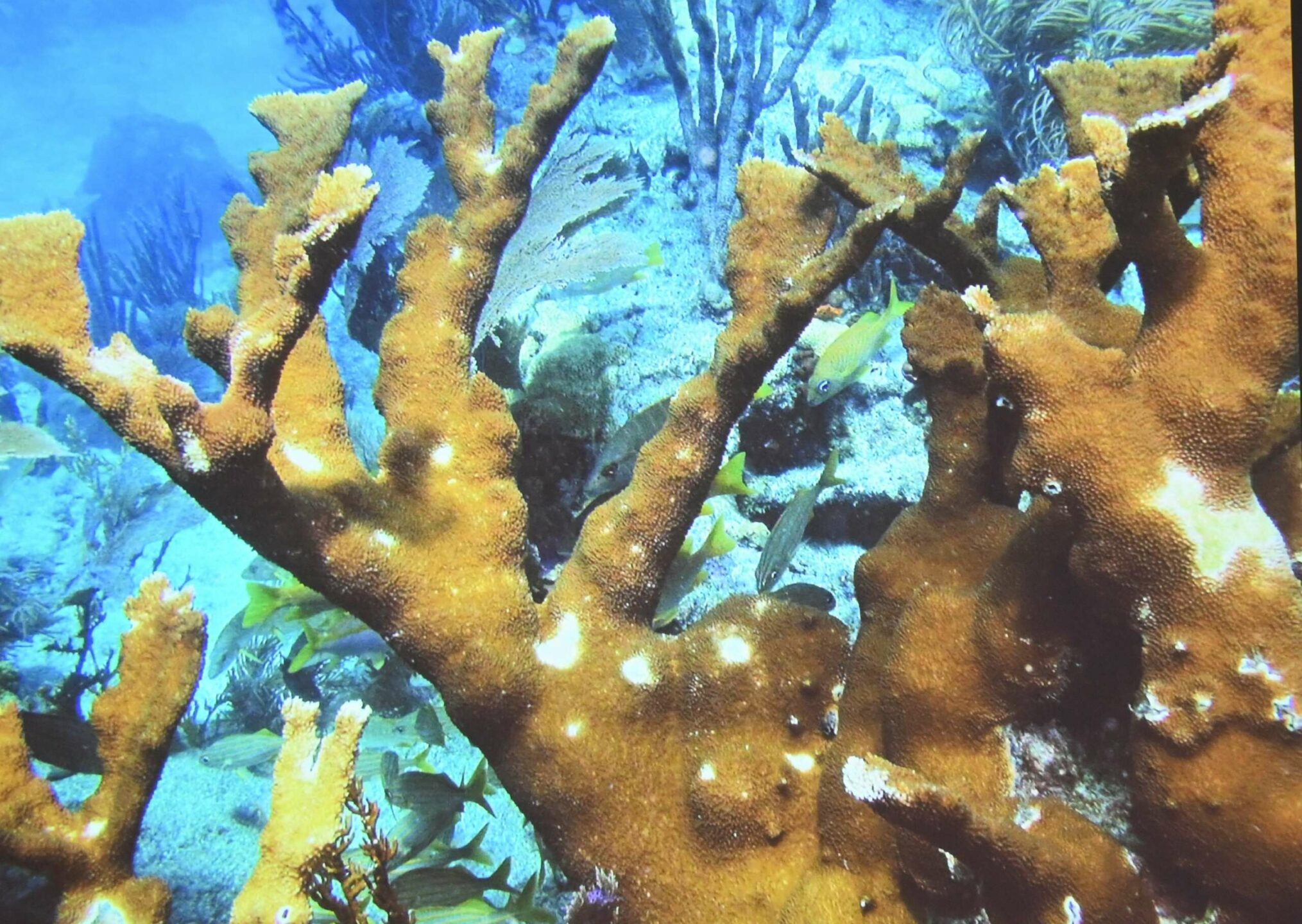
80% of elkhorn coral died
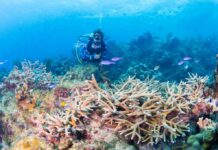
Long-term ecological studies that began in the Keys in 1996 have shown that almost 80% of elkhorn coral there has died, he noted.
Porter pointed out that elkhorn coral at one time was the most common coral in the Caribbean, and it has now entered the endangered species list.
>He said coral is being lost at an “extraordinary rate” in the Florida Keys, and worldwide.
“This affects Grand Cayman,” he said, “because the reef, the marine environment, is the economic engine of this country. It is the blue economy that is the basis for tourism and development and everything that is going on.”
While coral bleaching is perhaps the most commonly cited cause of coral loss, as noted in the ‘Chasing Coral’ documentary, it’s not just the warming oceans and the resultant bleaching that is affecting corals. The quality of the coastal waters also has a major impact.
Finding the cause of white pox
During his research into the previously unknown disease affecting elkhorn coral in the Florida Keys, he and his team determined the white patches they were finding on the coral wasn’t bleaching. They dubbed it ‘white pox’.
When he mapped terrestrial rainfall and runoff, he found that peak coral losses corresponded with periods of high runoff. The scientists took samples of water and of the affected corals. What they found in the coral samples surprised them – a potentially deadly human pathogen called Serratia marcescens.
“We’re talking about a human pathogen that was now killing coral reefs,” he said, as he recalled the results. “It’s not a marine bacteria. It does not tolerate salt. It does not tolerate high oxygen levels. Absolutely bizarre. Serratia marcescens dies in sea water after only one hour, so how is this possible?”
The scientists tried out a few different ingredients, to see the impacts. They added nitrogen, which elongated the lifespan of the bacteria in the sea water to 18 hours. They then added phosphorus, which enabled it to survive for two days.
“And now, total organic carbon, and you’ve got it surviving three days in salt water,” Porter said. “And then you add all the nutrients together, plus a little coral mucus, and what do you have? Five days of this non-marine anoxic bacteria surviving in the sea.” He added “Poor water quality lengthens the survival time of this non-marine bacteria from virtually nothing to five days in the sea water.”
Noting that, according to satellite data, the colour of much of the planet’s oceans is changing from blue to green, probably due to an increase in micro algae in the water,
Porter said, “That’s what we’ve done in our coastal zone in the Florida Keys, and you have not yet done it in Grand Cayman. Don’t do it. That would be a bad mistake.
“What runs off the land is not good for what brings you your economic present and confers to you your economic future. Florida Keys is a harbinger of this.”
Follow the ping pong balls
Porter explained that, using ping pong balls, he and his team were able to determine where the runoff from the land in the Florida Keys was ending up. “We went to the Key West harbour and the Key West sewage treatment plant, right there in Key West, and we threw ping pong balls in the water.”
That showed them that some of the treated wastewater running off that site was ending up, within five days, on the reef.
The team had identified Serratia marcescens as the bacteria that was killing the coral.
However, they had not yet proved that this bacteria was coming from human sewage, as there are different strains of the organism – one of which is found in the endangered Key deer, the smallest subspecies of the North American white-tailed deer.
At one point, when the deer were still considered the possible culprits, bumper stickers with ‘Shoot the Deer’ began to appear in Key West, Porter said.
After comparing strains of the bacteria found in deer and human faeces to the strain found in the affected corals, the scientists determined there was a 100% match to the human strain.
When the findings were published, there was widespread media coverage and calls for steps to be taken to rectify the situation. Porter says he spoke to “every politician between Miami and Key West”.
At the time, Porter says, an election was coming up, and one candidate, who was ultimately successful in his campaign, said he would raise taxes to find the $100 million that would be required to upgrade the area’s wastewater treatment plant.
Following that upgrade, the quality of the water increased hugely, with the bacteria reaching undetectable levels in later tests.
Porter said one of the reasons the project to upgrade the wastewater treatment in the Florida Keys was so expensive was because it required every private home and business to hook up to a centralised, publicly owned system. Hooking up to the centralised system cost each property about $5,000, over and above the taxes, which had to be paid by the property owners.
“They were cesspools and septic tanks, and all of them were closed down, and now it’s all centralised wastewater treatment from Key Largo to Key West,” Porter explained.
‘Greed versus need’
Asked by one audience member how to overcome “greed versus need” when implementing a centralised system, Porter said the only way is to promote the concept of self-interest, “that your long-term profitability is dependent upon you protecting the natural resources that people come here to see”.
Cayman activist Billy Adam has been raising the issue of potential damage being done to local reefs by local sewage systems, especially as the population of the island continues to increase and more developments are coming online. He has pointed out at several public meetings over the years that elkhorn coral has been disappearing from the local reefs for decades and questions if local effluent could be the cause.
At Porter’s presentation, he queried if Cayman’s level of 30 parts per million of total suspended solids and biochemical oxygen demand was too high, noting that in many parts of the world, it is 5 ppm.
Answering local photographer and environmentalist Courtney Platt who questioned how the government, which supports building a road through part of the Central Mangrove Wetland, can be convinced to become more conscious of and involved in the environment, Porter suggested expanding the concept of putting a monetary value on natural resources.
He cited a report by conservationist Guy Harvey, who has estimated that each stingray at the Stingray Sandbar is worth about $5 million to the tourism economy. “That’s a lot of money for fish,” he said. “Your mangroves are worth more. Your seagrasses are worth more.”
Related Videos