The US National Oceanic and Atmospheric Administration has declared that the planet is currently experiencing a global coral bleaching event – the fourth on record and the second in the last decade.
According to NOAA’s Coral Reef Watch, “bleaching-level heat stress”, has been and continues to be extensive across the Atlantic, Pacific and Indian Ocean basins.
“From February 2023 to April 2024, significant coral bleaching has been documented in both the Northern and Southern Hemispheres of each major ocean basin,” said Derek Manzello, NOAA Coral Reef Watch coordinator, in a statement issued in April.
“As the world’s oceans continue to warm, coral bleaching is becoming more frequent and severe,” Manzello said. “When these events are sufficiently severe or prolonged, they can cause coral mortality, which hurts the people who depend on the coral reefs for their livelihoods.”
Bleaching in Cayman
As anyone who dived, snorkelled, swam or fished at coral reefs in Cayman between August and October 2023 can attest, local reefs on these islands have not been immune to the impact of coral bleaching.
Last year’s severe coral bleaching event had been expected locally for several months.

As early as May, Cayman had been on what is known as a ‘bleaching watch’, then on a ‘bleaching warning’ in July, before entering Alert Level 1 at the start of August, rising to Alert Level 2 – the highest risk level at the time – shortly afterwards. Cayman remained at Level 2 until almost the end of October.
In all, last year’s bleaching event lasted 19.5 weeks – nearly five months – and sea surface temperatures did not start going down until November, Croy McCoy, who manages the Department of Environment’s Marine Resources Unit, told the Compass this week.
McCoy, who holds a Ph.D in ocean sciences and has authored or co-authored more than two dozen peer-reviewed scientific papers on coral reefs, said records show bleaching events have typically been reported about once every two years.
“But then we had 2023, which had the hottest temperatures recorded in the global tropics, the hottest temperatures in the region, and the hottest temperatures here in Cayman,” he said.
He added, “By October usually each year, it’s cooled down… but this was extreme. It went up [to Alert Level 2] in August and it stayed there for an extended period of time,” McCoy said. “That was very alarming and concerning.”
And this year, it’s expected to happen again.
“2024 is forecast to be even hotter and last longer,” he said. “It just seems like it’s becoming an annual event… and the time between bleachings seems to be reducing.”
NOAA expanded its alert levels to go up to level 5 after last year’s unprecedentedly long and hot spell.
Worldwide phenomenon
According to NOAA, since early 2023, mass bleaching of coral reefs has been confirmed in the Caribbean, Florida, Brazil; the eastern Tropical Pacific, including Mexico, El Salvador, Costa Rica, Panama and Colombia; Australia’s Great Barrier Reef; large areas of the South Pacific, including Fiji, Vanuatu, Tuvalu, Kiribati, the Samoas and French Polynesia; the Red Sea, including the Gulf of Aqaba; the Persian Gulf; and the Gulf of Aden.
NOAA says it has also received confirmation of widespread bleaching across other parts of the Indian Ocean basin, including in Tanzania, Kenya, Mauritius, the Seychelles, Tromelin, Mayotte and off the western coast of Indonesia.
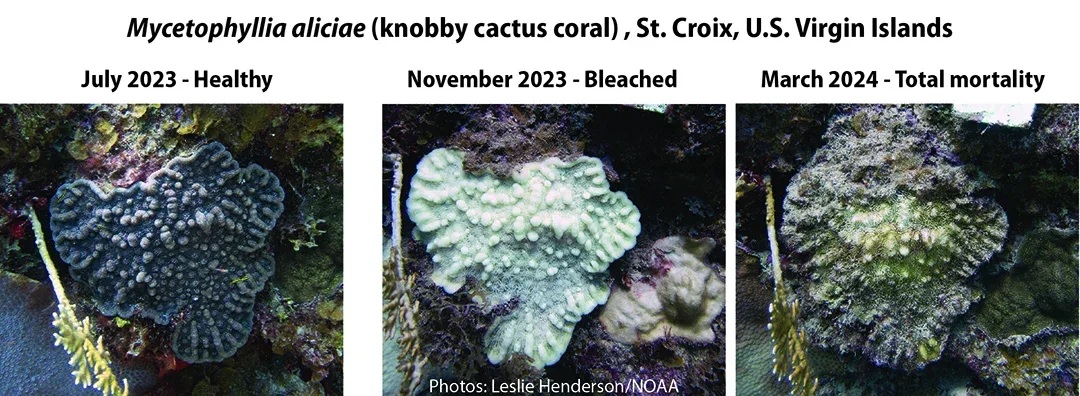
Coral bleaching occurs in instances when water is too warm, resulting in corals expelling the tiny algae called zooxanthellae that live in their tissues, causing the coral to turn completely white. This doesn’t mean the coral is dead, and it can recover from bleaching, but the longer a bleaching event lasts, the higher the risk of coral mortality.
Related Videos