

By Simon Cawdery, Compass columnist

Is Cayman’s public spending out of control?
Such a simple question, worth surely of a straightforward yes or no answer. To get to the answer, data needs to be collected and then interpreted. This article will do exactly that, but for those who want to know the conclusion, the answer is a highly likely yes – Cayman’s public spending is out of control and failing to deliver value for money to Caymanians.
To get started, we need to understand Cayman’s budgets and how Cayman’s government obtains revenue.
Cayman doesn’t have direct taxation (income tax, corporation tax and such like), but instead relies on indirect measures, such as import duty, fees, and levies (which the government calls ‘coercive revenue’ as opposed to ‘taxes’).
Total coercive revenue, according to the government’s own budgets, in 2022 was $965 million and similar in 2023 before expanding to $1.033 billion in 2024 and potentially substantially beyond that in 2025. Government forecasts for 2025 suggest $1.076 billion, but it could easily be much higher, given the fee increases being proposed for the financial services sector.
However, these numbers in isolation don’t necessarily allow for conclusions. Depending on your viewpoint (or biases), they may look big or small. The headline of ‘Government revenue to top $1 billion’ (Cayman Compass 28 April 2023) seemed startling to many when it appeared, but perspective is vital to draw conclusions.
Two primary sources of revenue
The first critical observation to make is that governments have two primary sources of revenue. One is revenue that they can mostly control – such as taxing its citizens, and the other is that which they don’t control – such as taxing international companies that elect to use Cayman. The reason I refer to this as “non-controllable” is that it is geographically mobile.
No international fund is obligated or required to remain in Cayman. No expatriate can be forced to live in Cayman and no foreign person is compelled to use Cayman for their international estate or financial planning. Thus, no government, at the end of the day, can guarantee that this part of their revenue stream will be available to be taxed in the future.
Just because Cayman’s government can’t compel foreign businesses to use Cayman doesn’t necessarily mean that rises in tax rates would cause everyone to leave. Indeed, the suspicion is that there would be very minimal grumbling or reaction by international businesses to modest price changes, but should materially larger tax changes occur, a potentially different and much larger negative response is likely.
Crucially though, Cayman’s government wants to be careful about testing where the tipping point is, since, once reached, it will likely be difficult to turn back the clock and revitalise a reputation.
Budget is reliant on non-controllable revenue
Of the revenue raised by government, my analysis suggests that approximately 40% of it comes from the financial services sector in the form of either fees and duties on local operators or from fees on funds, partnerships or companies operating through Cayman. This is the hidden taxation that those of us living in Cayman often never see explicitly (i.e., it’s paid by non-residents and non-citizens); we feel the benefits of the revenue it raises but don’t necessarily suffer the costs of paying it.
It’s worth noting that my methodology doesn’t include legal practitioners as the government’s budget numbers don’t distinguish between the types of practitioners, so the share is likely higher than the 40% presented.
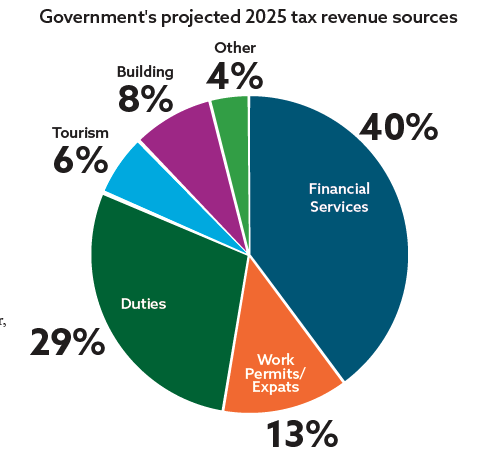 Perhaps the most eye-opening fact that arises from looking at the pie chart above is how potentially exposed Cayman is to the financial services sector; 40% of government revenue is explicitly derived from this sector (to say nothing of the import duty, permit fees and such like connected to those who work in it).
In fact, if one adds in revenue from work permits and tourism, then we find that at least 59% of government revenue is derived from potentially non-controllable sources.
That’s a very high figure for any country and should illustrate how reliant Cayman is on firstly keeping its reputation intact (in many ways), as well as how dependent Cayman is on the expatriate and international community to support government’s spending plans for the country.
Indirect taxes
The next largest source of government revenue is duties imposed on consumers. To assess this number, this article sums import duties with gasoline duty, diesel duty, car tax and insurance duties, since these are all duties individuals must pay to the government in the form of indirect taxes.
These indirect taxes (meaning we don’t explicitly see them, but they affect our everyday lives) accounted for $265 million in government revenue in 2022 and are forecast to account for $310 million in government revenue in 2025.
To put that in context, on average, each person in Cayman is paying the government approximately $3,388 each year in duties for things that they purchase (electricity, fuel, food, clothes, etc). That’s a large sum, particularly for lower-income families (since lower income families consume a much higher proportion of their earnings).
The financial services sector, in contrast, is paying approximately $4,744 per person in taxation to the government, a very healthy subsidy from international companies to Cayman’s prosperity and government coffers.
An interesting thought experiment would be to contemplate what the shock factor would be if the grocery stores, gas stations, car showrooms and retail shops in Cayman, all expanded their customer receipts to show additional detail. First, the total price, but then a second line showing separately how much of that was due to government duties and taxes. I suspect it would surprise many, as well as being a wonderful improvement in fiscal transparency. Which store wishes to go first?
The international context
Using international comparisons to assess government spending can be instructive, so let’s compare:
Cayman’s government spent $1 billion in 2023 and is forecast to spend $1.06 billion in 2025. If you include statutory authorities and debt interest service costs, the numbers are $1.25 billion in spending in 2023 and $1.47 billion by 2025.
Cayman’s Economics and Statistics Office estimates the population in 2024 at 87,866. That means Cayman’s government spends $16,150 per person. Remember, this number is in Cayman Islands dollars, so in US dollar terms, at current exchange rates, that’s US$19,695 per person.
Intuitively, that seems like a lot of money for a country without a substantial social security system and where all are required to have private medical insurance. Other countries have social security systems that provide support to families who are low income, in poor health or pensioners, and they provide free or partially free healthcare for their citizens – the US provides free (at the point of use) healthcare for its seniors and children (as well as some unemployed) and the UK provides free healthcare for all.
Also, Cayman doesn’t have an army, navy or air force. I say this because the armed forces consume a huge percentage of government spending in other countries. In the UK, it’s 2.15% of GDP and in the US it is 3.26% of GDP.
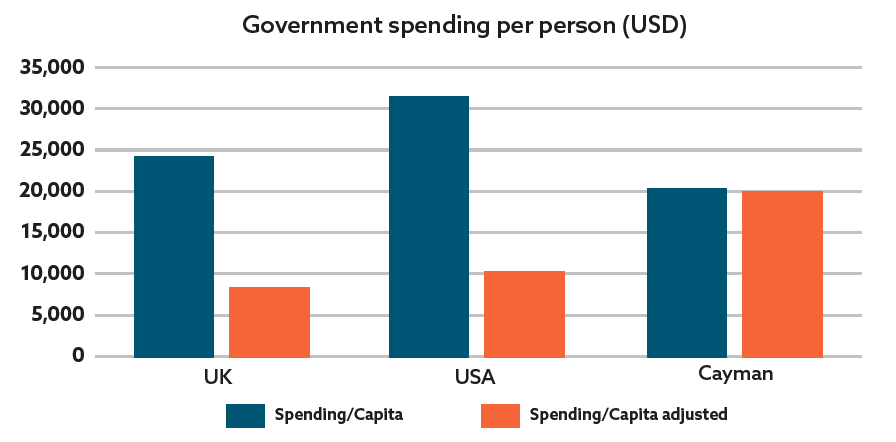 To compare Cayman’s spending with other jurisdictions, it is therefore necessary to strip out a number of items from other countries’ spending data. It will never be a pure ‘apples-to-apples comparison’ but it will be closer.
First, remove the spending on defence, as Cayman doesn’t have armed forces. Second, remove the spending on healthcare, as Cayman requires private insurance. Third, remove ‘social security’ spending, as Cayman doesn’t, in practical terms, offer unemployment insurance or state pensions and similar items.
The table above compares the pre-and-post-adjustment spending in Cayman, compared to two countries, the US and UK:
At first glance, before making the adjustments (the blue bars), Cayman’s government spending doesn’t look unusual … some might even say it’s a little on the ‘light side’. After making the adjustments (the orange bars) – what we see is that Cayman’s government spending is materially higher than the UK and US.
An alternative way of looking at this is that the UK provides a free healthcare system, free education for all children, and funds its army, navy and air force, as well as provides free state pensions to all seniors – all for the same spending per person as Cayman spends currently.
In other words, Cayman’s government is spending more than twice as much, per person, as the UK or US government is spending on services on a like-for-like basis. These numbers raise major red flags and indicate serious issue regarding the value for money Caymanians get from their government spending.
Is Cayman getting value for money?
Government spending is high, and there are real worries that Cayman’s citizens are not getting value for money and instead suffering waste and inefficiencies in government spending.
In terms of education spend, government spending is wasteful. Cayman government schools spend more per pupil than private schools to achieve worse outcomes, which is a truly horrific and inexcusable situation on so many levels. As for crime and expenditure on policing, despite all the money spent on Cayman’s police force, the crime statistics in Cayman paint a disappointing picture with more armed robberies and violent incidents per capita than other similar societies – another illuminating example of money not as well spent as it could be.
To assess value for money further, we need to look at other sectors of the economy. There isn’t space in this article to look at them all, but let’s look briefly at Cayman’s regulatory regime.
Cayman has approximately 200 persons working for the financial services regulator, according to the regulator’s annual report, which is a ratio of 0.2% of the population. Compare that with the ratio in the US (0.003%) or the UK (0.01%). Cayman is a smaller country and thus it’s not unreasonable that the ratio might be expected to be higher. But should the ratio be different by a factor of 20x? Headcount, though, isn’t the only way of analysing value for money.
An alternative perspective is to look at the cost per citizen of the financial sector’s regulatory system. In the UK, the cost per citizen of running the financial service regulator is approximately $11 per citizen. In Cayman the same cost is $519 per citizen (numbers taken from the total expenditure recorded by each regulator in their most recent annual reports). Once again, Cayman’s citizens are paying far higher per person for services performed. That could be because of the financial service sector’s outsized importance to Cayman, but it could also be indicative of inefficiencies. More red flags and evidence of a ‘value for money’ problem.
Finally, consider perhaps your own experience with the machinery of government. How many times have you stood in a queue to do something so mundane and trivial that the private sector would automate in a heartbeat? Hours are easily wasted in bureaucratic quagmires, navigating unnecessary complexities to achieve simple tasks. From anecdotal experience, it doesn’t often seem as though efficiency is key within the public sector.
Perhaps one final high-level set of numbers may help: Taking the UK government as an example and using data from the UK’s Office for National Statistics, the ratio of civil service jobs to total employment in the UK is 1.46%. In Cayman, according to data from the Economics and Statistics Office, the ratio is 8.22%. Indeed, if you strip out the 60,000 people in the UK who are employed in the ministry of defence (a department Cayman doesn’t have), the UK’s ratio is just 1.18%.
The difference in those ratios is extraordinary in so many ways. Cayman effectively has seven times as many civil servants per employed person as the UK has. Once again, one would expect a small island to have a necessary infrastructure that makes the ratio higher, but is seven times higher really necessary? Cayman’s governments seem very adept at hiring, but are they as good at delivering?
In conclusion, public spending appears out of control
There are many ways to slice data, and there will be reasonable critiques with some of the interpretations this article has taken with respect to the statistics presented, but the overall impression is that Cayman has an incredibly high reliance on non-controllable sources of revenue, has an unusually high share of its population employed by the government, and has a government that spends an unusually high amount per citizen, with major questions about the outputs achieved.
Cayman should have an independent fiscal authority that could produce analysis to help inform its citizens on what government is doing with its money. This would help focus attention, perhaps reduce waste, bring hugely beneficial transparency and be a much-needed independently funded auditor of government spending plans.
Perhaps the most ironic element in all this data is that, to the outside world, Cayman is often perceived as a lightly-regulated, lightly-taxed jurisdiction, and yet when you study the numbers, it is actually potentially overly bureaucratic and the government overly keen on taxation.
Simon Cawdery, CFA, is an investment manager and governance professional who lives and works in the Cayman Islands. He writes regularly for the Compass.
Related Videos













This article explains why, despite a Billion dollars in annual revenue our Govt has to borrow to fund capital expenditure. Despite this crisis the Public Sector continues to grow with several dozen adverts in the Compass every week for new positions in the Civil Service, CIMA and elsewhere. This situation is not the Governor’s responsibility as she is mandated not to interfere in internal self government unless there is evidence of criminal activity. We can only hope the new Govt after the election, take steps to deal with this unsustainable trend.
The CIG civil service is extremely over staffed. Then the majority of these governmental employees work from home or come to work late, 2 hour lunches and leave work early. Found this particular true in the tourism department.
Totally agree with your summary and thank you for advising the truth to the public “caymanians obtain no value to government spending”. From the get go (the government schools) caymanians are at a disadvantage. It would be good to see what are the costs of running the government and how each sections/departments are self sufficient and which ones add no value such as the costs of elected members (salaries) and what value they add during their respective terms.
CIG should have a policy for spending!
CAYMAN FIRST is needed before outside political interest groups. No more FREE handouts. Make them contractual loans that need to be repaid.
CIG is having to get bank loans with huge interest rate to pay for government spending.
Cayman residents can provide an extensive list of project that could be classified as Overspending, wasteful or inefficient spending, Inappropriate or fraudulent spending, Unfinished and abandoned projects, Unauthorized spending – unfortunately such practices are usual, customary and normal for the CIG.
Lets talk about one particular spending that falls under a Discretionary category.
Discretionary spending is a type of spending that must be formally approved each year through the appropriations process.
7/22/24
JOCC makes these statements:
• “We are truly blessed as a nation and people to be able to assist our brothers and sisters [other than Cubans]…Storms do not know faces, names or countries [other than Cuba, the most impoverished country after Haiti]”
• “The one commonality that we share is that we are all human…”
• “It is also our duty as a neighbour with strong historical ties to the nation of Jamaica to extend kindness at this time.”
THEN
she leads a sizeable delegation around the region take aid to islands hit by Hurricane Beryl
• 17,500lbs of aid cargo, worth $100,000, to Grenada and to St Vincent and the Grenadines as well as cheques for $700,000
• generators, chainsaws, shovels, rakes, tarpaulins, air mattresses, as well as toiletries, non-perishable food items, medical supplies and educational books to Jamaica
• gave $200,000 to Grenadian Prime Minister Dickon Mitchell
• PM Ralph Gonsalves [to St. Vincent and the Grenadines] received US$500,000 in cash along with $50,000 worth of supplies
• $200,000 was taken to Jamaica (allegedly to the Building A Better Jamaica Fund)
• $200,000 for Barbados
The above mentioned donations came as part of the US$1.2 million pledge by the Cayman Islands Government to assist the four Caribbean countries most impacted by Hurricane Beryl.
8/06/24
“The premier, two Cabinet ministers and a parliamentary secretary are currently in Jamaica to attend the Denbigh Agricultural, Industrial and Food Show…”
“According to a CIG release, the trip is being made at the invitation of the Jamaican Government. However, since it coincides with the delivery of more hurricane relief supplies, it would appear that the people of the Cayman Islands are paying for it.”
“The release gives no stated aims or tangible positive outcomes for Cayman associated with the all-expenses-paid visit, nor does it provide any idea of the cost of the trip, how long it will last or which ministry’s budget will cover it.”
Lending a helping hand to your neighbors after a disaster is an honorable thing. When it is done right. Yet, when it comes to this particulr case, some questions arise:
1. Where did the money come from? In other words, which ministry’s budget will cover it?
2. Who authorized the expenditure?
3. Did the affected countries ask for help?
4. Why do they have to fly all over the place handing out funds.
5. Also, why helping Jamaica? They were not hit that hard. If the Agricultural, Industrial and Food Show took place just few days after the Hurricane, then they weren’t hit hard after all.
6. Why the Premier, two Cabinet ministers and a parliamentary secretary went again to Jamaica on all-expenses-paid trip?
7. What was the aims or tangible positive outcome from attending ANOTHER Agricultural show in Jamaica?
Straightforward answers to these questions would put to rest all speculations on whether the decision to deliver aid and attend the Show was not unilateral and was proper from a legal standpoint.
As a side note: The US$1.2 million donation is more than the CIG spends on domestic drug rehab in a full calendar year.
Total agree with your above statements.
Traveling on CIG funds that does not provide any benefit to the Cayman Islands “citizens” happens way too often.
Then providing free $ handout to other countries should not be free but a LOAN to be repaid. Especially when the CIG has to borrow money for these free handouts and paying Huge interest rate on these bank loans.
CAYMAN FIRST should the CIG policy….
Excellent article which should be taken useful free advice to our Government of today. I fear though that this advice won’t be heeded. I wouldn’t be surprised to see the Government eventually commission a value for money analysis, ironically spending $000’s getting to the same conclusion.
Some of this isn’t entirely fair.. There are laws of large numbers at play where large nations with many people can be given a lesser standard/level of service and the cost per person is lower because there are more people. Consider that there are only 80k people here getting a service level better than in an economy of millions.. That infrastructure and support apparatus comes at a price and you haven’t adjusted for it. It would be good for you to write a part 2 calling out specific things that could be adjusted to lower waste.. The 80/20 (20% of things we can do to cut 80% of the problems). There is definitely waste and it would be good to put a finger on the worst of it. The risk is we lull ourselves into thinking the unsustainable is sustainable and run out money or hit a wall.