


Journalists and academics investigating financial crime will be able to access information on the true owners of Cayman-based corporations under new transparency legislation.
Regulations to allow those with ‘legitimate interests’ – including reporters – to access beneficial ownership information on Cayman entities was passed by Parliament on Monday.
The measures stop short of the fully open registers which the UK is pushing for, but go further than some financial services industry advocates in Cayman have advised.
A half-empty chamber voted nine to one in favour of the new rules Monday evening. Former Finance Minister Chris Saunders, now an independent opposition MP, was the only dissenting voice, citing data protection concerns.
Premier Juliana O’Connor-Connolly, also the financial services minister, said the measures represent a compromise that will allow Cayman to keep its critics at bay and to play a leading role in shaping the conversation on transparency for offshore centres.
The Premier, who held talks with senior UK politicians including Stephen Doughty, Minister of State for the Overseas Territories in London last month, said she had secured a commitment that the UK would not seek to bring an ‘Order in Council’ to force Cayman to adopt fully public registers. She insisted that was a “line in the sand” for the territory that would have triggered court action.
“These regulations provide what we believe are an acceptable and balanced alternative,” she said, insisting Cayman will provide appropriate information to anyone “whose objective is to help combat and prevent money laundering” without infringing constitutional obligations around privacy.
The basic definition of beneficial owners are the real individuals who exert control over, and derive benefits from, a company’s activity.
The Cayman Islands has long made such information available to financial crime investigators but has been under increasing pressure to offer more general access.
Reacting to the new rules, Tuesday, Cayman Finance CEO Steve McIntosh, argued that the islands’ current regime already made the risk of illicit finance in Cayman “vanishingly low” compared to other jurisdictions.
“Since there is no evidence whatsoever that Cayman has a problem with illicit finance, Cayman Finance sees legitimate interest access as a solution in search of a problem,” he said.
“However, we believe the law and regulations introduced by the government have struck a good balance between the protection of privacy for clients and investors and the concerns of our critics.”
Push for open registers
The UK parliament passed anti-money laundering legislation in 2018 requiring its overseas territories, including Cayman, to introduce public registers of beneficial ownership by 2020 under threat of an Order in Council to force the measure through.
However a European Court of Justice ruling that similar measures – introduced in the European Union – were invalid complicated the issue.
The court ruled that unfettered access to company ownership information amounted to a “serious interference with the fundamental rights to respect for private life and to the protection of personal data”.
Concerns citied included fear of kidnapping and extortion of wealthy individuals whose assets were publicly available for all to see
Referencing that ruling, Saunders said he had concerns about the regulations brought to the Cayman parliament Monday.
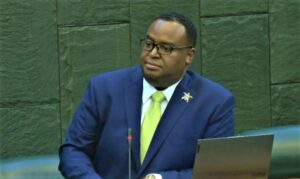
“I’ve always had an issue with beneficial ownership when it comes to privacy rights,” he said.
“It is something I still have very deep reservations and concerns about and at this point I don’t think I can support it until it becomes the global standard,” he said.
‘Line in the sand’
Premier O’Connor-Connolly said the regulations stopped short of making company ownership information fully open to the public – something she insisted had been a “line in the sand” during recent talks in the UK.
And she insisted Cayman would have been prepared to go to the European Court – which, even after Brexit, is the final court of appeal for the islands in human rights matters because of the territories’ constitutional relationship with the UK.
The Labour government’s willingness to compromise made that unnecessary, she added.
“I’m happy to say that we came away with the Prime Minister saying that they would not invoke an order in council.”
She said the regulations meet transparency goals as well as respecting privacy and constitutional obligations.
Anyone seeking information from Cayman’s central beneficial ownership register must demonstrate ‘a legitimate interest’ and that they are seeking such information for the purpose of “preventing, detecting, investigating, combating or prosecuting money laundering, its predicate offences or countering the financing of terrorism.”
The regulations also afford access to civil society organisations and anyone seeking information in the context of a business relationship, provided they meet the relevant criteria.
Political pressure
The passage of the Beneficial Ownership, Legitimate Interest Access regulations, will likely do little to placate Cayman’s fiercest critics.
The summit of overseas territories leaders in London last month was accompanied by fresh clamour from UK politicians over the issue.

“Public registers are needed to combat money laundering… [and] so we can follow the money to identify potential wrongdoing,” a group of 40 MPs wrote in an open letter to Foreign Secretary David Lammy urging him to take a tougher stance.
Labour’s Dame Margaret Hodge and the Conservative MP Andrew Mitchell, writing in the Guardian, criticised “dither and delay” over full public beneficial ownership registers.
“We know all too well that the overseas territories and crown dependencies play a pivotal role in helping crooks and tax dodgers launder and hide their dirty money,” Hodge and Mitchell said in a leader column in the left-wing broadsheet.
“Public registers, and the scrutiny that they bring, are the best antidote to the scourge of illicit finance.”
In an answering column in the Cayman Compass, economist Julian Morris accused Cayman’s critics of missing the point and misleading the public. He said Cayman has a world class beneficial ownership regime with a stronger record of verifying the accuracy of that information than the UK.
And he insisted that relevant information is already sufficiently available to those that need it for legitimate purposes.

“Privacy is not a luxury; indeed, for many, it is a necessity,” he wrote.
“In jurisdictions where the rule of law is weak, the ability to keep personal financial information confidential is a matter of life and death.
“Cayman helps thousands of entrepreneurs, investors and others who have acquired wealth legitimately, but who are at risk from kidnappers and government expropriation. It does so by providing a rule-of-law-based legal system and by ensuring that their information is not shared with those who mean them harm.”
Related Videos












Define “reporter” or “journalist” in today’s age? Is it someone with a smartphone and a social media account? Which is basically anyone. And how will a “legitimate interest” be determined and will the party whose information is being sought be given an opportunity to oppose an alleged “legitimate interst” ?
Absolutely wrong to give biased, nosy journalists the right to pry. As far as many of them are concerned, everyone living here is a money laundering criminal.
Our country will live to regret this decision.