

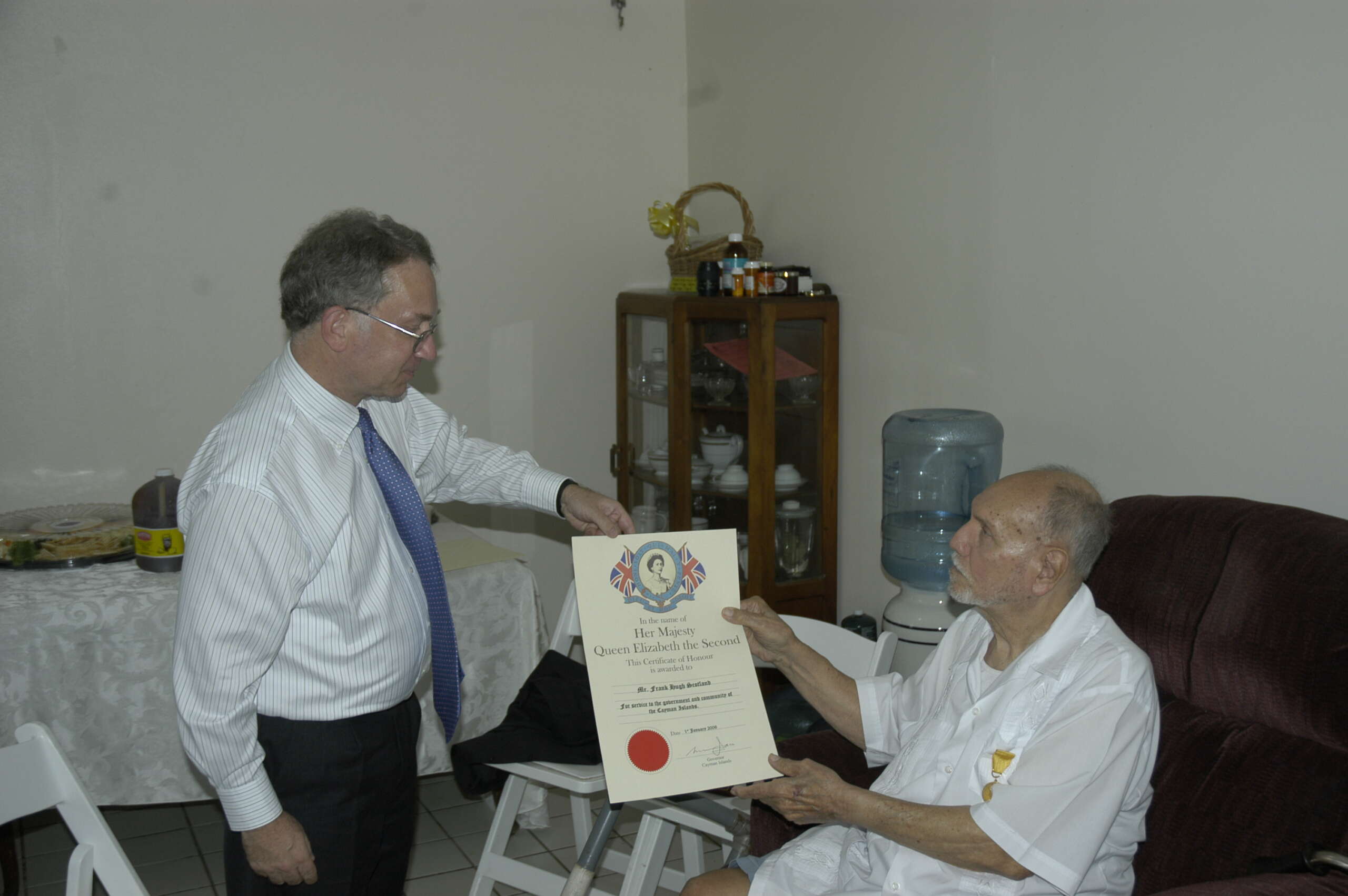
Frank Hugh George Scotland, who was named a National Hero on Monday, 28 Jan. 2025, brought electricity to Bodden Town in the 1960s.
His name was also among the 500 ‘nation-builders’ etched into the granite ‘Wall of Honour’ in Heroes Square in 2003, marking 500 years of Cayman history. He passed away on 12 Oct. 2012.
Born in St. Andrews, Jamaica in 1918, the only child of Theodore Adolphus Scotland and Evelyn Scotland nee Gauntlett, he moved to the Cayman Islands in 1960, and single-handedly developed the district of Bodden Town’s first source of viable electricity.
Through his ham radio hobby, he also became its primary link for the Bodden Town seamen, their ships and their families.
In a biography of Scotland written and read out by former Bodden Town legislator Anthony Eden at his funeral, he said Scotland’s radio use “drew him into the hearts of Caymanian families, especially in times of crisis when other communications failed, such as following the 1972 earthquake in Nicaragua or when hurricanes impacted the region. Anxious families were always reassured through his radio messaging.”
Son Clive Scotland recalled, “He was very self-disciplined, he would rise at 5am every day and he was always particular about time. On one occasion, Governor Stuart Jack was supposed to stop by at 11am, to drop off his Certificate and Badge of Honour and he arrived 20 minutes late.”
He smiled as he recalled how his father told the governor directly that he should always be on time, to which the Jack agreed, apologising for his tardiness and explaining that a traffic accident had closed the road and, therefore, delayed his arrival.
“Well, you should have left 20 minutes sooner to ensure you reached at the appointed time,” was the response.
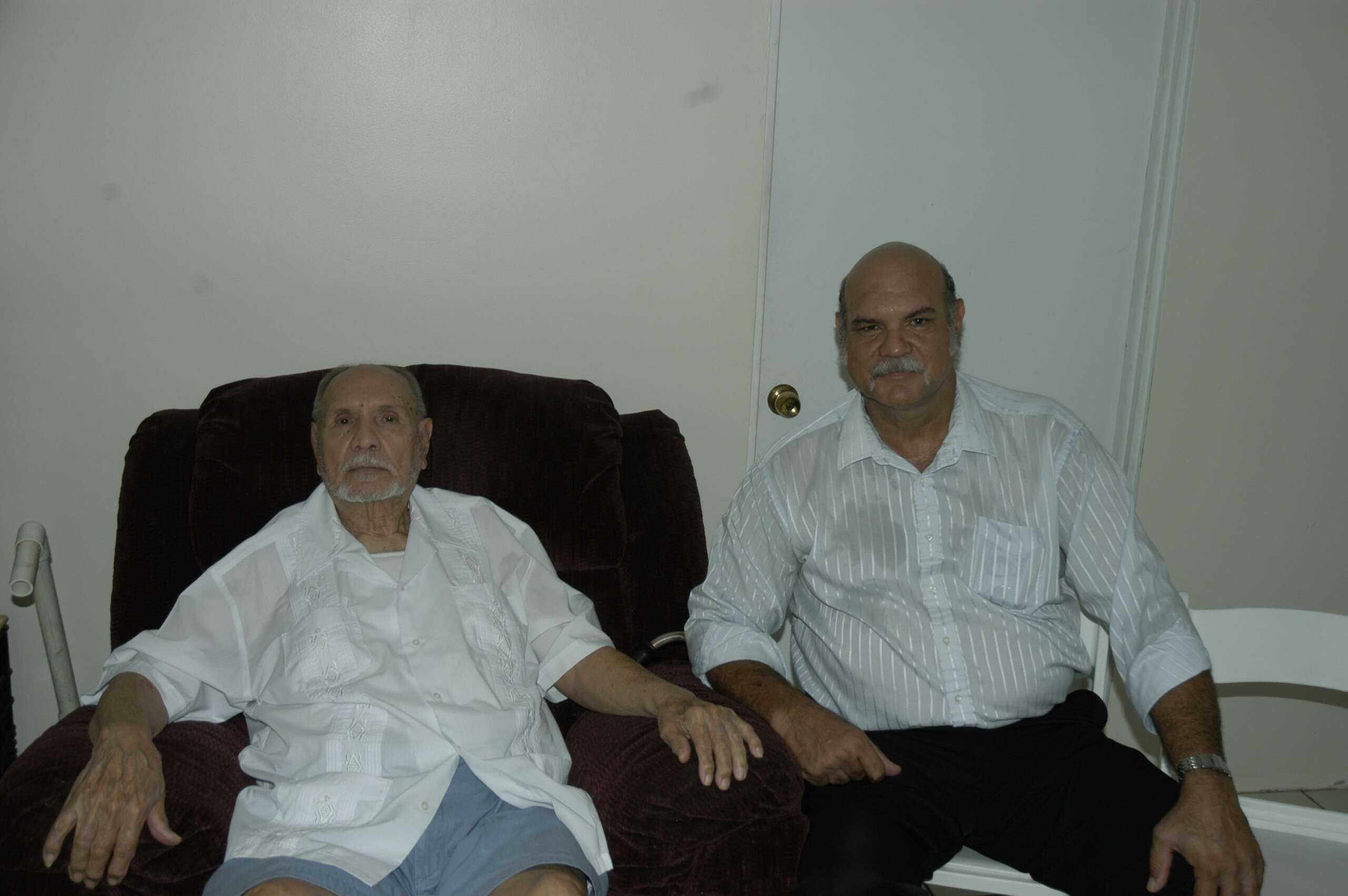
“He was also incredible with technology,” Clive said. “He taught himself how to use a computer and was sending emails long before almost anyone. He would also take them apart and rebuild them to his own specifications.”
His son puts his father’s skills in technology down to his career path, which first saw him working as a radio technician and then entering the field of electricity with the Jamaica Public Service Company.
He later served in the Royal Signal Corps in Jamaica as a signal man, in which capacity he travelled throughout the northern Caribbean establishing communication signals during World War II.
He would later work with J.S. Webster, a Jamaican shipping and business empire built by a Bodden Town family who had moved to that country. Scotland then went on to set up his own company which specialised in electro-plating.
“Frank Scotland’s career path took a serious turn when he met and married Joyce Elaine nee Ritch, only daughter of Jesse Ritch, nee Watler, another Bodden Towner who had chosen to pursue a nursing career abroad,” Eden said at the funeral.
When Jessie Ritch decided to return to Cayman to serve as the district nurse for the eastern districts, her only daughter, along with Frank Scotland and the couple’s two small children, Owen and Clive, would soon follow her to Cayman.
“It is well to note at this time that the District Health Clinic named in her honour stands on the site in Bodden Town where Mr. Frank located his light plant,” Eden said.
“Moving from the comforts of life in Jamaica which had long out-paced Cayman, was a cultural shock. With two small sons Owen and Clive, the Scotlands found life without electricity, and all the modern conveniences it allowed one to use, a definite step back in time.”
From swamp to power plant
Scotland decided to change that, not just for his family, but for the entire community in which they had chosen to make their home, Eden recalled. “He started the Bodden Town Power and Light Company and began transforming a piece of swamp land into a viable site for an electrical plant.”
With limited funds, and without the benefit of modern-day equipment, he mixed cement in a trough, made the blocks and started constructing a building to house the generator.
“Late evening would find him working there with his two sons, fending off the hordes of mosquitoes, which infested the area, with smoke pans,” Eden said.
To accomplish his dream, however, there was still much work to be done.
“Poles had to be buried, lines had to be laid out, and a very sceptical public had to be persuaded that they were really going to get electricity like ‘them George Towners’, and they should get their houses wired,” Eden said.
“And then, of course, there was the question of returns! Folks had to be persuaded that they had to pay a small amount for the service.”
Scotland’s electricity plant was a “godsend to the people of Bodden Town”, Eden said, adding that he would eventually sell his facility to the Cayman Islands government in 1968.
He then got involved in formulating the Electrical Law and Regulations, and the Radio Law and Regulations. For many years, he helped safely install electrical wiring in many homes and businesses around Cayman.
In 1972, he joined the Public Works Department, initially as an electrician, and then as the islands’ first electrical inspector. He officially retired from public service 11 years later.
“He was also very involved in the Bodden Town Seventh-day Adventist Church,” said his daughter-in law, Joyce Scotland. “He was well respected. He did so much, and he was well-loved in the community.”
Related Videos










Two articles in your Friday edition require my comment. Those are, the article on National Hero Frank Scotland and the article on the Flowers Group.
Mr. Scotland did indeed bring electrical power to Bodden Town, as a result of the suggestion and encouragement of Government Civil Servant and war veteran (hero?) Harwell (Harry) McCoy OBE, BEM JP. Hero, as he saw active service on RN minesweepers and was the only Caymanian in the RNVR in Trinidad to be promoted to the role of NCO, also he was personally selected by the base commander to lower the British flag at the decommissioning of the base in 1946. My father.
Dad was a visionary who should have been an entrepreneur but was dedicated to his work with the Civil Service, after the War. He was a dedicated follower of Popular Science and Popular Mechanics magazine, among others. After both returned home from Naval service, Dad presented Mr. Clarence Flowers with the suggestion of buying a block machine (as seen in Popular Mechanics) and if he did, he would be his first customer. So said, so done. The rest is Flowers family and Cayman industrial history.
After making monthly purchases of Flowers’ blocks on his Government pittance and storing them, Dad completed his home in 1953 and decided he wanted electrical power, so he ordered a Petter diesel generator. He approached Mr. Scotland, a well known electrical/electronic “tinkerer”, ham-radio operator and friend to help install it and later The opportunity for a commercial venture was obvious and Mr. Scotland asked Dad to order one for him. The rest is BT and Cayman industrial history. From the mid 1950s until the arrival of CUC in the mid/late 1960s, our BT home was powered by our own diesel generator; we never needed the Scotland grid.
Around this time, Dad was agent for Petter and Onan generators, Myers water pumps, Kelly-Springfirld tyres and part owner of Oasis Gas Station (Lorna’s Texaco) in BT, a partner in Capital Traders (Philips electronics) and dealer for Mido and Omega watches, in partnership with Vassell Johnson. In my opinion, he should have retained these business ventures but, as he rose within the Civil Service his dedication was to that organization. Favouring his career, he relinquished all of his dealerships.
The achievements of Mr. Frank Scotland and Mr. Frank Flowers, in their contributions to Cayman’s development, are most certainly worthy of accolades and recognition. I’m younger than the Scotland sons and the Flowers sons and I know these events; I would imagine their respective fathers would have shared the same with them.
While acknowledging and accepting the accolades due their respective fathers, there is no harm in shedding a little light (pun intended) on the person who inspired their fathers’ entreprenuer ventures.
Always wondered about Owen and Clive , they were our back neighbours in Richmond park/ max field Avenue in early 1950’s.