

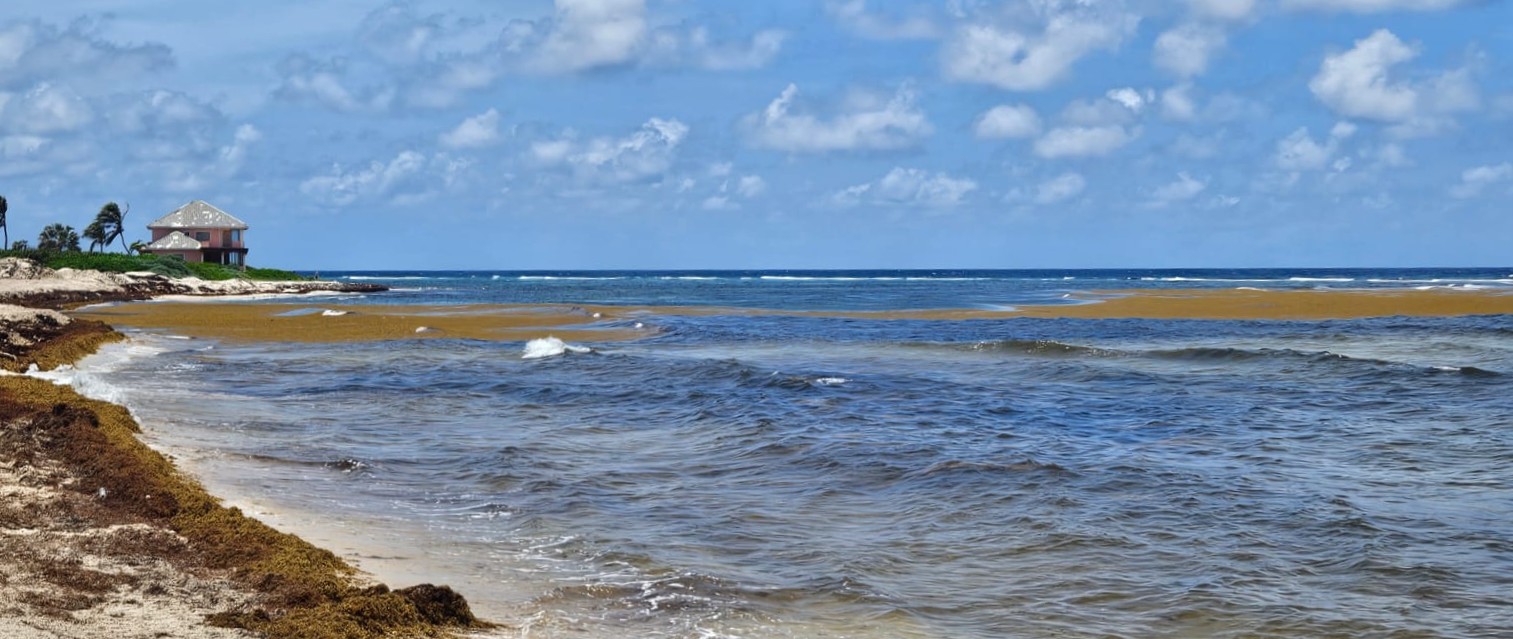
Plans for a sargassum screen gate to protect the Diamond’s Edge luxury development in Crystal Harbour are to be scrutinised by the planning board, with the National Conservation Council (NCC) disagreeing with developers over whether the proposed mechanism would be able to deal with the problem.
Sargassum, an unsightly brown, floating, marine algae, has been a problem throughout the Caribbean in recent years. It can be a significant issue in the Cayman Islands when it comes ashore in large quantities, as it releases an unpleasant smell when it decomposes. This year has been a particularly bad one for sargassum, with holidaymakers from Barbados to Mexico put off by the odour, fish being suffocated under the mass, and hoteliers asking government to do more to help. Luckily for Grand Cayman, Seven Mile Beach lies on the leeward, west side of the island and has not been impacted.
Heritage Holdings, the private, locally owned real estate development and investment company behind the Diamond’s Edge development, has submitted a $100,000 application to the planning board for an underwater gate, which it says will deal with the problem of sargassum in the marina while still allowing access to boats.
Concerns
The National Conservation Council said that it had doubts whether the proposed mechanism would be able to deal with the sheer weight and volume of sargassum influx in the long term.
In its letter to the Central Planning Authority, Heritage Holding said that the Nautica development at Diamond’s Edge had been “significantly impacted by sargassum accumulation”, with client and property owners expressing concerns about “the unpleasant odour and aesthetic degradation caused by sargassum entering the marina”.
An initial attempt to address the issue by installing a two-winged gate made of stainless steel proved impractical due to excessive maintenance requirements.
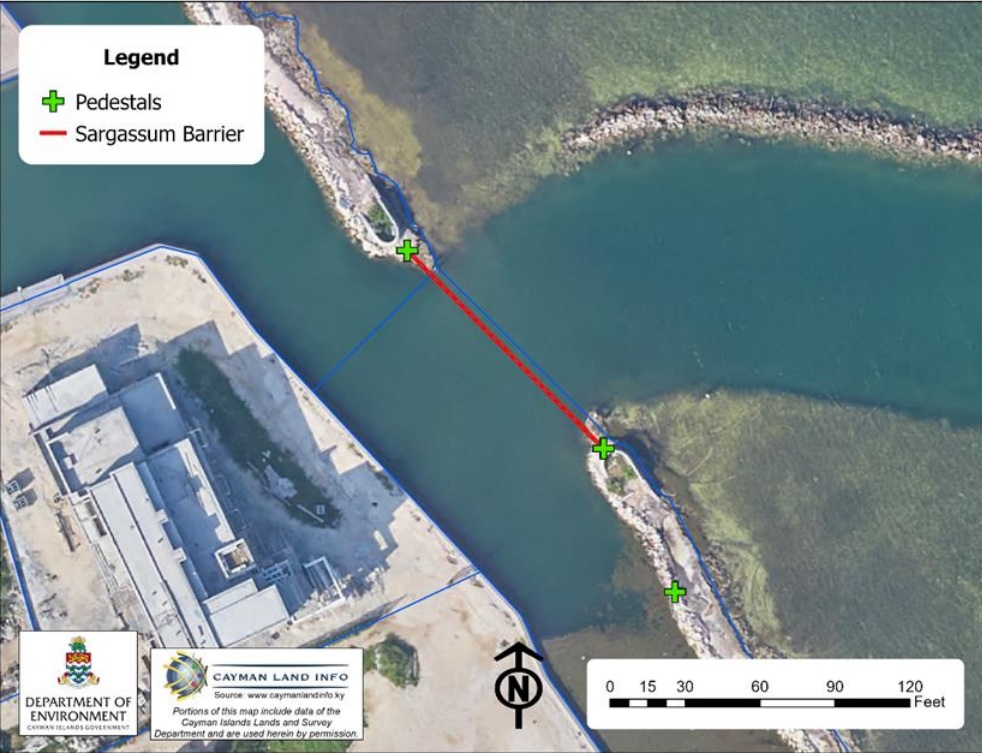
Heritage Holdings said, “After evaluating multiple alternatives, we determined that a floating barrier with a net operated by a cable pulley system would be the most effective solution. This system efficiently prevents sargassum from entering the marina while allowing easy boat movement.”
The barrier would consist of a stainless-steel cable running between two I-beams and a cable guide positioned six feet above the seabed that would move a net along floating plastic pontoons. A mobile-app-controlled mechanism would allow users to operate the gate via their phones, and the plastic floating structures could be removed and cleaned.
“This approach presents a cost-effective, long-term solution to controlling sargassum influx while maintaining smooth and efficient boat access,” Heritage Holding said.
However, the National Conservation Council said that while it had “no significant environmental concerns with the proposed structure (provided it does not obstruct tidal flow), we do have concerns with the likely efficacy and long-term practicality of the proposed system for managing sargassum influxes”.
Sargassum build-up
The NCC went on to say that while the idea might contain the issue on a short-term basis, it was hard to see how the mechanism could cope with dense, heavy loads of sargassum that might actually build up on the barrier.
“Rather than being repelled by the net, it is more likely that large quantities will end up collecting and exerting significant pressure on the structure,” it said. “It is unclear if and how the proposed mechanism would be operated under such conditions, particularly how users would be able to open or close the system when sargassum has already built up against the barrier.”
In the CPA meeting on 9 July, it was decided to adjourn the application and invite the applicant before the board to discuss how the gate would operate, including the disposal of the sargassum.
Related Videos









Now is the time to allow trial solutions, especially in light of this proposal raising no environmental concerns. It’s the developers money being spent to try to enhance their own development. Why prevent their an attempt at a solution? They may be leading the way, or they may be adding data to the process of selection if this particular trial fails.