


Students will be allowed to use artificial intelligence in their school assessments from next year, but will need to follow specific guidelines when doing so.
The development was announced by officials from the Caribbean Examinations Council (CXC) who were in the Cayman Islands on Friday, 15 Aug., for the release ceremony of the 2025 exam results across the Caribbean.
CXC Registrar and CEO Wayne Wesley and Director of Operations Nicole Manning shared data from more than 100,000 candidates across the region who registered to sit more than 600,000 subject entries in the 2025 Caribbean Advanced Proficiency Examination (CAPE), Caribbean Secondary Education Certificate (CSEC) and Caribbean Certificate of Secondary Level Competence (CCSLC) examinations.
It was the first time that the Caymans Islands had hosted the ceremony, which is held annually by a CXC-participating country.
Manning said that from 2026 onwards, candidates, particularly those doing school-based assessments, will be allowed to use artificial intelligence in their work.
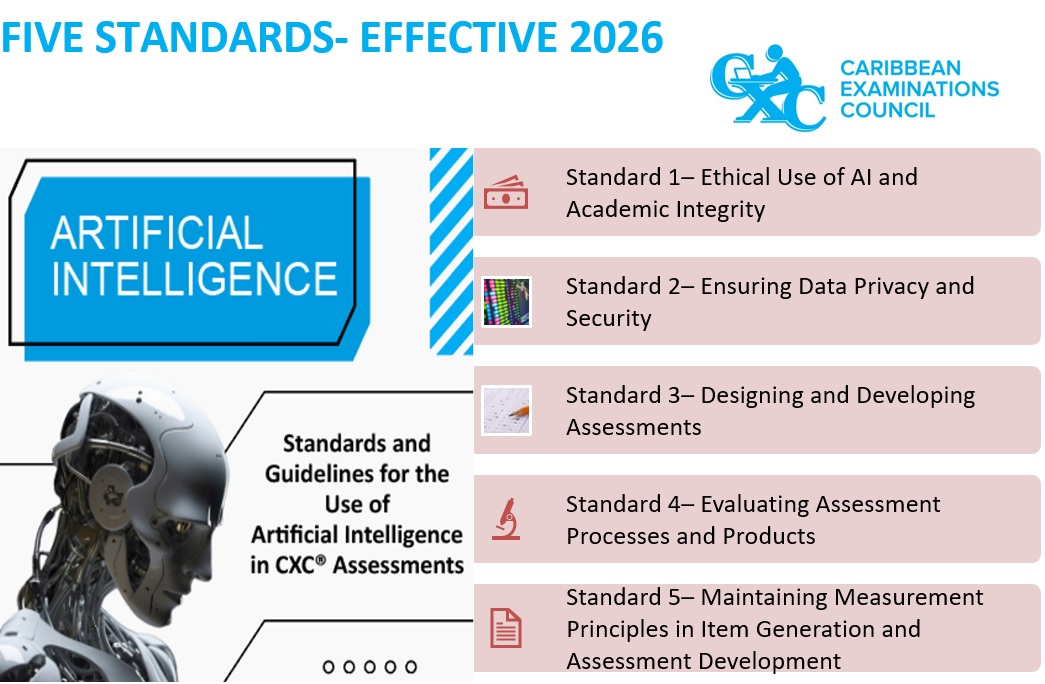
“There is a standard that students need to abide by,” she said.
“It’s there to protect you, as well as to help you to understand – not only the students, their parents, but also teachers. So instead of persons trying to find out how to use AI, we have shared how to reference AI. … We feel very good that we are able to offer this to the region and we are encouraging everyone to go through and to utilise it.”
Promising results
While overall performance statistics for the Cayman Islands were not released, CXC shared some significant highlights for students in specific subjects.
Cayman Islands students recorded strong results in the region at the CSEC level, with a pass rate in English increasing from 71% to 75%, and mathematics improving from a 40% to a 43% pass rate – although that was lower than the pass rate of 47% in 2023.
Students made a particularly good showing in information technology, recording a pass rate of 98% and grade 1s increasing from 30% to 47%. The pass rate for industrial technology (building) dropped from 98% to 92%, but the percentage of top grades increased from 7% to 37%.

Speaking about the exams results, Education Minister Rolston Anglin said he would be making a statement when he got the detailed figures, but said, “Today was extremely exciting – exciting to have CXC and its officials here, exciting that this is the first time Cayman has been the host country for the announcement of results. We, in some areas, have beaten the regional performance, which is a positive thing for such a small school system in a small community.”
He added, “What’s most important is that irrespective of how pleased or how disappointed an individual student may be, this is just an initial point in their lives. And so, whatever comes next is going to do a lot more to define what your life’s outcomes are, than this particular matter.
“The bottom line is, whilst today is a hugely important celebratory point … there’s still work to be done. Young people, be positive. There will be options for you, irrespective of how well or how disappointed some may be today.”
Related Videos












Using AI to enhance the curriculum or to dumb it down more? Seems like the latter.
In any case, our public education system should revert to GCSE curriculum before we’re absolutely, totally screwed.
Would NCFC consider that?
Responsible integration requires establishing clear ethical guidelines, ensuring human oversight, and adapting assignments to prevent misuse and maintain academic integrity.
Also read this article.
The implications of using AI to generate exam answers
https://www.turnitin.com/blog/the-implications-of-using-ai-to-generate-exam-answers
“The first and most obvious risk of AI-generated exam answers is that they allow people to pass exams and qualify for professions without developing the necessary knowledge and competence.”
“When you visit a doctor or consult a lawyer, you expect them to have genuine expertise in their discipline. When you cross a bridge or walk into a building, you trust the engineers know what they’re doing. But if students rely on AI to pass their exams, they risk graduating without the knowledge and skills required to perform their duties effectively. This can lead to dire consequences – from misdiagnoses and flawed legal advice to structural failures in public spaces.”