

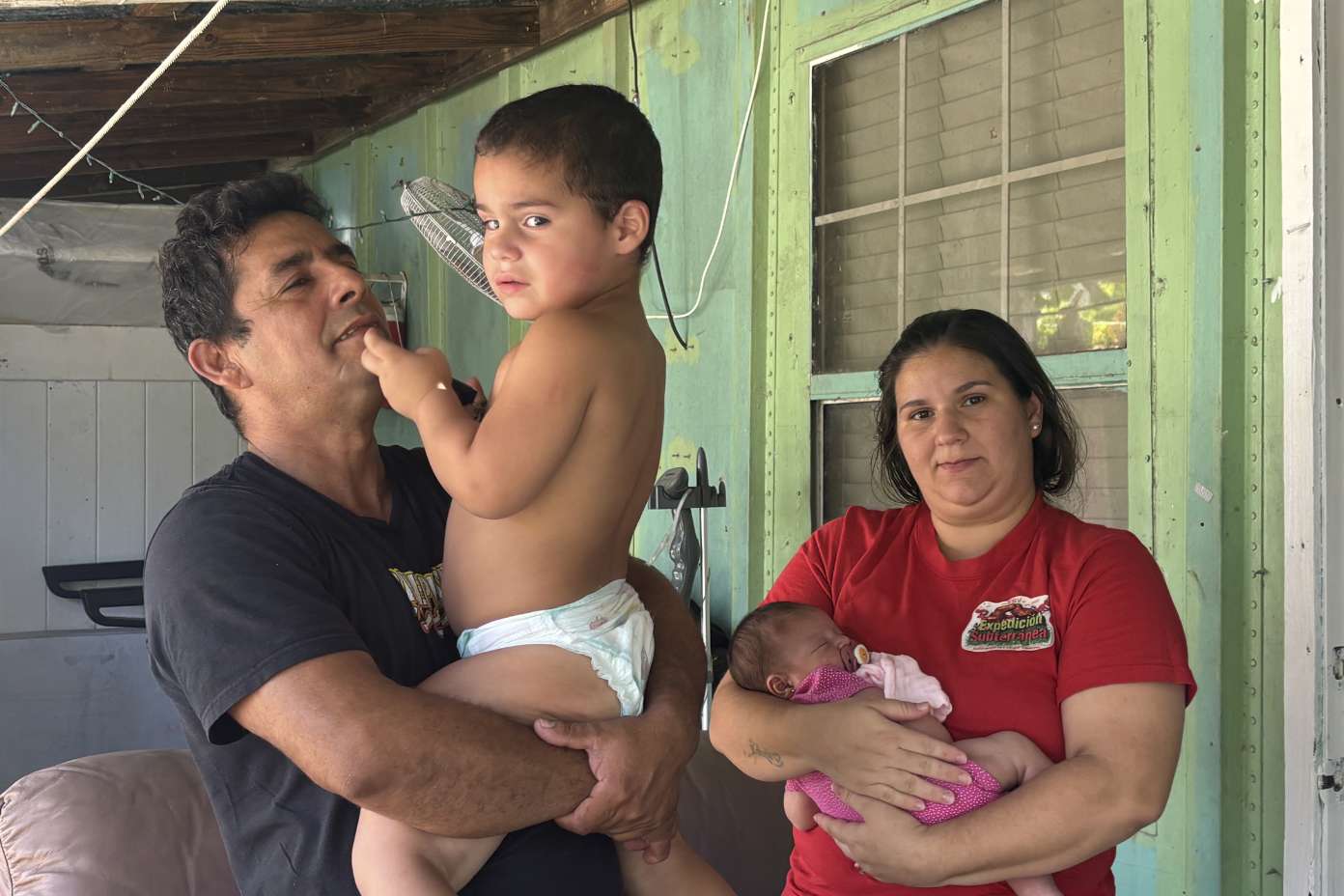
A Cuban couple living in a government-provided converted shipping container home in West Bay says they are struggling to survive on limited monthly assistance as they face the prospect of repatriation with their newborn daughter and 3-year-old son with autism, whose access to treatment, they say, would be limited in Cuba.
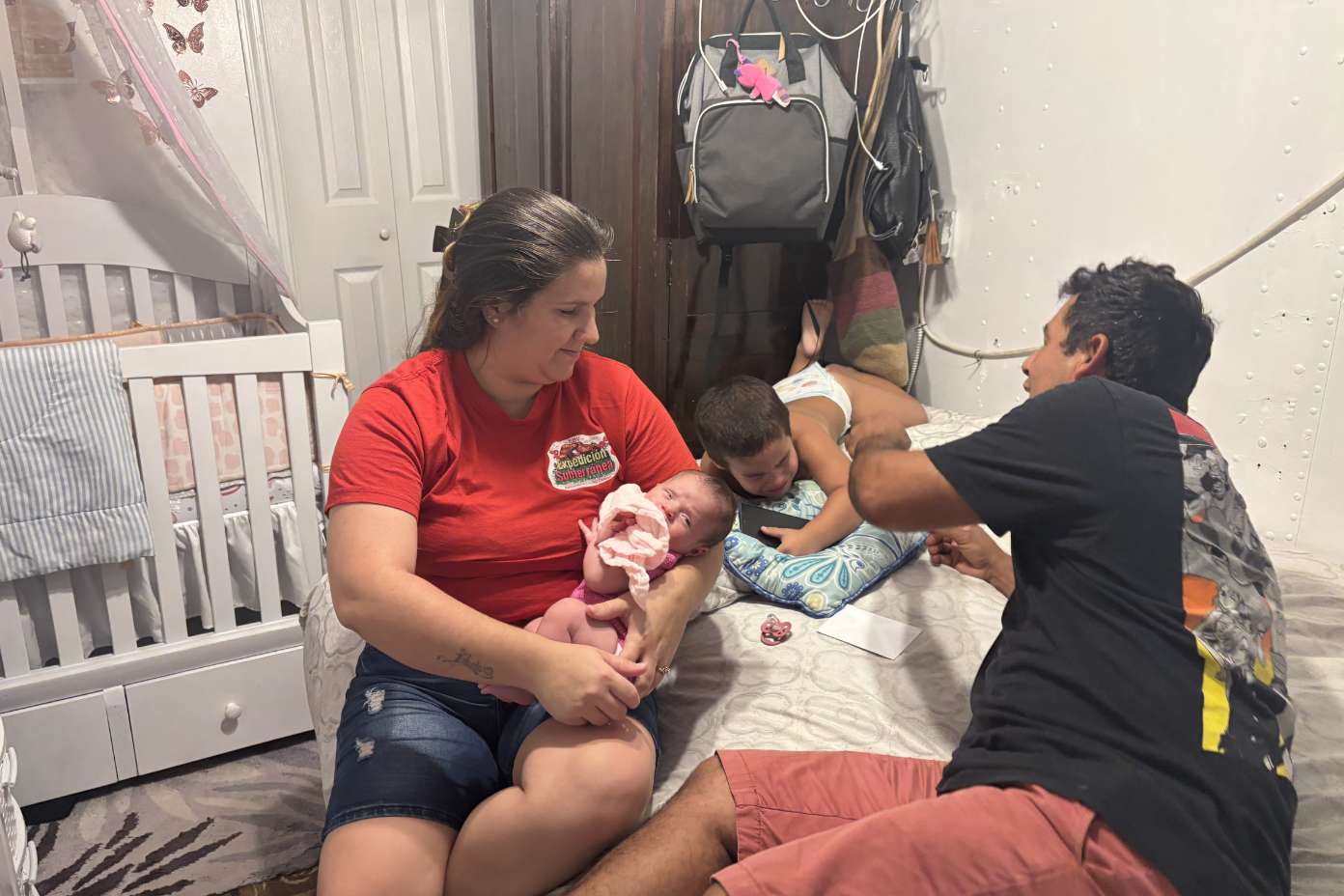
Inside the roughly 20-by-8-foot container that Richard Hernández and Mailemy Hernández Marchena now call home, there is evidence of resilience in the midst of hardship.
In the small yard outside, the family has domesticated feral chickens and planted fruit trees to help supplement their food. Friends have painted the walls and added insulation in parts of the structure. A local church helps with diapers and other essentials, while meals sometimes arrive from a nearby restaurant run by friends who have come to treat them as extended family.
But even with that support, the couple says their situation remains precarious. Monthly government assistance which amounts to just a few hundred dollars does not stretch far enough to cover even their most basic needs such as infant formula, or the yogurt and milk their son relies on as his only source of nutrition.
“We are doing everything we can,” says Richard. “But it is not enough.”
Their departure from Cuba, they say, was triggered by growing pressure against them, linked to the husband’s adult son – a military officer connected to President Miguel Díaz-Canel – who fled Cuba in 2021.
They arrived in Cayman in April 2022, after a 15-day journey by raft that nearly killed them. Mailemy said only after the rescue, at the hospital, did she learn she was pregnant. That amplified the couple’s fear of further persecution if they were forced to return.
Customs and Border Control, in response to queries from the Compass, said it could not comment on the individual case of the Hernández family due to confidentiality obligations, but noted that individuals who express fear of return are processed in accordance with Cayman law and international obligations, with each case assessed on its merits.
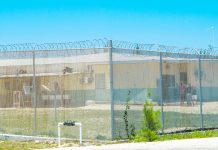
The couple says that after their rescue, they were held at the Immigration Detention Centre for about 30 days before being transferred to an evacuation centre in East End.
Because Mailemy was pregnant, friends sought permission for the couple to stay with them.
They remained with them for about nine months until after the baby was born, before being moved into their current accommodation.
Dreams of asylum
Both parents were interviewed in 2022, and each of their asylum claims was rejected at the initial stage and again on appeal in 2023. They say they later attempted to escalate their case to the Refugee Protection Appeals Tribunal, stating that they attended their first tribunal hearing alone.
They claim that they were unable to find free legal representation. As a result, friends in the community raised about $8,000 to help them hire a lawyer.
CBC says individuals engaged in the asylum process are informed of their rights, including the right to legal counsel, and that interpretation services are made available where necessary.
The couple says that after the tribunal process concluded, they were told no further legal avenues were available. Only later did they learn that an application to Grand Court might have been possible, but that there had been a 14-day period to file, which had already transpired.
They allege they were never informed of that deadline.
CBC did not address that specific claim but said asylum cases are handled within an established legal framework that includes opportunities for appeal.
Limited financial means
While the legal process has unfolded, the family has spent the past four years living on government assistance, which they say has ranged from about $260 to $300 per month.
Mailemy says the amount is not enough.
“The baby’s formula alone costs $45 and every 15 days we have to buy it. That’s not counting diapers, wet wipes and everything else,” she says.
Their son’s needs are even more demanding. The 3-year-old, who has autism, eats only milk and yoghurt, and only specific types.
“Every two days, it is about $25,” Richard says. “That is all he eats.”
CBC says financial support is assessed based on a number of factors.
“With respect to financial assistance and welfare support, individuals may be eligible for limited assistance,” said a CBC representative. “The level of support provided is assessed based on established criteria, including household composition and identified needs, and is subject to periodic review.”
The couple says that while their son’s special needs are a source of added expenses, they are grateful that he is provided with government-sponsored weekly therapy, which has been essential.
Mailemy said that her toddler was developing normally at first but then regressed.
“He was a normal baby,” she says. “He ate everything. He said ‘mama,’ ‘papa.’ And then suddenly, nothing.”
He stopped speaking. He stopped eating most foods. He began walking on tiptoe, flapping his hands, running constantly, unable to settle.
“I knew something was wrong,” she says. “I had to find help.”
In Cayman, she says, that help exists. In Cuba, she fears, it will not, particularly given the ongoing social and economic crisis.
Cuba is experiencing its worst conditions in decades, characterised by severe shortages of food, medicine and fuel, along with daily, long-term power blackouts. More recently there has been a significantly elevated perceived threat of potential US action against the country, characterised by harsh rhetoric and economic pressure.
Humanitarian considerations
Customs and Border Control say that humanitarian considerations, including the welfare of children and individuals with medical or developmental needs, are taken into account in decision-making and that the Cayman Islands adheres to the principle of non-refoulement.
“The Cayman Islands Government does not return individuals to a country where there are substantial grounds for believing they would face persecution or serious harm,” said a representative from CBC. “All such claims are carefully evaluated within the established legal framework.”
But for the family, the fear remains immediate and personal.
“I am more afraid for him than for myself,” Mailemy says, nodding toward her son as she chokes back tears.
“If we go back, he will not get better. He will get worse.”
Richard says he wants to work and, if allowed, he would take any job available. In Cuba, he worked as a bricklayer and later as an inspector for the electric company but says political pressure forced him out.
Under Cayman law, asylum applicants are not permitted to work – a restriction CBC confirmed.
That leaves the family reliant on others.
“We don’t want to depend on anyone,” Richard says. “We want to work. We want to live.”
For now, they remain in limbo, waiting on documentation issues related to their children before any repatriation to Cuba can move forward.
CBC says delays in such cases can arise from administrative, legal or logistical factors, including nationality documentation for minors.
In the meantime, the couple hope for a positive change in their circumstances.
“Let us stay,” Mailemy pleads. “Let us stay together. Let my children have a future.”
Related Videos









The situation requires a thorough review of the family’s specific asylum claim, with special attention to the vulnerability of the child.
Allowing the father to work while their status is in limbo would reduce their dependence on government assistance and charity, addressing one of the couple’s primary requests.
If all else fails, why won’t CIG delay the repatriation of this family until the uncertainties of the potential conflict between Cuba and the U.S. are resolved and surviving conditions improve?
This approach makes sense in the context of current events. In early 2026, tensions between Cuba and the U.S. have escalated significantly following a U.S. fuel blockade and threats of a “friendly takeover” by the Trump administration. This has led to severe humanitarian crises in Cuba, including widespread blackouts and fuel shortages, which would justify a request to delay repatriation.
I have known them since the day they arrived. They have been part of our church family, and I can truly testify that they are an exemplary family. They are among the best brothers and sisters in serving the community—always willing to help, to serve, and to share the love of Christ.
I know they are in God’s plan because they faithfully work in His ministry, preaching the Word and bringing hope to others. That is why I firmly believe that God will not allow them to be removed from this island, where they have built not just a small family, but a home filled with purpose, along with their two young babies.
We also know that if they are sent back to Cuba, they would be exposed to persecution from the government of Díaz-Canel due to their son’s situation. This is a reality we cannot ignore.
I trust that this government, in this Christian island, will not allow something like this to happen. We continue believing, praying, and trusting in God’s justice and His perfect will.
We would just like to state that we are 100% certain neither the payed Attorneys nor Immigration informed these poor folks of their legal options. If there was a 14 day deadline by LAW they should have been notified. This is clearly a case of Malpractice and Inhumane treatment. The Cayman Islands Government should consider helping this poor family as they have endured and been through enough. Remember our Christian Heritage and the Good Book says : ” Do not withhold good from those to whom it is due, when it is in YOUR power to act” Proverbs 3:27
The consistent use of emotionally triggering language and narratives seems designed to push socialist values and government intervention over the rule of law.
We should remember that residing in Cayman is a privilege, not a right, for non-Caymanians. If individuals are looking for robust refugee programs, nations like Canada provide those systems (and at a great cost to their own societal stability, as we are seeing now with crime and drug issues in Toronto).
We should not allow emotional storytelling to weaken our borders, dictate our policies, or drain the resources meant to support the community Caymanians have worked so hard and consistently to build.
There are far more problematic countries in the world than well-run ones like Cayman.