

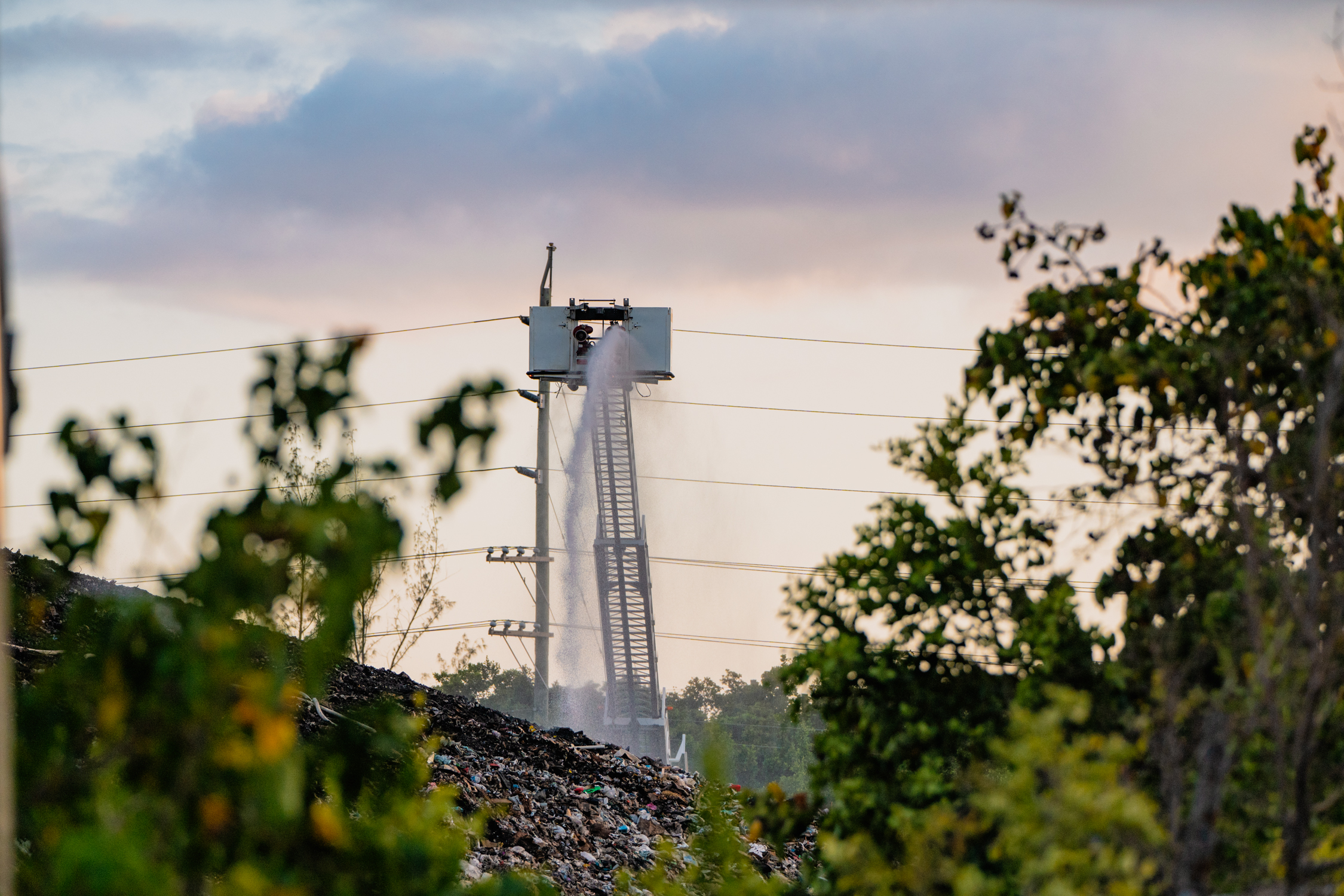
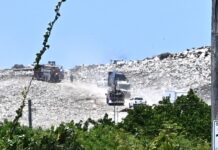
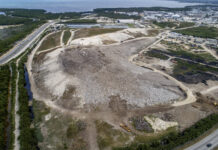
Government is preparing legislation that would give Cabinet the power to make recycling mandatory as it continues to grapple with the fire and environmental threat from the dump.
Speaking at a West Bay community meeting on Monday 20 April, Sustainability Minister Katherine Ebanks-Wilks acknowledged that better infrastructure was needed around recycling, both to manage the fire threat and reduce the amount of waste going into landfill.
Her comments came as Department of Environmental Health chiefs told Compass TV on Tuesday that the fire was likely started by a vape or cell phone battery discarded in household waste.
“Someone brought that fire to us,” said Michael Haworth, assistant director of solid waste.
Director Richard Simms said the department was on constant alert.
“When it comes to fires, it is something we are highly concerned about every day,” he added.
Fire Service officials told the Compass they had been called to approximately 110 landfill fires over the past 20 years. In 2025, there were 12 recorded incidents, a spokesperson said.
Speaking on ‘Daybreak’ Tuesday, Simms said last week’s blaze was a surface fire spread by wind. “This time around I can tell you it seems like we got something hot in household waste and it started the fire.”
Ebanks-Wilks gave a similar account to residents at Monday’s meeting. An investigation into the precise cause remains ongoing.
Link between dump fires and lack of recycling
The minister said the link between dump fires and the absence of proper recycling infrastructure was clear.
She was responding to a community member who argued that batteries and gas containers should never reach the general waste stream in the first place.
“Things like batteries, coals – these are some of the things that cause the landfill to catch fire,” she said, adding that new “diversion facilities” would allow for greater separation of materials.
Cayman already has supermarket drop-off zones for electronics and batteries, and nine drop-off points across the island for card, glass and metals, Haworth said in the Compass TV interview.
Ebanks-Wilks acknowledged that was not enough and the government was now moving towards making recycling compulsory by law.
“The country will need to get to a place of mandatory recycling,” she said. “But before you can do that, you have to have the facilities constructed, which is what we are working on now.”
Draft Environmental Health Bill
A draft Environmental Health Bill would be brought to Parliament in the near term, she said, giving Cabinet the authority to pass regulations making recycling mandatory. The rollout would start with commercial operations before potentially extending to residential properties.
“We need to be realistic about where we are as a country, and we need to start a national movement,” she said.
Ebanks-Wilks said green waste, which is collected and processed separately in many countries and sold as compost, was a significant driver of landfill volume.
“One of the materials that takes up a lot of space in the landfill is green waste,” she said. “So diverting that out of the landfill and preparing a processing facility that shreds the green waste and keeps that from going into the landfill will save us some time.”
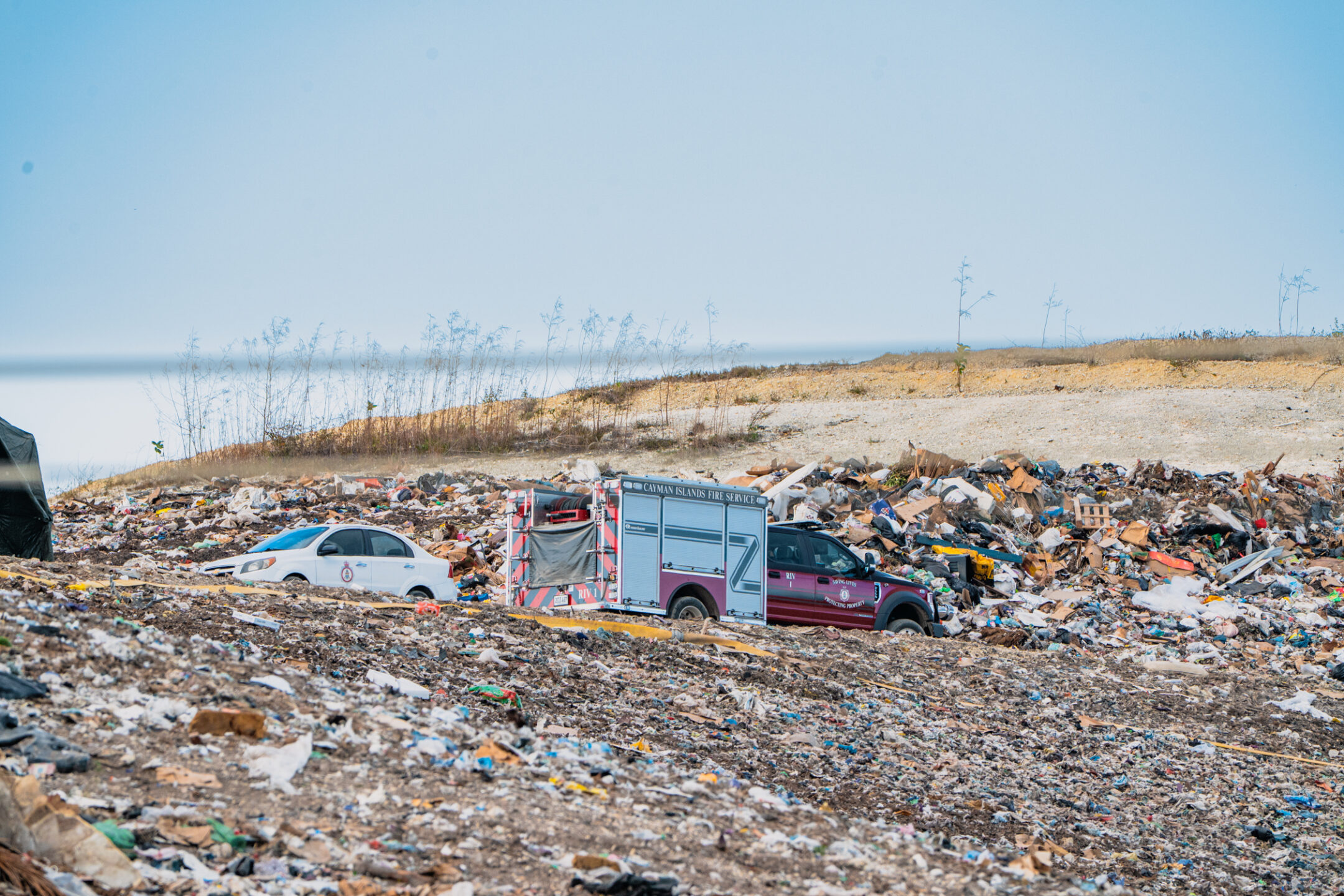
Two further recycling facilities are planned, one for construction waste and one for commercial recycling. Scoping and business case documents are budgeted but construction is not likely to begin until the next budget cycle. In an earlier Finance Committee speech, she revealed that 60% of waste going into landfill in 2024 came from commercial waste, 17% was from vegetation waste and 12% came from household waste.
The broader crisis at the landfill traces back to the collapse of the waste-to-energy arrangement with the Dart organisation.
“Whilst the waste-to-energy arrangement would have been a nice, clean, fresh way of dealing with our waste, we simply couldn’t afford it, and so this is the reason why we’re here,” the minister said.
Related Videos









Blaming individual consumers for improper lithium battery disposal is unreasonable in the ABSENCE of comprehensive nationwide recycling INFRASTRUCTURE and widespread EDUCATION.
Majority of consumers do not know how to properly recycle lithium-ion batteries, and are unaware of the dangers of improper disposal. The current waste management “system” in Grand Cayman is not equipped to handle high-tech waste like lithium-ion batteries.
While mandatory recycling can increase participation rates, making recycling compulsory by law without proper public education is a largely ineffective, or “futile,” strategy.
Educating children on lithium-ion battery disposal in schools is highly effective because it teaches them to identify common items like phones, toys, laptops, tools etc. Children often act as “agents of change” who can influence their parents and grandparents to adopt proper recycling habits and prevent dangerous household fires caused by improper disposal.
Children have a better memory and will ensure their elders use, store, and dispose of lithium-ion batteries properly.
A rapid, island-wide initiative for educating children about lithium-ion battery safety is highly feasible WITHIN A WEEK, provided it is launched with visually appealing, age-appropriate, and engaging materials.
On such a small island a quick rollout is possible, with a focus on simple, visual messages about the safe use, storage, and disposal of batteries to prevent fire risks.
“…you have to have the facilities constructed, which is what we are working on now.” Can they provide more details on the construction of the facilities? Which facilities exactly are they talking about?
“A draft Environmental Health Bill being brought to Parliament in the near term…” Does this mean that full-scale recycling will be delayed indefinitely?
“We need to be realistic about where we are as a country, and we need to start a national movement”. This statement is a cliché because it is a formulaic political phrase used so often that IT HAS LOST ITS ORIGINAL IMPACT AND POWER. It is a shallow, overused remark intended to sound profound and unifying while actually offering no specific substance, concrete plan, or new insight.
“…but construction is not likely to begin until the next budget cycle”. Here we go again, until the next major fire. The dump saga will continue indefinitely. SO MUCH FOR A NATIONAL EMERGENCY!
Why have we not banned single use plastics yet. That would be a good start!
This is an excellent start, but please let’s get this fast tracked. We have been discussing the dump for years and years and years…. One government signs off on something and another government kicks it out. This is an ABSOLUTE PRIORITY – for our health and for our environment. Let’s get this done and lets educate the public on recycling and proper battery disposal (which a lot of people are woefully ignorant about). NO MORE KICKING THIS FOOTBALL DOWN THE ROAD!
I’ve always thought major problems such as this occur because nobody in the highly rewarded ranks of the Gov’t/Civil Service is charged with the responsibility of solving the problem. It is batted back and forth and nothing happens. Time our mandarins earned their salaries.
Great comments and input but no one in the Government “machine” ever reads public commentary.
Worse if you write to them…no response.
It’s the world-class public service culture that some boast about.