

South Sound protestors intend to appeal a recent Central Planning Authority decision that has the potential to shape the development of Grand Cayman’s coastline in future years.
The question at hand is whether a property’s seaward boundary recedes along with physical erosion – or whether, once the boundary is fixed, the property owner still maintains control over the extent of the land, even if it becomes submerged under the sea. Another question is whether previously stipulated mangrove buffer zones should still be observed even if the mangroves are destroyed, in order to give the mangroves the opportunity to regenerate.
The authority’s decision is made even more controversial due to the proposed site’s relationship to the contentious Emerald Sound subdivision just across South Sound Road.
During its 15 August meeting, the authority approved an application by Emerald Sound developer R.C. Estates (Rene and Julie Hislop) to move the location of an approved seawall some 50 feet south and reclaim land lost to erosion due to Hurricane Ivan. In conjunction, the authority removed a nearly 13-year-old requirement that the developer maintain a 50-foot-wide mangrove buffer, which was destroyed by the 2004 storm.
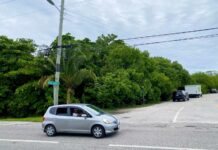
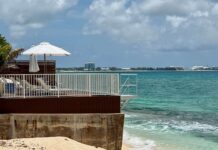
The proposed seawall and boulders would run some 2,000 feet along 17 parcels on the seaside of South Sound Road, just west of Old Crewe Road, and be located only 2 feet from the high water mark established by a 1999 survey.
Arguing on behalf of the developer, attorney J. Samuel Jackson said, “There are two types of boundaries, general and fixed. A fixed boundary is for perpetuity in the Land Law. It is clear, if the seaward boundary has a fixed boundary, then it is fixed.”
Gencorp precedent
Mr. Jackson referred to a decision the authority made in March granting after-the-fact permission to Gencorp Equitable Natwest Corp. Ltd. to clear and fill a vacant lot, up the high water mark, on Shamrock Road next to the Vista Caribe apartment complex in the Red Bay area. The process involved measures to prevent future erosion, recovery of land lost to erosion, and the removal of mangroves that the applicant claimed had been killed by Ivan and subsequent storms.
In that case, planning officials discovered the work was being done in late July 2011. The developer then applied for permission in early August 2011. Planning officials conducted another site visit in September 2011 and saw that work was still being done.
The authority was scheduled to hear Gencorp’s application in October 2011, but adjourned the application to allow the applicant and objectors to appear. The authority heard the application in March 2012.
The Cayman Islands Department of Environment said it would have supported maintaining a 50-foot mangrove buffer along the property boundaries, and strongly recommended that the authority instruct the applicant to reinstate the mangrove removed along the property boundaries to create a 50-foot buffer.
“Furthermore, in this particular location there is a unique ironshore habitat, which has now been destroyed through the filling of this property,” according to the department.
Gencorp said it had paid the $500 application fee and produced an e-mail excerpt from Assistant Director of Planning Ron Sanderson stating the department would not charge the applicant an after-the-fact application fee that would have been $5,000.
R.C. Estates
During the August 2012 meeting, Mr. Jackson said the driving factor behind the Hislops’ application was the authority’s approval of Gencorp’s project.
According to the minutes of the meeting, Mr. Jackson said, “They received after-the-fact permission to do what this is, filling out to the fixed boundary. [R.C. Estates] deserves the same treatment and this isn’t after-the-fact.”
Department of Environment Deputy Director Tim Austin said, “Just to address the other situation, it was a complete mess. The government Legal Department and Lands and Survey don’t feel the issue of the seaward boundary is as clear cut as Mr. Jackson describes. But no reasons were ever provided because the parties couldn’t agree. They’ve never heard back from them. They would like it sorted out for once so everyone is on the same page.”
The department acknowledged that the mangroves had been destroyed by Ivan, but that the ecological importance of the South Sound mangroves is such that the department has an initiative to plant and assist the re-growth of mangroves in the area.
Mr. Jackson characterised that programme thusly: “[T]here are some pots with mangroves that his client paid $75,000 for in consultation with DOE and they are not doing very well. If the mangroves grow back past his boundary there is nothing he can do about it. He wants to put in a seawall with rip rap.”
According to a presentation by the department, “it is unlikely mangroves in the area will be able to establish on the new seawall and rip rap due to the depth of water offshore”.
The department recommended that the 50-foot-mangrove buffer should be left in place and the scenic coastline classification preserved.
“Regardless of the confusion surrounding the present definition of the high water mark and whether it can be fixed or not, the DOE would recommend to the CPA that approval should not be considered for a seawall and filling in the South Sound Replenishment Zone at this time,” according to the department.
“Alternatively, the CPA should consider deferring the application until a clear and concise legal opinion on what constitutes a ‘fixed’ seaward boundary on private coastal properties can be established,” according to the department.
The authority told the applicant and objectors that “The legislators need to address that”, according to the meeting minutes.
“Sometime you just have to read existing laws and not pass new ones,” Mr. Jackson said.
In its decision to approve the Hislops’ application, the authority said, “The authority considered the application further and accepts the applicant’s attorney’s argument that the seaward boundary is fixed and that the applicant has the legal right to develop to that boundary. Further, the authority is of the view that there is not definitive evidence that the proposed seawall with rip rap will cause environmental damage along the coastline.”
Appeal
Katrina Jurn of Protect South Sound, a group that organised in opposition to R.C. Estates’ Emerald Sound plan, said the group’s pro bono legal team is reviewing the authority’s latest decision.
“We will be submitting the notice of appeal shortly,” she said.
In August 2011, the authority approved the planning application for the inland aspects of the 91-acre development, which included a canal system, lots for luxury houses and apartments, and relocating South Sound Road some 30 to 75 feet inland. (The current South Sound Road would remain as a private drive for the seaside lots.) Later, Member of the Legislative Assembly Mike Adam indicated that the ruling United Democratic Party was not inclined to approve Emerald Sound’s coastal works licence application necessary to connect the canal system to the sea.
In late April 2012, the authority OK’d the so-called “backup plan” to Emerald Sound, a development called Adagio consisting of a 23 residential lots and two lakes.
Related Videos











The mangroves buffer would have been nice, a small price to pay to keep that section protective and wild. But these folks have had their development plans changed and possibly delayed.. There have to be some give and take.
although I believe, environmental issues and recommendation disregarded should be a last resort; their hire is as Cayman protectors from ourselves.