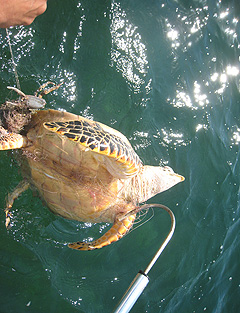
Underwater, a plastic bag looks like a jellyfish to a turtle and as turtles eat jellyfish, the presence of plastics in the ocean poses a large risk to turtles and other marine animals.
That’s just one of the reasons why Ocean Conservancy runs an annual international coastal clean-up day.
Already several companies and organisations have signed up to take part in beach and near-shore clean-ups throughout Grand Cayman on the 27th annual International Coastal Clean-Up Day.
Wendy Williams, environmental assessment officer at the Cayman Islands Department of Environment, is helping to coordinate the clean-up efforts. She is also a member of the Corporate Green Team in Cayman, which has spearheaded a campaign to reduce the number of plastic bags in supermarkets.
“The clean-up is being led by the Ocean Conservancy in Washington, DC. They hold the International Coastal Clean-Up every year and different countries sign up to take part. It doesn’t have to be a government initiative – any party, a group of friends or a company, can sign up to take part and let them know what they’re going to do,” Ms Williams said. Those who participate keep track of the amount and kinds of garbage and debris they find on their clean-ups so that the Ocean Conservancy can get an idea of what kind and how much rubbish has accumulated.
Ms Williams said those taking part would be asked to tick off, for example, how many plastic bottles or cigarettes they collect during the clean-up. Afterward, she will collate the information.
According to the Ocean Conservancy, each year, rubbish in the oceans kills more than one million seabirds and 100,000 marine mammals and turtles when they ingest or become entangled in it. The organisation points out that a plastic bottle that entered the ocean in 1986 will still be decomposing 400 years from today, while fishing lines left in the sea takes 600 years to decompose.
So far, a number of companies in Cayman have volunteered to help clear some of this rubbish from Cayman’s waters and beaches. These include Caribbean Utilities Company, whose staff will tackle Barkers Beach in West Bay; McLean Marketing Services will clean up Smith Cove and also snorkel near shore to pick up any rubbish or fishing line they find in the sea; KPMG has volunteered to clean up South Sound; while Credit Suisse staff will clean up along Manse Road in Bodden Town. Staff from the Department of Environment are also joining the efforts and will be tidying up an area from Manse Road to the Bodden Town police station.
Groups of friends or individuals are also being urged to do a clean-up of their areas and divers can offer to clean up their favourite dive sites.
Ms Williams said teams that want to take part should contact the Corporate Green Team so that they can let the Department of Environmental Health, which collects solid waste, know where to leave pick up the collected garbage. If the Corporate Green Team is contacted, it can also arrange for the provision of gloves and garbage bags.
Last year, nearly 600,000 people picked up more than nine million pounds of trash along more than 20,000 miles of coastlines worldwide. During the past 26 years, more than nine million volunteers have removed 153 million pounds of rubbish from more than 312,000 miles of coastline and waterways in 153 countries and locations.
Since Ocean Conservancy started its clean-up campaigns, volunteers worldwide have collected 55 million cigarette butts, which if stacked vertically, would be as tall as 3,613 Empire State Buildings; have picked up enough glass and plastic bottles to provide every resident of New York City, Los Angeles, Chicago, Houston, and Philadelphia a cold beverage on a hot summer day; enough appliances to fill 37,434 single-axle dump trucks; more than 870,000 diapers – enough to put one on every child born in the United Kingdom last year; and enough cups, plates, forks, knives and spoons to host a picnic for 2.15 million people.
This year, volunteers cleaning sites along the west coast of America expect to find debris from last year’s deadly tsunami in Japan.
“Trash jeopardises the health of our ocean, our economy and people,” said David Pittenger, director of Ocean Conservancy’s Trash Free Seas programme. “Sometimes there are uncontrollable events – like the Japan tsunami – that add to the larger problem of marine debris. That’s why it’s important to tackle what’s preventable.”
“We need more volunteers than ever,” Pittenger said. “Last year, volunteers found enough food packaging to get takeout for breakfast, lunch and dinner every day for the next 858 years.”
To take part in the clean-up in Cayman, e-mail the Corporate Green Team and Ms Williams at [email protected] or register directly on the Ocean Conservancy website.

Related Videos