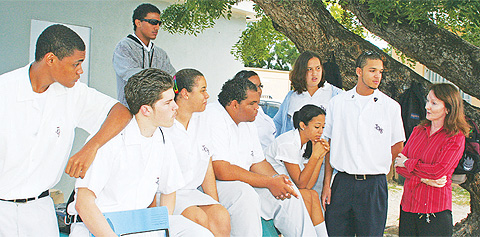
Any workforce for the future of the Cayman Islands is going to have to come from the bottom, beginning with the basics – education, exposure to international influence and a fresh calculus to balance tradition with modernity.
“This is the first (of this) generation of young Caymanians entering the workforce for the first time,” says Shannon Seymour, clinical psychologist, founder and director of the Wellness Centre, offering stress management, personal growth and corporate training.
As Cayman becomes a global centre for finance and tourism, emerging from historical isolation as a small-island fishing village on a sliver of Caribbean land, the stresses are increasingly evident, straining the traditional seams that bound the community for generations. “They are competing globally for local jobs, something they have never had to do before,” Ms Seymour says, “A lot of people are unprepared to compete for entry-level work.”
In November, Ms Seymour was a panelist at a Chamber of Commerce forum discussing the group’s Future of Cayman vision, launched in 2010 with a call to both the public and private sector to address five particular areas of development.
Addressing the development of talent, Ms Seymour shared the afternoon “Next Generation Workforce” panel with Margaret Jackson, head of Career Services at the Ministry of Education’s Further Education Centre, and Milly Serpell, managing partner of Stepping Stones Recruitment agency.
“We need to keep looking ahead as employment starts to open up. There is a big hospital being built and now there are nursing programmes to help that,” says Ms Serpell, alluding to the summertime ground breaking on Dr. Devi Shetty’s Health City hospital, a $2 billion,15-year medical-facility investment, and new University College nurse-training courses to meet anticipated demand when Health City opens in early 2014. “But now we also have a level playing field with international competition for entry-level jobs, and while it used to be a huge advantage to be Caymanian, it is not so much anymore. Fifteen years, 20 years ago there was a place for everybody, a lot of entry-level work in filing and clerking, but with increasing automation and technology, that’s no longer the case. We need to build a more skilled and educated workforce,” she says.
Ms Jackson said her 280 students at the Further Education Centre were not unaware of the situation, but many were still learning how things really worked.
“The way it works here is that three days per week they are in classes and two days per week they are in the workplace. They are all over town, in every company you can name: Banks, hotels, legal firms, tourism, dive shops,” she says. “What we have done, though, is totally de-glamourise the workplace. A lot of them used to say ‘oh, you parents and teachers don’t know anything. I’m ready to go to work and it’ll be fun. There are no rules. I can do what I like.’ And then after a little while, they realise: ‘uh-oh’. It’s a wake-up call. They realise that if they don’t go to college or for further education, they end up photocopying and filing, doing more menial jobs,” she said.
In its third year, the FEC has seen encouraging results – and a recent survey by the school produced some surprising results. “We’ve had great success with our automotive students,” Ms Jackson said, alluding to placements with local garages and dealerships. “In our first year, we placed three people with Automotive Art; in our second year, two out of three went full time. Some will go on to UCCI. Quite a few get part-time service jobs; some go full time and a few earned scholarships, some of which their company pays for.”
“We had an informal survey, and one of the surprising things was there was a lot of interest in the medical field. Some [students] spent two months at the George Town Hospital; there was lots of interest in Dr. Shetty’s hospital, and not all of that is in higher academic jobs. Quite a few were interested in more creative work, like photography and video, doing web pages or graphic design. A lot wanted to work in IT, and some even wanted to be in HR. We still get a few saying they want to join the police or the Fire Department or the Immigration Department,” Ms Jackson says, naming some of the traditional employment paths for Caymanian school-leavers, “but those are less than before.
As young people realise that their place in a 21st Century workforce requires changes in their own behaviour – asking for better education and greater professionalism – so employers appear to recognise the changes young people are working toward and the changes they are likely to bring to the workplace.
Samantha Nehra, co-chair of the Chamber’s Skilled Workforce panel and vice president of people and development for the dms organisation, said a future workforce is likely to change the work environment as much as it will change them – and that we all share the responsibility. “The millenials,” she said, referring to a generation born during the last two-and-a-half, decades, “will dictate the type of workforce they need and we should work to embrace those differences and how they can propel us. Millenials are different – they are far more optimistic than the baby boomers (for good reason), they think more globally, they are friends with their parents, they have difficulty focusing on non-stimulating things, they’re ambitious without a cause, far more entrepreneurial and, as employees, they place a higher value on flexibility, personalisation, integrity, technology and innovation.”
Asked how employers and educators can develop that kind of modern workforce, Ms Nehra answers simply: “They will develop us,” while dms “continues to grow and will embrace the millenials: The workforce of the future.”
Ms Seymour addressed the long-lamented sense of entitlement of which young Caymanians are frequently accused, citing the Wellness Centre and the Ministry of Education’s Passport 2 Success remedial programme, helping school leavers find employment. “We try to help them break down that barrier, that sense of entitlement and what it means to be Caymanian,” she said, “showing them that they are expected to give back. But young people are willing to challenge themselves, and we need to give them an opportunity to talk about that and to change. We all share in the responsibility. Parents have a responsibility to make sure they are training their children to enter the workforce, to be on time, to dress properly, to plan, to demonstrate a good work ethic and to be cooperative. Employers need to go a little further as well. They need to think about creative ways to motivate employees, to mentor them, to find ways for them to be successful. It’s a whole social ethic and we all benefit. I need young people to grow and to prosper and to be strong as I get a little older. We need the younger generation,” Ms Seymour said.
Ms Serpell observed that schools were already seeking to keep students on the premises a little longer each day, to offer work experience, to develop a sense of readiness and ethics. “We need to build a more skilled and educated workforce and we need to address that earlier, on Day One of school and we are all hoping this will grow,” she said echoing Ms Seymour’s sense of collective responsibility “If you take on a summer student, you are responsible to see they dress correctly and are on time. An employer needs to step up, take some time and provide some training.”
Ms Jackson says achieving the kind of changes the future will demand is a difficult question. Present conditions are relatively easy to asses, but gaining ground is hard work. “Now we need more career education in schools. We need to expand career services and to expose people to the opportunities and the challenges out there.”
Editor’s
note: This article reprinted from Chamber Magazine, Issue 1 , 2013
For more on the upcoming election, please click here.

Related Videos