

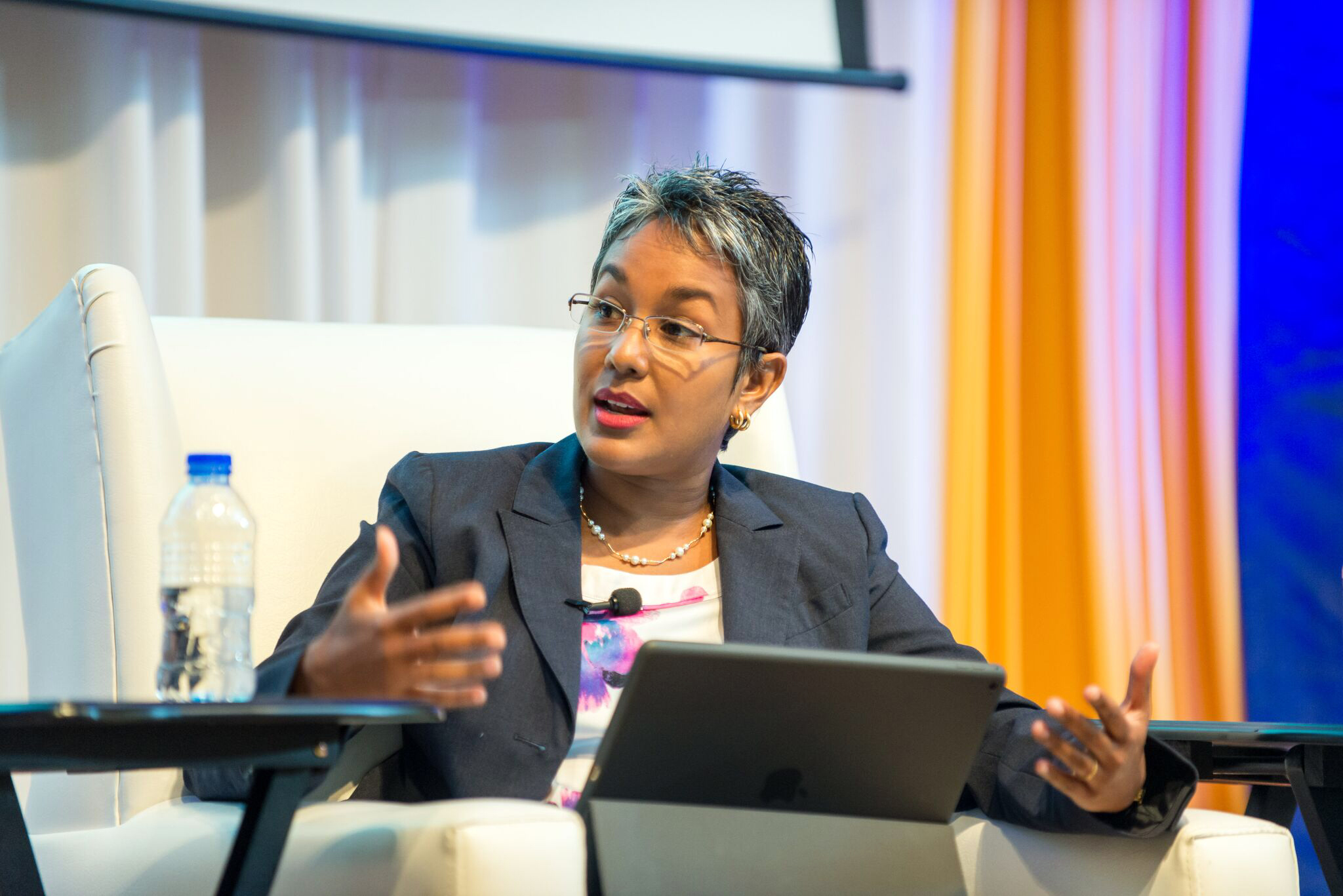
The Cayman Islands may not need quite as much growth as is commonly believed, because the goal of higher living standards can be achieved, in part, through better income distribution, according to economist Marla Dukharan.
Speaking on an episode of the Cayman Compass Facebook talk show The Resh Hour, she said economic growth, in terms of an increase in a country’s gross domestic product, is the needed mechanism to raise the standard of living.
Growth is therefore much more important in developing countries than in a high-income economy, like Cayman’s.
“I don’t think that GDP per capita is your problem. So therefore, I don’t think growth is your problem,” the Barbados-based economist from Trinidad said. Cayman did not have an issue with creating jobs either, as in fact labour has to be imported to do the work generated by the local economy.
As such Cayman is not plagued by some of the traditional economic challenges faced by countries in the region like Barbados or Jamaica.
“I actually think the Cayman Islands does not need the kind of growth that you think you need or that other countries need that are earlier on the development path than you are,” Dukharan said. “What you need, I think, is a greater distribution of that income and that wealth.”
Addressing inequality
Due to a lack of income taxation, Cayman has a regressive tax system. It means that lower income groups spend a greater proportion of their income on taxes like import duties or stamp duties on property transactions.
To address rising inequality, countries generally make their tax regimes more progressive, which means changing the system so that everyone across the wage spectrum should spend roughly the same percentage of their income on taxes.
However, Dukharan said, Cayman’s tax system makes this more difficult than in other places which, for example, could simply adjust income tax rates.
In addition to changing the tax regime, more could be done to strengthen the social safety net, including for the working poor, who typically do not qualify for assistance, and those experiencing a specific crisis, such as during the recent pandemic.
This can tackle some inequality, the economist said, because poverty is subject to what is called hysteresis.
“The longer you are poor, the longer you are likely to remain poor.”
To lift people out of poverty, measures enabling access to credit, healthcare and education are three of the biggest factors making a difference, she noted.
Decoupling economic and population growth
Regarding the local discussion around balancing population growth and sustainable development, Dukharan cited a United Nations report, Why population growth matters for sustainable development. It noted that achieving the United Nations’ Sustainable Development Goals, particularly those related to health, education and gender equality, can contribute to slowing global population growth.
Looked at it in another way the report states the more developed countries are, the less their populations will grow.
Dukharan said that, at the same time, population growth magnifies the harmful impact of economic processes on the environment. A rapid population increase can therefore exacerbate the challenge of ensuring that future development is sustainable and inclusive.
Moving the economy towards greater sustainability, she said, will require a progressive decoupling of population growth and economic activity, away from further resource extraction, waste generation and environmental damage.
Population growth and economic growth are not inextricably linked. Increased productivity will also translate into economic growth, but it requires investments in infrastructure, technology and education.
Common vision for Cayman
Given that, in her view, not as much growth is actually needed to improve living standards, all the trade-offs in terms of population growth, economic growth and sustainability should be placed in the context of a long-term national vision.
Dukharan said Cayman needs to decide what it wants to look like in 2040 or 2050.
This type of vision must be created by the people, for the people, she said, and be resilient to frequent changes in government administrations.
All policy interventions, to address inequality or plan for better land use, have to be grounded in that view of what the country should look like in the future, Dukharan added.
“Otherwise, you’re creating policy somewhat in a vacuum.”
Related Videos











In other words: let’s introduce direct taxation and drive away the source of our miraculous growth.
Very foolish idea.
The best solution is to create more industry, particularly on the east end, which can train people into sustainable wage jobs. You don’t defeat poverty simply with government safety nets – you have to give people careers in sustainable industries.