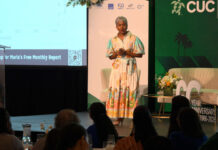
The European Union has awarded the University College of the Cayman Islands a grant of almost $1 million, which the educational facility plans to use to become a solar-powered ‘living laboratory’.
The grant, for 1.1 million euros (CI$960,000), from the EU’s sustainable development fund, RESEMBID, will be spent on creating a solar array to power the university campus, where energy and environmental parameters will be continuously monitored.
The data from that initiative will be shared with other islands across the Caribbean, UCCI president and CEO Robert Robertson said at an event at the university on Friday, 3 March, to announce the granting of the funds.
This is the second RESEMBID grant awarded to the university within 12 months. In March last year, it received €432,000 (CI$405,000), to help train students in trades that are sustainable, both environmentally and economically.

‘Case study’
Robertson said UCCI’s renewable energy plans could become a “case study”, and a number of educational institutions in the region had already expressed interest in the university sharing information about the grant, as well as transferring knowledge about the planned solar energy and sustainability project.
“With this grant, it’s an opportunity for us to act as a best practice case as a sustainable campus,” he said.
He added that the project will also help prepare students, who are already studying in sustainability fields at the university, for “green jobs”.
“We are looking, for example, at the installation of solar energy panels, which in a place like Cayman is a no-brainer; we need to have alternative sources of energy. By doing that, it affords the opportunity to train young people on the installation and maintenance of those types of devices,” Robertson said.
UCCI is using funding from the grant it received last year to offer free courses and certified training to 55 Caymanians on Grand Cayman and Cayman Brac in industries including renewable energy, tourism, information and communications technology, and construction.
RESEMBID, which stands for ‘Resilience, Sustainable Energy and Marine Biodiversity Programme’, provides grants to Caribbean Overseas Countries and Territories. Since December 2021, it has provided eight grants to the Cayman Islands – to UCCI, the Ministry of Sustainability and Climate Resiliency, the Central Caribbean Marine Institute, the Mangrove Education Project, and the Cayman Islands Red Cross.
Programme director Andrea Floudiotis, joining the event via video, said the success of RESEMBID is “only possible because of the innovative and impactful projects and ideas” that stem from Cayman and other Overseas Territories that receive the grants.
“At RESEMBID, we are proud to support UCCI’s and the Cayman Islands government’s efforts and their commitment to the sustainable green energy transition,” he said, which would have “tangible and long-lasting benefits for the inhabitants of the Cayman Islands”.
Kristen Smith, the government’s senior policy advisor on energy, said she was looking forward to seeing UCCI’s living laboratory “come to life, and to, one day, in the not too distant future, welcome a new generation of energy professionals into the workforce”.
Energy efficiency in homes and public buildings
Smith also gave an update on projects the Ministry of Sustainability and Climate Resiliency would be undertaking with the help of two RESEMBID grants, totalling just over CI$1 million, it had received for energy efficiency programmes for local housing and government properties.
She said the ministry’s submission to RESEMBID was a request for funds for pilot projects for affordable housing and public sector buildings.
In the public sector side, the project will involve auditing 13 government buildings and choosing two for retrofits, that will include air-conditioning and spray foam insulation, Smith said.
The residential programme, she said, will focus on homes built by the National Housing Development Trust and will involve the installation of renewable energy systems and monitors to track consumption in real time.
“Taking on these pilot projects will reduce the cost of living by NHDT residents, help government save on recurrent expenditures by reducing energy consumption, and raise awareness about social, financial and environmental benefits of enhancing energy efficiency, which are essential to achieving the objects of the National Energy Policy,” she said.
The RESEMBID grant programme, which is funded by the EU and implemented by Expertise France – the development cooperation agency of the government of France – supports sustainable human development efforts in 12 Caribbean Overseas Countries and Territories: Aruba, Anguilla, Bonaire, British Virgin Islands, the Cayman Islands, Curaçao, Montserrat, Saba, Saint Eustatius, Saint Barthélemy, Saint Maarten, and Turks and Caicos. It has so far funded 47 projects across those islands.
Related Videos