The Cayman Islands government has received a $1 million grant to help make government buildings and affordable housing more energy efficient.
The Resilience, Sustainable Energy and Marine Biodiversity Programme, known as RESEMBID, which is funded by the European Union, recently awarded the Ministry of Sustainability and Climate Resiliency more than €1.2 million (CI$1 million) which will be used as part of a programme to improve energy efficiency in public sector buildings and government-built affordable homes.
According to a press release issued by government this week, the Cayman Islands Energy Efficiency Programme aims to improve energy efficiency and facilitate retrofits for existing government buildings and for National Housing Development Trust homes to reduce greenhouse gas emissions and provide cost savings for homeowners and the government.
The programme will include energy audits, energy efficiency retrofits and the installation of renewable energy for NHDT homes, from the 100KW CORE allocation which was designated to the NHDT in 2020. It will also include training, establishing minimum energy efficiency standards for new builds, and an assessment of financing mechanisms for retrofitting of additional public sector buildings and residential buildings.
Premier Wayne Panton, who is also minister for sustainability and climate resiliency, said in the release that the programme represents “a ‘triple win’ across the three pillars of sustainable development: economy, society and environment”.
“This is a win, win, win scenario: The residential energy efficiency programme will reduce burdensome electricity costs on affordable housing residents while the public sector project has the potential to avoid tons of greenhouse gas emissions and save millions of dollars on electricity consumption,” Panton said.
He thanked his team, particularly Kristen Smith, the senior policy advisor for energy, who he said was instrumental in securing the grant award.
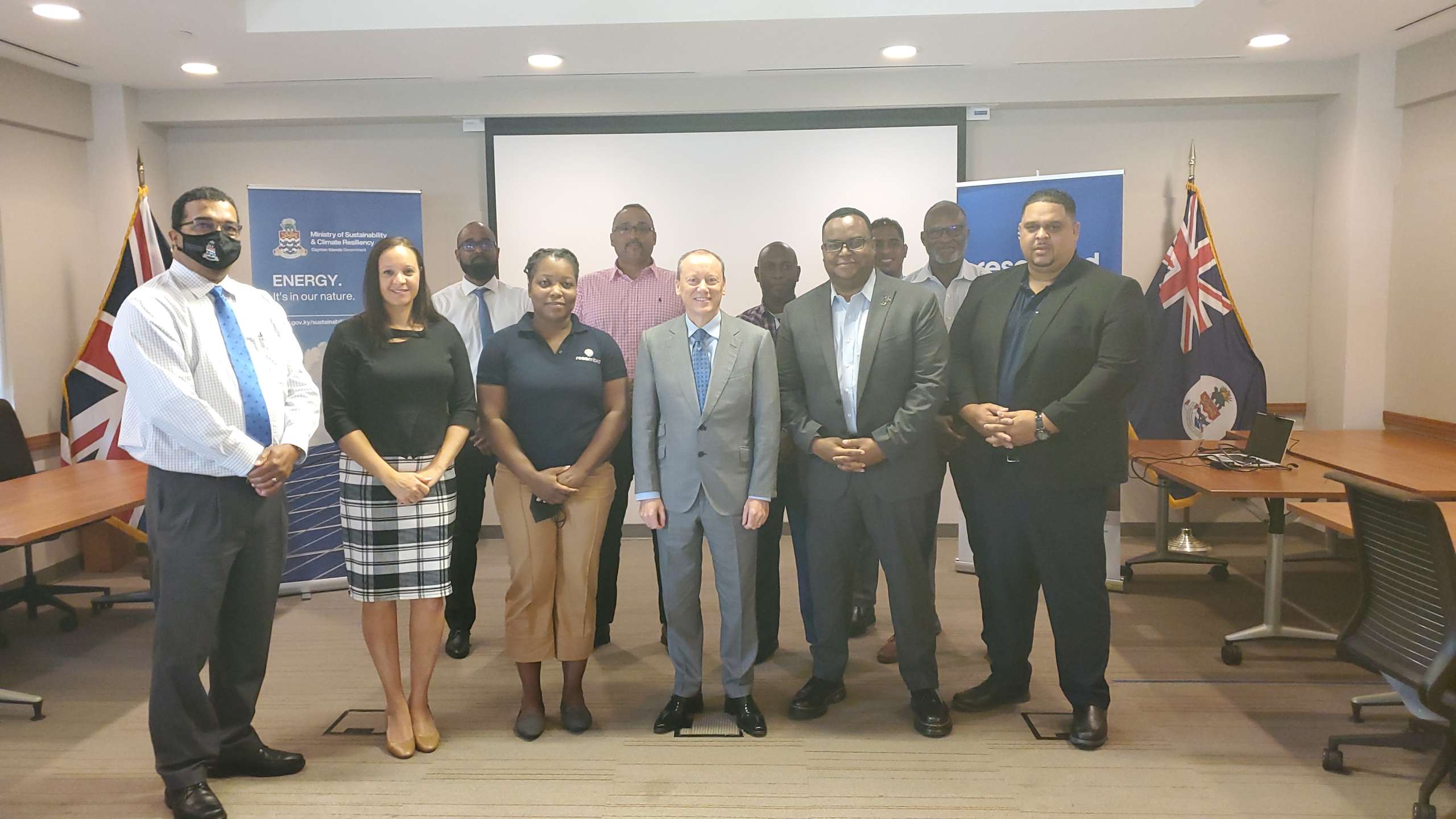
RESEMBID’s Sustainable Energy Programme Manager Nnyeka Prescod has been visiting Cayman to take part in the official launch of the University College of the Cayman Islands’ free sustainable development training programme and attend the soft launch of the government’s Energy Efficiency Programme.
She said, “Through a residential programme and public sector building retrofit programme, the Government provides an example of the relevance, applicability and replicability of sustainable energy actions in public facilities – yielding technical benefit for staff, workers and proof of concept and awareness opportunities for the general public.”
Under its National Energy Policy, the Cayman Islands has set a target of having 70% of its energy supplied by renewable sources by 2037.
According to the release, the new Energy Efficiency Programme supports several objectives identified under the National Energy Policy, “which aims to promote energy efficiency and conservation measures, and support energy security by reducing the reliance on imported fossil-based fuels in the Cayman Islands”.
Ministry Chief Officer Jennifer Ahearn says implementing renewable energy and energy efficiency measures are complementary tactics that contribute to a more sustainable Cayman Islands.
“Reducing electricity consumption is essential to meeting global goals to combat climate change and lower emissions,” she said. “These programmes will be a step in the right direction towards meeting these objectives. Electricity supply and consumption accounts for approximately one third of our national emissions. While we work to increase renewable sources of energy, we can simultaneously work to reduce the amount of power needed to keep our homes and offices running.”
Smith says the projects also aim to build Cayman’s energy sector capacity, and act as a catalyst for increasing energy efficiency uptake here.
“Our 2020 home energy efficiency competition demonstrated how switching to an energy efficient air conditioner and applying spray foam insulation can dramatically lower electricity consumption and help homeowners save hundreds of dollars every month,” Smith said in the release.
She added, “Taking on these pilot projects will help reduce cost of living for NHDT residents, help Government save on recurrent expenditures and raise awareness about the social, financial and environmental benefits of increasing energy efficiency, which are essential to achieving the objectives of the National Energy Policy.”
RESEMBID, funded by the EU and implemented by Expertise France – the development cooperation agency of the Government of France – supports sustainable human development efforts in 12 Caribbean Overseas Territories – Aruba, Anguilla, Bonaire, British Virgin Islands, the Cayman Islands, Curaçao, Montserrat, Saba, Sint Eustatius, Saint Barthelemy, Sint Maarten and Turks and Caicos.
Related Videos