

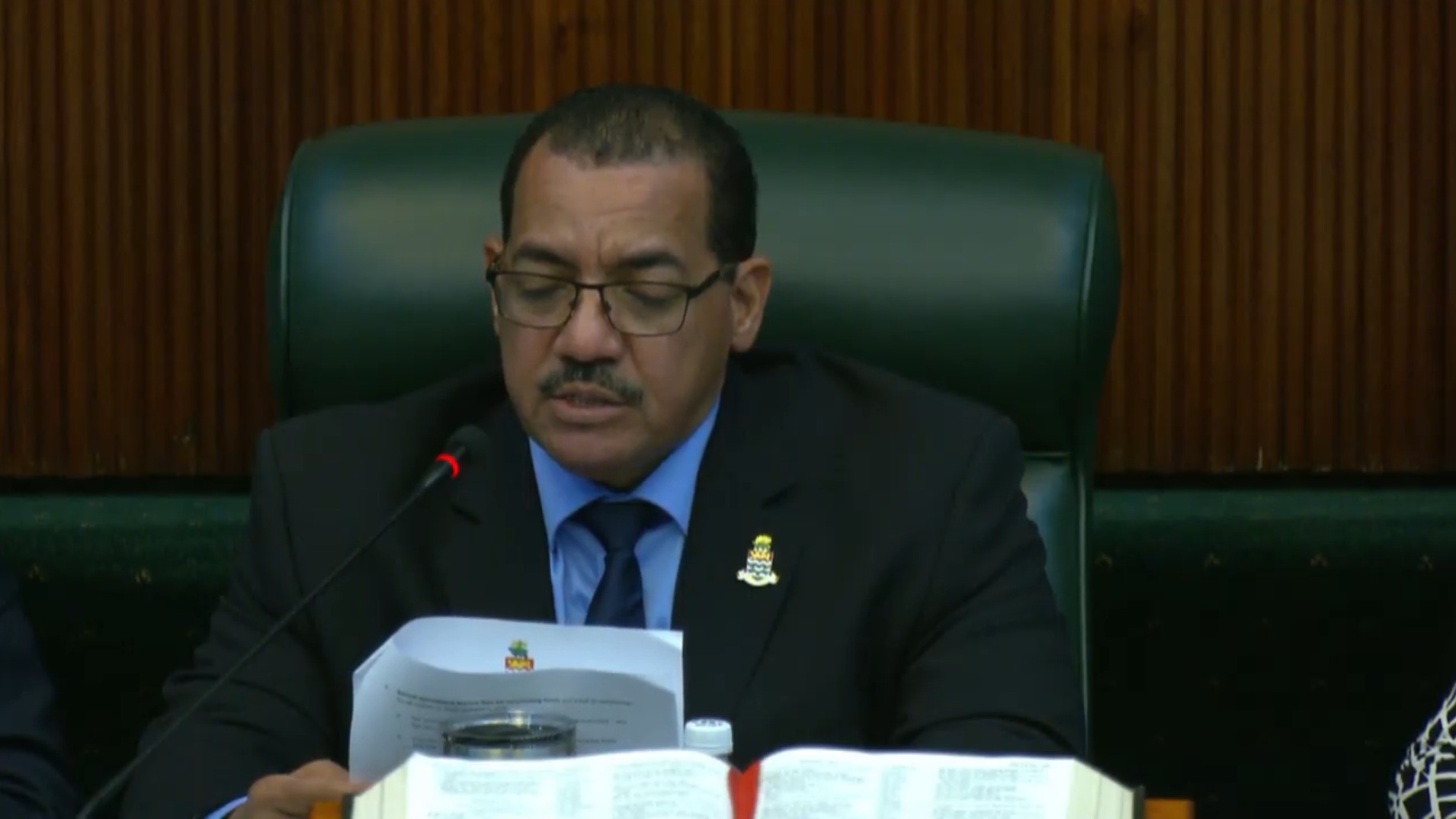
Minister of Finance and Economic Development, Rolston Anglin, revealed significant increases to a wide range of fees paid by foreign individuals and companies.
Anglin presented the details behind the government’s revenue raising measures, during the parliamentary finance committee meeting late on the afternoon of 14 Nov.
The comprehensive document outlined important increases to fees across broad swathes of the Caymanian economy. The new measures impact everything from driving licences to bank and trust licenses.
But one clear theme is an attempt by the government to increase fees on non-Caymanian individuals and companies.
Twenty-five different categories of fee increases were listed in Anglin’s plans to augment government revenues in 2026 and 2027. The Compass will have a more detailed analysis in the coming week, but we highlight some of the most notable below.
Non-Caymanians to pay more
The largest jump in fees relate to immigration with some categories increasing by 600%. There were big ticket increases at the top end with Residency Certificates (Independent Means) and Direct Investment Certificate, which will both increase to $50,000 from $20,000. Meanwhile Permanent Residence for Persons of Independent Means will increase to $200,000 from $100,000.
Lower down the immigration pecking order, the work permit admin fee increased to $500 from $100 while temporary work permits will increase by up to 200% depending on the income band. Anglin said that the immigration fees are expected to earn an extra $15.4 million in 2026 and around $17 million in 2027.
Non-Caymanians will also be targeted through driving licences. Three-year licences for both cars and motorcycles will jump to $600 from the current level of $75. Licences for heavy equipment, trucks and busses will now cost non-Caymanians $750, up from $120. Anglin projects the measures will raise $9.6 million in 2026 and the same amount in 2027.
Businesses being targeted
Non-Caymanian business interests are being targeted in a myriad of ways. Realtors with non-Caymanian agents will see their business licence increase to $10,000 from $750.
Businesses licences for property developers with more than 15 employees will jump to $20,000 from $750, while those with 15 employees or less see an increase to $10,000 from $750.
One of the biggest revenue earners is the increase in stamp duty, which will rise to 10% on properties worth $2 million and above. The government expects this measure to earn an additional $11.7 million in 2026 and $11.2 million in 2027.
Cayman’s legal profession is another big target for the new measures, with Anglin expecting to make an extra $10.2 million from lawyers in 2026 and $6.3 million in 2027. The fees are graded so that larger firms or those with non-Caymanian lawyers will pay more.
Related Videos












Thoughts that come to mind reading this…
1. Business always finds a way. The island economy we enjoy comes from businesses and individuals who adapted away from one place to Cayman because our tax rates, framework of law and lifestyle were favorable. Just as business found its way to Cayman, some of these fees will push business away because business finds a way. Sometimes elsewhere.
2. Some of these fee hikes are good because they are discretionary. The revenue increases are real and people will pay because the fees were due for an increase and the costs are fair. Others are experimental and too aggressive. They tinker with the system that built our growth in the first place and could break the virtuous cycles we want to reinforce.
3. Government is too big and getting in the way of business. There are too many Caymanians relying on government, for work and support, and government risks making business here too hard and too expensive. We are all in Cayman because too much tax breaks the cycle of prosperity and pushes people and money away.
Sometimes we are all too close to things to see the consequences of our actions. I hope our ministers have a plan or system to reduce any fees that are too large or that adversely impact the golden routine that brought us the prosperity we seek to tax.
Kudos to Minister Anglin for his fundamental belief in education as the foundation of success for Caymanians. He is absolutely right to focus on that. Let’s all be prepared to adjust and react quickly if we learn we’ve made a mistake.
So, the overarching theme of the proposed measures is clear: a broad-based rise in coercive fixed costs. While there are sector-specific nuances, the direction of travel is unmistakably upward…
For Caymanian entrepreneurs operating small and mid-size businesses in non-professional sectors (think: retail, tourism, and hospitality) the impact is likely to be immediate and disproportionate. General fee increases, combined with higher costs attached to expatriate employees, will place pressure on short-term cash flow and could limit growth or hiring plans. In our economy where many SMEs operate on relatively narrow margins, these changes may feel less like a routine adjustment and more like the tide rising faster than expected around their feet…
At the same time, the substantial increases targeting professional services firms (legal, accounting, banks) are, in principle, more manageable. Large international practices typically have the scale and margins to absorb increased operational fees, particularly where such costs remain modest relative to their global revenue base. However, the concern is less about any single increase and more about the compounding effect of rising licensing fees, work-permit costs, and administrative charges. When multiple cost pressures converge, even well-capitalised firms may begin to reassess the overall competitiveness of the jurisdiction. It is not unreasonable to wonder whether some of their clients, especially cost-sensitive institutional clients, might begin to explore alternative jurisdictions such as Bermuda, Mauritius, or the Channel Islands for equivalent services. Cayman’s competitive position is strong, but even the strongest vessels can begin to drift if too much weight is added at once.
Given the breadth and scale of the changes, it would be constructive for the government to publish a comprehensive cost-benefit analysis along with any macroeconomic stress-testing models used to forecast the impact of these reforms. Transparency would help reassure stakeholders (particularly SMEs) that the long-term benefits outweigh the short-term disruption. While certain elements of the reforms were subject to consultation, the public had limited time to digest, discuss, or meaningfully contribute to the final outcome. For changes of this magnitude, a more deliberate and consultative approach would have strengthened confidence in the process.
Houses will now sell for 1,999,999.
Never seen almost any government administration around the world that is this anti business, capitalism and grow of the economy.
We’re really trying to follow Cuba in the Cayman Islands. These fees aren’t inflationary, they are “please take your business out of Cayman fees”
It’s bizarre. They won’t be re-elected, that’s for sure. They seem to have no realisation that exempt companies can easily leave for other jurisdictions. The risk to the competitiveness and to activity in the financial-services ecosystem is non-trivial. Increased work permit fees will lead to increased living costs for Caymanians, and more and more jobs silently outsourced. The construction sector will also slow down, as will stamp duty revenues. Not one of those ministers has even the smallest understanding of basic economic principals.
Anglin is proposing to increase the cost living to another extreme level for all Caymanians. Cayman businesses will just pass on these new expenses at the cash register. Just Disgusting.
“Residency Certificates (Independent Means) will increase to $50,000 from $20,000”
This certificate simply gives a healthy, well-off property owner the right to stay longer than 6 months at a time with no right to work. More time to spend lots of money in Cayman on groceries/alcohol, dining out, diving, clothes, gas, services, fund raisers…
Independent means does not mean unlimited means. Why would the gov’t want to discourage people from spending their money here?
I won’t be employing anybody else in Cayman with 600% work permit fee hikes, I’ll tell you that now. It’s already cheaper just to hire somebody in the UK or Canada for half the salary and without the burden of WORC unreasonably scrutinising every hire.
I have been a yearly visitor for over 30 years What I see and read about the “Caymanians” and “non caymanians” and “ex pats” reminds me off the US in the south in the 1950s. Pitting one group against another was a recipe for unrest then and I see such a wedge developing in Cayman. I have often wondered how CIG would allow so many people to live in shacks…literally shacks. The defense of no one can afford a home here because expats drive up the price doesn’t justify it…there will always people who for whatever reason can not afford a home. That doesn’t mean they don’t deserve decent housing even if it has to be provided by the government. Low income and subsidized housing should have been introduced years ago in CI. I hope CIG uses some of this new found money to provide for their people in need. Stop blaming the one group for the failings of the other. Your government has the duty to provide for them. And it has failed to do so. The same applies to education
How about increasing the import duties for companies that operate under an LCCL and compete with local companies?
That’s one way to get cars off the roads. Now how about a decent public transport system?
Sadly, another tax and spend government has taken over. They never learn from history until they run off investors in their economy, layoffs start, and then they panic, but it is too late.
Q: What happens when a supermarket drastically increases its prices?
A: You guessed it. Customers go elsewhere.
Beware the law of unintended consequences…..
Rollie may be brilliant!
If his maths are correct then the increased revenue from the higher fees will offset the loss from the decrease in economy activity.
Population will shrink as people aren’t hired and some leave not ‘letting the door hit them on the way out”.
Going forward we will have fewer jobs and people on this island. Which is what some people want.
This article doesn’t drill down at all on the new finance sector fees
licensees with assets between US$1 billion and US$3 billion, the annual
fee increases from $1,000,000 to $1,200,000 in 2026 and to $1,500,000
in 2027; and
b. licensees with assets exceeding US$3 billion, the annual fee increases
from $1,000,000 to $1,500,000 in 2026 and to $1,750,000 in 2027;
50% fee increases for some business that have no new revenue means the entire businesses will certainly without a doubt, close shop, lose all jobs and leave. There will be a few surviving financial companies from this but there won’t be many.
There needs to be a bigger highlight on the finance industry because this is the death blow.
Higher fees for almost everything ? How about increase in salary as well? Minimun wage of 8KYD is not enough to pay for a drivers license of 500KYD for three years. That can be a full weeks salary???
In exchange for 100M in revenue from ex pats in 2026, please OPEN THE GROCERY STORE ON SUNDAYS!!!! Even in the most religious parts of Utah, the grocery store is the only thing open!! Nail salons are open but groceries are not? How did that happen? lol you’ll probably get less complaints from folks if you give something back. This for that.
Caymanian owners don’t want to pay wages on Sundays. This is what some Foster’s employees told me.