

At a glance:
• Cayman has no formally approved national sargassum management plan and currently relies on reactive clean-up responses.
• Government is exploring a more proactive strategy, including offshore interception systems such as floating booms and coastal berms.
• Scientists warn 2026 could be another major sargassum year.
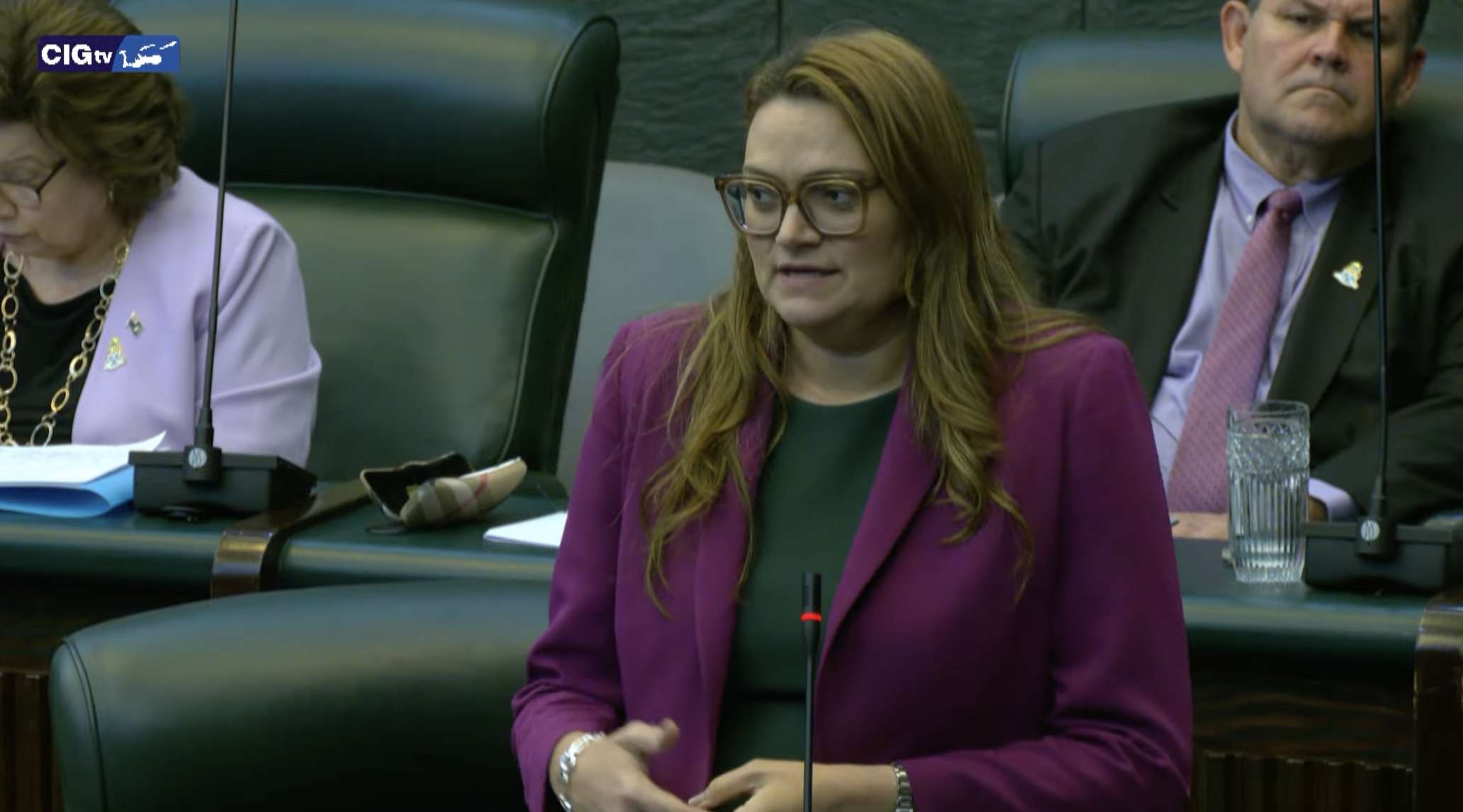
Government has not yet finalised a national plan to manage sargassum in the Cayman Islands, but Environment Minister Katherine Ebanks-Wilks says work is under way on a more proactive strategy that could include measures to intercept the seaweed before it reaches shore.
Sargassum, a floating marine algae once largely confined to the Sargasso Sea, has increasingly inundated beaches across the Caribbean in recent years, typically peaking between May and late July.
While Seven Mile Beach on the west side of Grand Cayman generally remains less affected by the seaweed because it lies on the island’s lee shore, other areas are more exposed to prevailing winds and ocean currents and experience more frequent accumulations.
Responding to questions in Parliament on 6 March, Ebanks-Wilks said that without a formally approved plan, government departments have largely relied on reactive coordination to deal with periodic influxes in recent years.
Instead, the islands currently rely on response protocols focused on coordinating clean-up operations and advising property owners on removing sargassum once it has already washed ashore.
“The protocol does not presently address management of sargassum offshore before it lands on our shores,” said Ebanks-Wilks. “The direction I wish to see moving forward is a more comprehensive and proactive strategy.”
Ebanks-Wilks did not provide a specific date for the release of a national sargassum management plan but indicated that proposals outlining possible management approaches would soon be brought to Cabinet for consideration.
Among the strategies being examined are containment systems such as floating booms and berms. The former could help intercept or redirect large mats of seaweed before they accumulate along the shoreline and berms, and the latter being raised barriers made of sand, rock or other materials constructed along the shoreline and are traditionally used for coastal protection.
Floating booms are designed to capture or redirect drifting sargassum and guide it toward collection points for removal. Similar systems have been deployed in parts of the Caribbean, including along Mexico’s Riviera Maya.
Raising the issue in Parliament, Ebanks-Wilks pointed to some of Cayman’s more heavily affected areas.
“Mr. Speaker, given what we know about the situation, is the government willing to consider installing berms or booms around the island’s sensitive areas, particularly along the south side, which is so heavily affected, especially in Bodden Town?” she asked.
Risks of not being proactive
The minister warned of environmental and public health risks associated with large accumulations of decomposing seaweed if the issue is addressed only after it reaches land.
“Addressing sargassum only after it reaches the shore can create secondary impacts,” she said. “Mechanical or improper removal can disturb beach profiles and interfere with marine life, including turtle nesting activity.”
She added that the seaweed can contain heavy metals that may leach into soil or groundwater if large volumes are piled in one location, and that decomposing sargassum releases hydrogen sulphide gas, which can pose serious health risks.
“Exposure to high concentrations of hydrogen sulphide can cause collapse, respiratory paralysis, convulsions, coma, cardiac arrhythmias and death within minutes,” she said.
Ebanks-Wilks also highlighted the economic implications for the islands’ tourism sector, which is already grappling with coastal erosion.
“Having challenges with our beach eroding coupled with sargassum puts us in a tight spot when we’re trying to attract our visitors here,” she said.
She added that the islands currently lack sufficient facilities to safely process or store large volumes of the seaweed during major influx events.
For now, government does not plan to hire dedicated staff specifically for sargassum management. Instead, Ebanks-Wilks said the current response framework relies on coordination among government agencies rather than the creation of a standalone workforce.
Another record year projected for sargassum
The issue may become more pressing this year. Projections from the University of South Florida’s Optical Oceanography Lab’s Sargassum Watch System show larger-than-average accumulations of sargassum across the Atlantic basin.
Satellite monitoring indicates that in just the past month, sargassum across the Atlantic surged from just under half a million tons to nearly 1.7 million tons.
“Because of the continuous growth from November to January and because of the record-high Sargassum amount in most regions, 2026 is very likely another major Sargassum year (i.e., Sargassum amount exceeds 75% of the historical values),” said the report.
Related Videos









We have experienced this sargassum problem for many years, why do we still not have a plan to deal with it?.
Ms. Ebanks Wilkes Why don’t you pick up the reigns, and get a program started posthaste. Too much talk, for far too long, affecting the very beauty of Cayman, not to mention the impact on tourism. Would I want to come to Cayman with this nasty odoriferous substance encroaching on beaches and further on the shore. No!