The Cayman Islands Department of Agriculture has launched a district-wide response to tackle a surge in spiral whitefly infestations, as reports continue to rise across Grand Cayman.
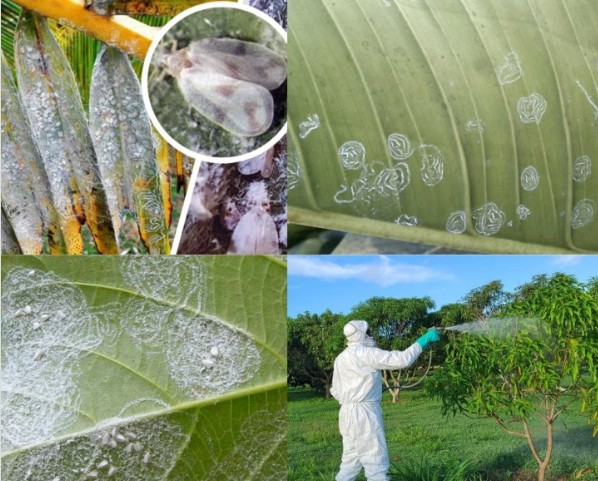
The spiral whitefly, has become increasingly visible in recent months, leaving a tell-tale black coating of sooty mould on leaves, fences and outdoor surfaces. While not new to Cayman, officials say populations have expanded rapidly since late 2025.
“Our spray team will be working district by district to reduce and manage the infestation,” the department said in a statement issued Thursday, 23 April.
The coordinated response started in Bodden Town this week, before moving into George Town, with each district scheduled for treatment over a two-week period. The programme is expected to run through the end of June.
A fast-spreading nuisance
Spiral whitefly are sap-sucking insects that feed primarily on the underside of leaves. According to plant protection officer Nelson Laville, the pest damages plants in two key ways.
“The feeding reduces chlorophyll production, weakening the plant, and at the same time the insects produce honeydew, which leads to the growth of sooty mould,” he explained.
That black mould, while not directly infecting the plant, blocks sunlight and reduces photosynthesis, ultimately affecting growth and crop yield. In severe cases, leaves can die off entirely.
The insect’s lifecycle also contributes to its rapid spread. Females lay up to 90 eggs in a distinctive spiral pattern on leaf surfaces, with new adults emerging in just a few weeks under favourable conditions.
Backyard problem driving outbreak
Department of Agriculture officials say the current spike appears to be driven largely by untreated residential areas rather than commercial farms.
“In October and November last year we started to see an increase in sooty mould across vegetation,” said agronomy manager Claudette McKenzie-Bowen. “As we carried out surveillance, it became clear the population was growing at an alarming rate.”
Commercial growers are generally protected under existing crop management programmes, but backyard gardens; often with fruit trees like coconut, mango and banana, have become hotspots.
Areas including Savannah, Newlands, Prospect and Bodden Town have seen the highest concentrations so far, with scattered reports in George Town and fewer cases in West Bay.
Targeted spraying and ‘soft’ chemicals
To curb the outbreak, the department has deployed teams to carry out targeted pesticide applications, focusing on heavily affected areas.
The approach includes the use of potassium-based soaps; considered suitable for organic farming, alongside other treatments where necessary. In some cases, systemic insecticides are being used for taller trees such as coconuts.
Officials stress the goal is not eradication, but population control.
“We are not putting out an atomic bomb,” Laville noted. “The aim is to bring numbers down so natural enemies can regain control.”
Predatory insects and parasitic wasps are known to feed on whiteflies, but current populations appear overwhelmed by the scale of the outbreak.
Public urged to assist
Residents are being encouraged to report infestations and request inclusion in the spray programme by contacting the Department of Agriculture.
Officials warn that unmanaged infestations could lead to wider agricultural and environmental impacts, including increased and potentially improper pesticide use by the public.
For now, the message is clear: coordinated action and community participation will be key to restoring balance.
“This is about getting ahead of the problem,” McKenzie-Bowen said, “before it becomes something far more difficult to manage”.
Related Videos