

Stingray killed by boat prop, DoE officer no longer at sandbar

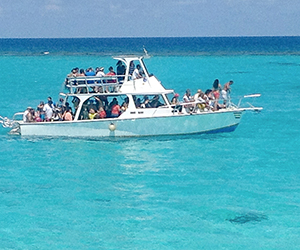
Concerns have been raised over crowded conditions at Stingray City Sandbar, including dangerously overloaded boats, and reckless behavior from some tour guides.
A stingray was killed by a boat propeller earlier this month, while several tour operators have complained their boats have been bumped or damaged by careless boat captains.
Other tour leaders are accused of lifting stingrays out of the water and rubbing them on people’s backs in the jostle for tourist dollars at the busy attraction.
Photographs supplied to the Caymanian Compass show boats crammed from bow to stern, with dozens of tourists huddled on deck.
The Department of Environment used to station an officer at the site but he has not been seen for the past four months, according to operators. They say standards have worsened considerably in his absence.
Guy Harvey, who has been at the sandbar this month collecting data, said he was concerned about the impact on the animals, as well as the tourist experience at one of the world’s most famous wildlife interaction zones.
He was present when a stingray, mortally injured with more than a dozen propeller slashes, was discovered at the sandbar and his research team conducted an autopsy before disposing of the body.
He said, “Even before this incident happened, several different tour operators told me that it is now a “free for all” at the sandbar without the enforcement officer there.
“Bad boat handling, large numbers of people crowded into a small space, tour operators reviving the old tricks of rubbing rays on swimmers’ backs covered in sunblock and lifting them out of the water.
“All of this indicates a need for a revision in how we manage the interaction at the sandbar. After all, each stingray generates half a million dollars per year in revenue.”
He raised the possibility of collecting a 50 cent fee from all visitors to the sandbar to ensure enforcement officers could be stationed there and to help fund research efforts.
With plans for a new dock expected to herald ever growing numbers of cruise visitors, Tourism Minister Moses Kirkconnell acknowledged that something may need to be done to manage traffic and behavior at the site.
He said both he and Environment Minister Wayne Panton had met with operators and were working on a solution.
“Stingray City is one of our most important tourist attractions and we have to manage it to ensure it remains a world-class experience for visitors,” he said.
Mr. Harvey said his chief concern as a researcher was the welfare of the animals. But he warned that the abundance of boats – sometimes as many as 25 at one time – risked “diluting the experience” for tourists if they were not properly managed.
“They need someone out there with a big stick who knows about these animals, who is well known in the community, and won’t stand for any nonsense,” he added.
No one from the Department of Environment was available last week to comment on why an officer was no longer stationed at the site or the environmental concerns raised.
Cayman’s stingrays have been legally protected since May last year when amendments to the Marine Conservation Law came into effect.
Issues around boat safety, including the overloading of vessels, would fall under the remit of the marine police. No one from the police department was available for comment on Friday.
One tour operator, who asked not to be named, said the overloading of boats was the biggest safety issue at the sandbar. He said he had seen boats almost sinking under the weight of too many tourists.
He added that some operators were careless in how they handled their boats and minor crashes between vessels were increasingly frequent.
Mr. Harvey’s latest census at the Stingray Sandbar, conducted between Jan. 5 and 8, identified 88 separate stingrays at the site. He estimates each one is worth as much as $5 million to the Cayman economy and maintaining the numbers is crucial to the viability of the interaction zone.
“We continue to take the sandbar and its friendly inhabitants for granted. We just show up every day and assume the rays will be there. What would happen if this resource ceased to exist because of our negligence?”
He said collecting a small charge from visitors, as happens at the USS Kittiwake dive site off Seven Mile Beach, could be one solution.
“These funds would pay for two enforcement officers working shifts, for boats, fuel and for all the research projects ever needed for many years. Tourists would be glad to know that part of the price goes to research and conservation of stingrays. In addition, the attendance data would also be collected.”


Related Videos









Anyone remember the Complaint Commissioners report on Safety of Small Commercial Waterborne Vessels that went before the LA in November 2006 and was then buried without a trace? If you can still find a copy it is well worth reading because the warnings in it seem to have been completely ignored.
Check out – http://www.compasscayman.com/caycompass/2006/11/09/Strong-boat-regulations-advised/
Why not start feeding stingrays in a better location. An area where there is more space and not in front of a channel. As for the problem of too many people on board the boat , Just charge more. How about charging US 80 per person ? That would be in line with the cost of living and pay the captain and mate more ? Everybody would be happier and you wouldn’t need the tip.
It would be worth it to pay a nominal fee (small amount) per person to keep it organized, safe and open for everybody’s enjoyment. However, if the D.O.E officer is simply watching as when one of the stingray were hit by a propeller, what could he possibly do to stop it? Seems like trips need to organized and time managed before letting too many operators in to overwhelm the area. Scheduling trips and approval for them in advance of letting them to the sandbar would be the best solution in my opinion.
I’ve paid the extra money to dive the USS Kittiwake and believe it was well worth it. It may help organize the crowds better, but it was definitely one of the best dives I’ve experienced in the Caymans in a while.
Self regulation in Cayman doesnt work!
The enforcement of not only what operators and tourists do but also length of stay rules at the sandbar would be a big step forward.
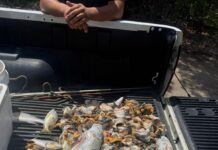
Also banning of commercial tourist operators collecting conch each day would be a big step forward.
Couple of suggestions – at present the WIZ (wildlife Interaction Zone) permits are valid for three years and are only a few hundred dollars.
The Wiz permit needs to have a ‘seat’ component to it
so somebody with a boat rated for, inspected for, insured for, say 12 persons should pay a base permit and 12x seat, someone with a 100 capacity boat should pay base 100, and it needs to be replaced annually so the DOE gets to see the current insurance and inspection certificates.
Once the DOE have a cross reference of Permit to Capacity enforcement can be more effective.
It also removes the temptation to put a couple of extra passengers on board – who’ll know.
The boat ‘passenger’ definition is from the 1950 when people where on average lighter, and is considered very lenient today – it is possible to have the only US Coast guard rated number of passengers on a vessel yet still be overloaded.
Good point Andy but unfortunately the economics, as in the boat operators ability to pay these charges, seems to be limited. I suspect that is why the WIZ fees were set so low in the first place.
As long as you have a situation where the cruise ships are charging their passengers around US85-90 for Stingray City then allegedly only paying the boats operators about US15 then the boats will be overcrowded and poorly maintained.
I have even been told that, to ensure all booking were made through them, cruise lines have been threatening to cut off Stingray City operators who their staff catch touting for walk in business in GT.
Apart from the need to finally take on board the 2006 SSCWV report and implement the recommendations this abuse by cruise lines, who are apparently taking blatant advantage of their financial muscle, has to be tackled.
Based on the figures I have been given every Stingray City booking made on board a cruise ship nets the cruise line nearly five times as much profit as the boat operator gets paid for actually doing the trip – if true (and if anyone out there can clear this up it would be appreciated) this needs to change.
We live along the Yacht Drive channel and most of the stingray city (sandbar) boats pass behind our house.
Many of the boats are well managed, especially the sailboats.
Many however are overloaded and go far faster down the channel than is allowed. It is a NO WAKE ZONE. A person who operates kayak tours in the channel tells me she and her customers are sometimes almost capsized by inconsiderate boat captains.
Calls to the marine police and port authority have no effect.
I pity the treatment the stingrays are receiving.