Mizu Asian Bistro & Bar’s Executive Chef Dylan Benoit spent the summer in Asia with his brother Lucas, exploring the region’s cuisines, techniques and ingredients, with the aim of enhancing and further perfecting the menu at Mizu. In the third of a five-part series, he shares his culinary adventures.
This was the first day since we arrived in Hong Kong that we didn’t have dim sum for breakfast, and my brother Lucas was visibly annoyed with me that I was disrupting his five-day dim sum streak. However, I promised him dim sum for dinner at “Tim Ho Wan,” the world’s first Michelin Star dim sum restaurant, located in Kowloon Bay, Hong Kong. I also assured him the dumplings we were going to have for lunch would be worth the cross-border mission to Macau, a small enclave about 37 miles east of Hong Kong.
We got on the ferry around noon, and after a 45-minute ride east across the South China Sea, the skyline of Macau became visible – soaring skyscrapers, bridges and skyways, all jostling for space.
Dubbed the “Vegas of the Orient,” Macau is a former Portuguese colony, and, like Hong Kong, is now considered a Special Administrative Region of the People’s Republic of China, which means it has its own police, legal system, monetary authority, and customs and immigration policies.
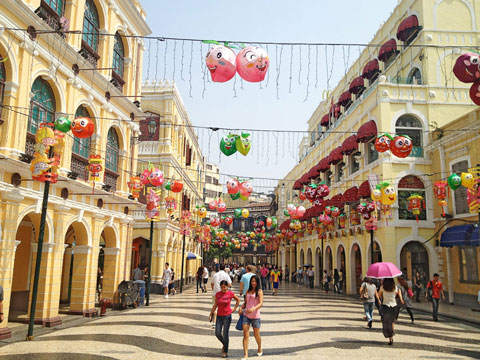
Walking around Macau, the European influences are immediately visible, with colonial-style buildings and churches dotted among the modern-day buildings. Even the road signs are in Portuguese, as well as Cantonese and English.
Armed with nothing but a vague recollection of the area and a photo of the storefront that was still on my phone from a previous trip, my brother and I hit the streets, trying to find the small alleyway off a pedestrian side road that was home to the dumpling shop – the sole purpose of our day trip.
As we wandered around in search of the shop, we took in the sights, sounds and smells. From the storefronts emanated the aroma of “bak kwa” (dried meat), a mouthwatering and unmistakable smell. This dehydrated meat product is the oriental cousin of jerky; it is sweet and salty, usually made from beef, pork or mutton.
In basic bak kwa, the meat is finely chopped and seasoned with salt, sugar, spices and soy sauce, then dried. But there are numerous stores dedicated to bak kwa, and countless flavors.
Eventually, we came across a recognizable landmark, the ruins of St. Paul’s, a stunning 17th century Portuguese cathedral and a UNESCO World Heritage Site, which I had seen on my previous trip.
I asked Lucas if he wanted to climb the stairs to see it. “See what?”, he asked.
“The church. Do you want to go up and see it?” I replied.
“I can see it from here” he said. “Let’s eat.”
Fair play, we were here for the food, after all.
After sourcing directions from a store clerk, we finally stumbled upon the dumpling shop. Its big green sign and white letters barely illuminated in the daytime sun, read: Loja de Comidas Sio Seong Hoi.
This “mom and pop shop” merely consists of a roll-up corrugated metal door with a counter in front. On the counter, two large steel plates around 3 feet in diameter are used to sear the dumplings to golden brown perfection.
Like most places on our travels, the menu is limited to just a few items, each done exceptionally well.
Not knowing what the menu says, we just pointed to the dumplings in the metal plate and signaled for two orders. The dumplings are quite small, about two bites each – or one bite if you’re my brother.
They are handmade from the most delicate flour dough and stuffed with roughly chopped pork, which is perfectly spiced and seasoned. They are then boiled until cooked, and then pan fried to order. There are no plates here, or knives, forks, tables and chairs. The middle-aged woman with short black hair flipping the dumplings puts three pieces in a small white plastic bag, pierces one with a bamboo skewer and hands it across the counter to me.
To the left of the counter is a small metal container with a delicious roasted chili paste. I add a tablespoon before tightly securing the bag and shaking it vigorously in order to evenly coat the dumplings.
We head outside and sit on a small curb running the length of the building next to the shop, where we quickly devour our dumpling feast. Still hungry, we order another three dumplings each and a couple of scallion and sesame fritters. These too were golden brown and salty, the dough moist and buttery, like a non-flaky croissant. The scallion and toasted sesame seed creating a depth of flavor one might not imagine possible in something so simple as a fritter, accentuated by the lingering heat from another completely unique chili paste. The taste, the smell, the location and company all combined to create another amazing dining experience.
With just an hour-and-a-half to spare before the last ferry left to take us back to Hong Kong, we headed to The Sands casino, just in case Lady Luck was on our side.


Related Videos