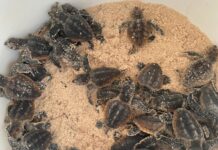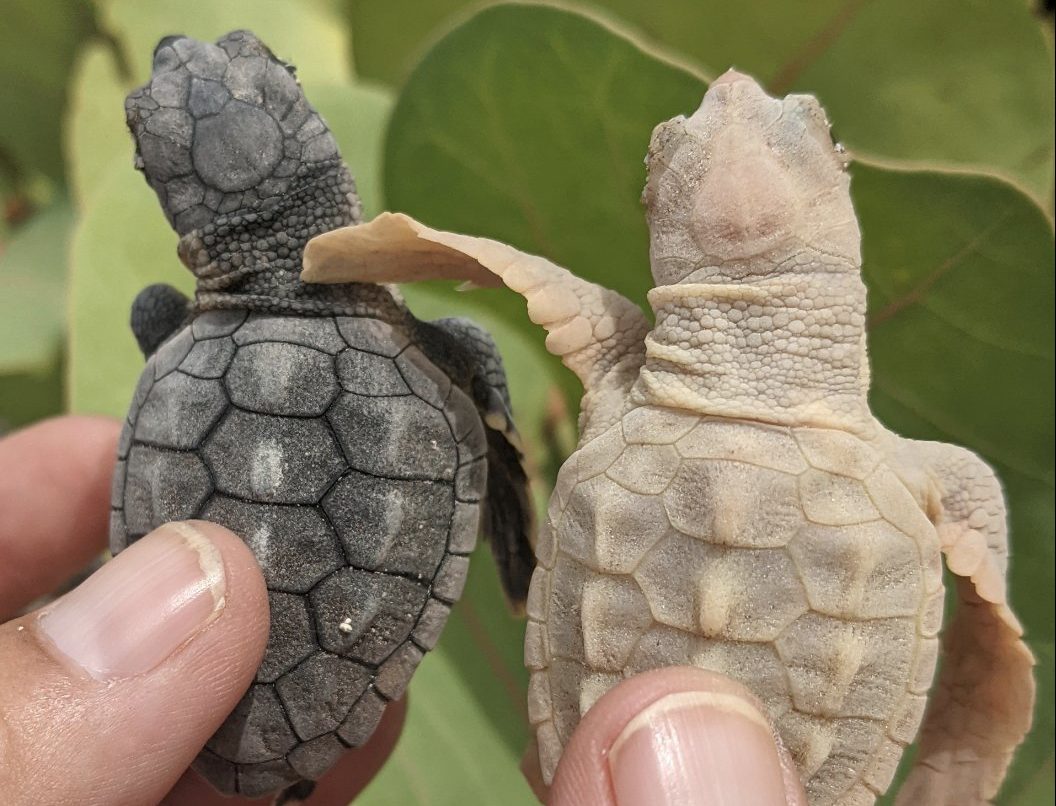
Three rare leucistic, or pale-coloured, loggerhead hatchlings were discovered by the Department of Environment’s turtle team on Tuesday.
One of the hatchlings debuted on Wednesday in a photo on the DoE’s official Twitter account.
“The turtle team came across a rare find when excavating a nest yesterday – three rare leucistic loggerhead hatchlings. Leucism is a genetic condition that causes reduced pigmentation,” the DoE post said.
DoE Research Officer and Sea Turtle Programme Manager Jane Hardwick, in response to queries from the Cayman Compass on the find, said, the turtles were excavated from a nest in North Side and
“It is very rare to find healthy/strong leucistic hatchlings. They often have deformities which mean they don’t survive to final stages of development in the eggs, so the team were pleased to find three that appeared completely normal. Unfortunately because of their colour, they are more at risk of predator detection in the water so they have a lower chance of survival to maturity,” she said via email.
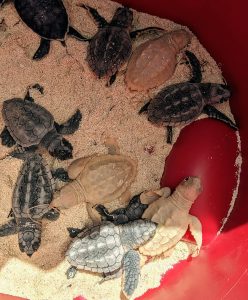
The DoE, on its Facebook page, added, “Often leucistic hatchlings have other malformations which means they do not reach the final stages of development but the team [is] happy to report that these hatchlings were healthy and strong and have been released along with others that were found left behind in the nest.”
Hardwick said the DoE Turtle Team released the leucistic hatchlings along with others from the same nest that were left behind and hadn’t made it out by themselves.
“As per DoE’s nest monitoring protocols, after seeing evidence that a nest has hatched, the team waits 3-4 days before excavating which gives all hatchlings a chance of getting themselves out. During a nest excavation, the egg shells are counted. Any hatchlings that are stuck/left behind are rescued and released,” she explained.
She said leucistic hatchlings, because of their colour, are more at risk of predator detection in the water so they have a lower chance of survival to maturity.
“However, there have been some leucistic adult sea turtles reported in other parts of the world (for example, in 2018, 2 leucistic adult females were recorded nesting in Tortugeuro National Park, Costa Rica). There are not many studies on the condition and so much more research is needed to better understand its causes and the survival rates,” she said.
According to Loggerhead Marine Life Centre in Florida, leucism is “a genetic mutation that is not compatible with the successful continuation of the species.
“This and other genetic mutations create anomalies, and the affected individuals are not well suited for survival. Perpetuation of these traits will weaken the species overall. Without the necessary pigmentation these individuals cannot camouflage in the sargassum, during their early years. This actually attracts predators, thereby putting these turtles as well as normal healthy ones nearby at risk,” it said in a post-hatchling summary.
The centre pointed out that the absence of protective melanin means leucistic hatchlings will be susceptible to UV sun damage, painful burning, and developing cancer.
Hardwick urged the public to be aware that at this time of year there are many sea turtle nests hatching.
“If you need to bring machinery onto the beach or clear vegetation, please contact DoE first. You must also obtain permits from DEH for beach bonfires. If you see hatchlings heading to the water please leave them alone, keep a safe distance and do not use any lighting,” she reminded.
If you see hatchlings in danger, please call the Turtle Hotline immediately on 938-NEST (938-6378).
If you see anybody interfering with a turtle, a nest or hatchlings, call 911 or DoE Conservation Officers on 916-4217.
Related Videos