The discovery of a late turtle nest has increased hope for the team at the Department of Environment that more turtles could visit Cayman’s shores before the month’s end when the season officially closes.
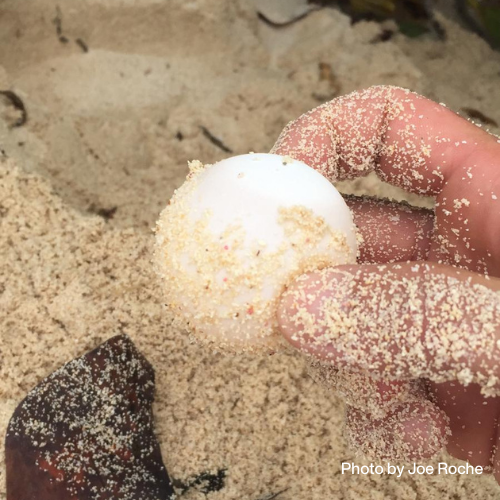
This week, the DoE team announced, via its social media pages, the discovery of a green turtle nest, found on 31 Oct. on Seven Mile Beach.
“As it had been six weeks with no new turtle nests recorded, the team [was led to believe] the nesting season had finished, so this was a very nice surprise,” Jane Hardwick, research officer at the DoE Sea Turtle Programme told the Cayman Compass Friday via email.
She said the team had only recently stopped monitoring the beaches “as we continue for five weeks after the last nest is laid”.
“So it is lucky that this was reported by a member of the public. Although it’s not completely unheard of for green turtle nests to be laid this late, it is very uncommon. Usually, it is hawksbill turtles that lay nests later in the year, like the Christmas Eve nest on the Brac last year,” she said in her response to Compass queries.
With the latest nest, she said, there could be some more discoveries.
“It’s possible that this female will return again or that there could be a late hawkbill nest, we are keeping watch,” she said.
So far, for the three islands combined, Hardwick said the DoE has recorded 179 green turtle nests, 349 loggerhead turtle nests and one hawksbill nest.
“These numbers may change slightly as we continue to clean the data and check carefully that no nests were recorded twice, etc. We will report final numbers soon,” she added.
It’s unclear how many eggs may be in the nest as Hardwick said the team hasn’t counted them yet.
“We confirmed that it was a nest rather than a false crawl activity by locating the eggs, but we do not count them until after the nest hatches to ensure we do not impact the development of the eggs,” she explained.
Green turtles typically nest in the Cayman Islands from mid-June to late-September.
“From the last 23 years of nesting data, only five green turtle nests have been recorded later than this one, proving this is an uncommon occurrence,” a DoE Facebook post said.
“This serves as a good reminder that although nesting and hatching season is typically between 1st May – 30th November, sea turtles do not always stick to our rules,” the post added.
Hardwick said it is expected that the nest will take a little longer to hatch, with the baby turtles appearing in early 2022.
“Sea turtle egg development speed depends on sand temperature, as does the sex determination of the hatchlings. At the warmest part of the year, eggs will hatch around 50-55 days, and at this time more females are produced. As it gets cooler they can take between 60-70 days, and more males are produced,” she said, adding many other variables also contribute to the speed, “such as depth of the egg chamber, whether the nest is shaded or unshaded and the sand type, making it difficult to predict accurate hatch dates”.
The DoE urged the public to report any suspected sea turtle tracks or stranded hatchlings to the DoE’s Turtle Hotline via WhatsApp on 938-6378 (938-NEST).
Related Videos