

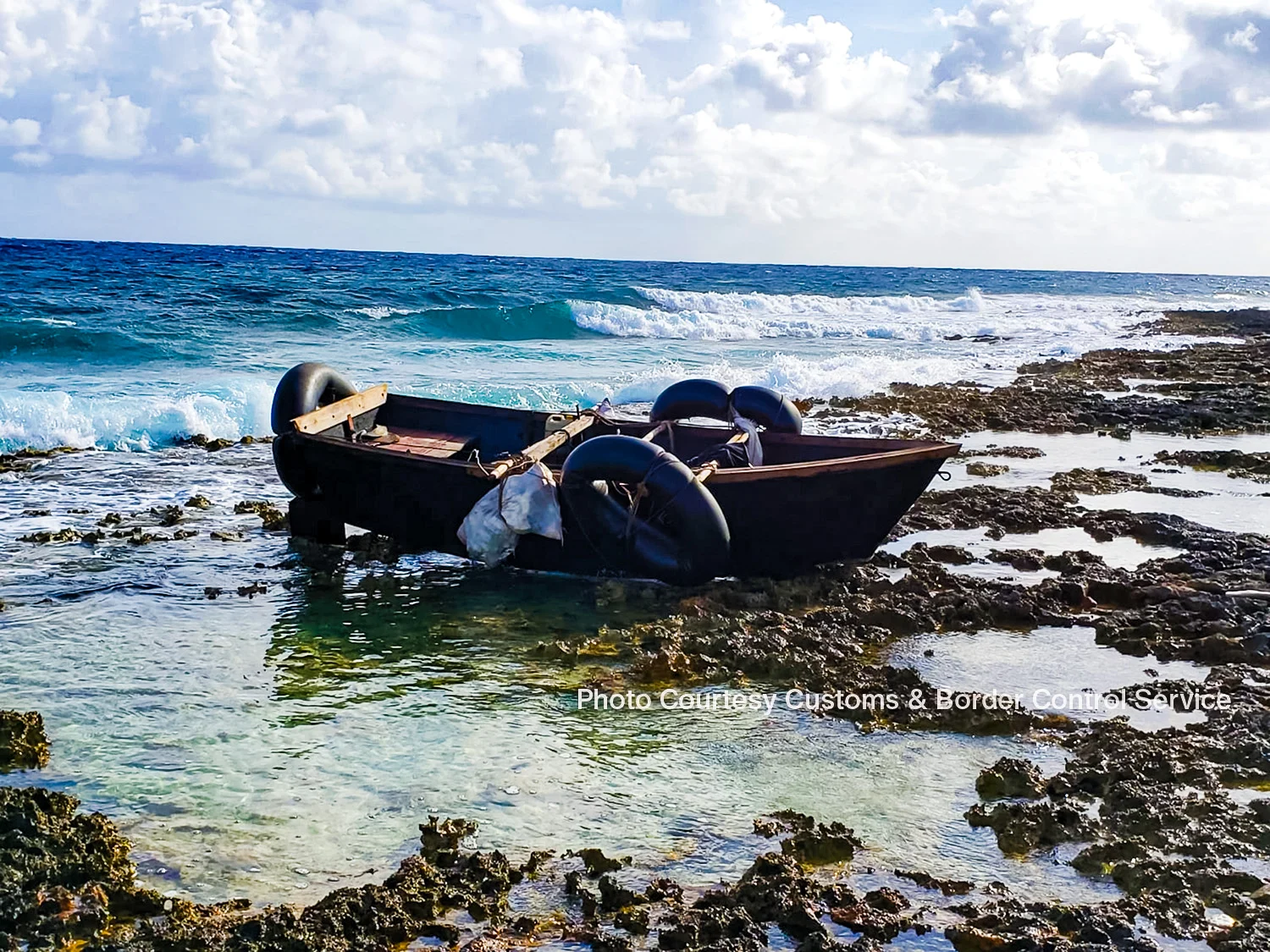
With nearly 100 people now under government management, local officials are reviewing contingency plans in case of an influx of people landing here illegally.
“In the event of local law enforcement agencies becoming overwhelmed due to a mass influx of migrants, assistance will be sought from other neighbouring British Overseas Territories through the Governor’s Office and/or the United Kingdom,” according to a Customs and Border Control Service press release issued Wednesday night.
Community and migrant safety
CBC Director Charles Clifford, said, as a proactive measure, CBC recently hosted a multiagency ‘Mass Migration Committee’ meeting to discuss contingency planning, as the number of people landing illegally increases.
Between March and April, 51 people landed illegally, the most recent being the arrival of 15 Cubans on the Brac on 24 April.
The Mass Migration Contingency Plan outlines the functions and responsibilities of the various government agencies, who all work together to provide a range of services including logistics, security and social services and welfare.
All persons who arrive illegally are also required to quarantine in accordance with Cayman’s COVID-19 protocols; upon completion of isolation they are transferred to Grand Cayman.
Additionally, Clifford said, together with the health and well being of the community, safety is also paramount.
“Ensuring national security is at the forefront of our work in processing migrants as we have an overriding responsibility to keep our residents, visitors and indeed the migrants safe,” he said.
Any arrival who has been identified as having a criminal background during processing, the statement said, may be separated from others for the purpose of determining the risk they may pose to themselves, any other person, or to the community in general.
Challenges
According to the CBC, at the end of 2021, $850,000 was spent on managing people who landed in Cayman illegally.
“A mass influx of migrants or refugees will inevitably present budgetary and national security challenges,” Clifford said, adding that the Mass Migration Contingency Plan can be activated once the CBC Detention Centre reaches 80% capacity.
Clifford explained the detention centre had recently been repaired and upgraded “to bring it to the standard deemed appropriate for its intended use”.
“While the numbers of migrants are not over capacity at the [centre], it was important to not wait until the situation became unmanageable to brief and prepare the Mass Migration Committee and by extension the agencies which constitute the Committee,” he said.
The CBC director said intercepting at sea will not change Cayman’s responsibility.
“[T]hey will still have to be processed in the same manner in accordance with the International Convention on the Treatment of Refugees,” he said.
The CBC pointed out that in mid-April 2017, a memorandum of understanding was modified and agreed upon by the governments of the Cayman Islands and Cuba, which defined time frames within which undocumented Cuban nationals would be repatriated to Cuba from the Cayman Islands.
Mass Migration Committee
Customs and Border Control (Chair), RCIPS, Cayman Islands Coast Guard, Workforce Opportunities and Residency Cayman, Ministry of Border Control & Labour, Office of the Governor, Office of the Deputy Governor, Department of Children & Family Services, Health Services Authority, Public Works Department (Grand Cayman and Cayman Brac offices), District Administration, Government Information Services, Hazard Management Cayman Islands, Cayman Islands Prison Service, Cayman Islands Regiment
Related Videos









I’d vote for prompt repatriation.