


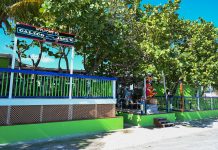
Dart’s Shoreline Development Company has applied for permission to modify parts of Calico Jack’s in anticipation of opening a beach bar/restaurant at the site – a proposal the Department of Environment is opposed to because the building’s seawall falls well outside the permitted high water mark setback limit.
Calico Jack’s shut in April 2020, after 15 years, as the island was in lockdown and the closed borders meant the bar’s steady flow of tourist customers disappeared. Owner Handel Whittaker told the Compass at the time that the bar’s lease had been due to expire at the end of the year, and he had taken the difficult decision to shut it down.
If the Central Planning Authority, of which Whittaker is currently the deputy chairman, grants permission for the modifications to go ahead, the bar could open later this year.
The site is owned by Dart, which is planning to modify the bar’s existing building façade and parking layout, and add a new restroom building.
In a letter to the Central Planning Authority accompanying its planning application, Shoreline stated, “With the return of tourism, our intent is to restore a signature destination beach bar and restaurant to fill a gap felt by both locals and visitors.”
It said it planned to open the bar in time for the 2022-2023 high season.
It added that the design “works within the existing footprint”, adding, “A primary design consideration is that the facility be a good neighbour and complement the activities at Seven Mile Public Beach without drawing upon its resources.”
The planning application, which will be heard at a CPA meeting on Wednesday, 11 May, includes the installation of a 6-foot-high wooden fence to enclose the kitchen area and support facilities.
Shoreline is also proposing including a pedestrian path from Calico Jack’s to its nearby Hotel Indigo development.
DoE opposes plan
However, the Department of Environment, in its submission, recommended that the Central Planning Authority refuse the application, and urged Shoreline to remove the existing seawall and instead build a more sustainable structure on the site.
The DoE noted that minimum coastal setbacks for hotel/tourism zones, under the Development and Planning Regulations, state that a coastal setback of 130 feet from the mean high water mark is required.
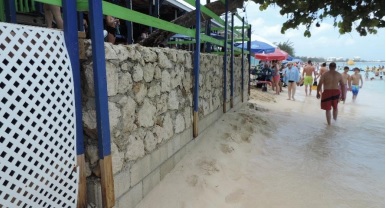
“Despite this, the proposal includes the renovation of the existing building, which was the subject of a lapsed temporary building permit (the current status of which is unknown to the DOE) and part of which is a seawall that was refused after-the-fact permission,” the DoE stated, adding that the seawall was measured as being 29 feet from the high water mark, “amounting to just 22% of the required minimum setback”.
The DoE said it was “extremely concerned” about the continuing impact of a seawall not meeting coastal setback requirements, especially as it is located next to Public Beach.
It noted, “The existing site has experienced instances of erosion in the past. With a proposal for redevelopment, the applicant now has the opportunity to build in a more sustainable and climate-resilient manner, future-proofing the current structure.”
In its response to DoE concerns about the seawall, Dart stated that after it had reviewed historical CPA decisions for this property, it found that the planning board had subsequently approved a request to re-instate planning permission for the restaurant/bar and for after-the-fact additions, and that “as part of their decision, CPA did not condition the need to obtain permits or Certificates of Occupancy”.
The company also contended that the issues raised by the DoE were not part of the application, which only deals with modifying the interior of the existing building, and therefore “do not constitute or contribute to a material change in the use of the building”.
According to Shoreline’s plan, the bar/restaurant will undergo internal changes only, and its existing floor and roofed areas will not be expanded.
The company stated that the only elements of its proposal that require planning permission are the alteration of the building’s north façade, the restroom block, and the 6-foot fence, so “if the application were to be refused, renovations to the bar and restaurant could move
forward subject to obtaining applicable permits”.
DoE directives
As well as recommending that Dart submit a revised plan removing the seawall, deck and seating section from the area surrounded by the not-permitted seawall on the beach, the DoE advised that no construction work, vehicle access, storage of equipment/materials or other operations should take place on the beach during turtle nesting season, between 1 May and 30 Nov., “without the express consent of the DoE”.
The DoE, under authority delegated to it by the National Conservation Council, also issued two directives to the board in relation to the planning application. Those stipulated that all construction materials and debris be stockpiled at least 50 feet from the mean high water mark to prevent material entering the marine protected area; and that screens must be installed to catch any construction-related shavings, foam waste or polystyrene debris to prevent those entering the sea.
Directives issued by the NCC to the board were considered to be binding under the National Conservation Act, but after the Central Planning Authority last year ignored a DoE directive not to approve an application to rebuild a seawall at a cabana on Boggy Sand Road, a judicial review is scheduled to get under way next month into whether the NCC has the power to influence a planning board decision.
Related Videos








There are rules and regulations in place to protect the Island and the environment. Everyone must be expected to abide by them – no exceptions!!
We need something like Calico Jack Beach/Bar restaurant for tourists and mostly for Caymanians to enjoy with quality facilities for them to enjoy all year. But do not forego the need to prevent further erosion of the beaches. Why not offer Dart to move the facility back to meet the high water setback limit thereby showing to all future builders that it is important for the future of Grand Cayman to adhere to their plans to prevent further erosion.
To entice developers and builders, like Dart, to spend the funds to meet the new coastal requirements why not show to them that the government will allow them to have – for example more beach area for their Hotel Indigo or something like that. The overall primary goal is to establish, with no pun intended, a ‘line in the sand’ that all builders and developers must meet to protect against future reach erosion.