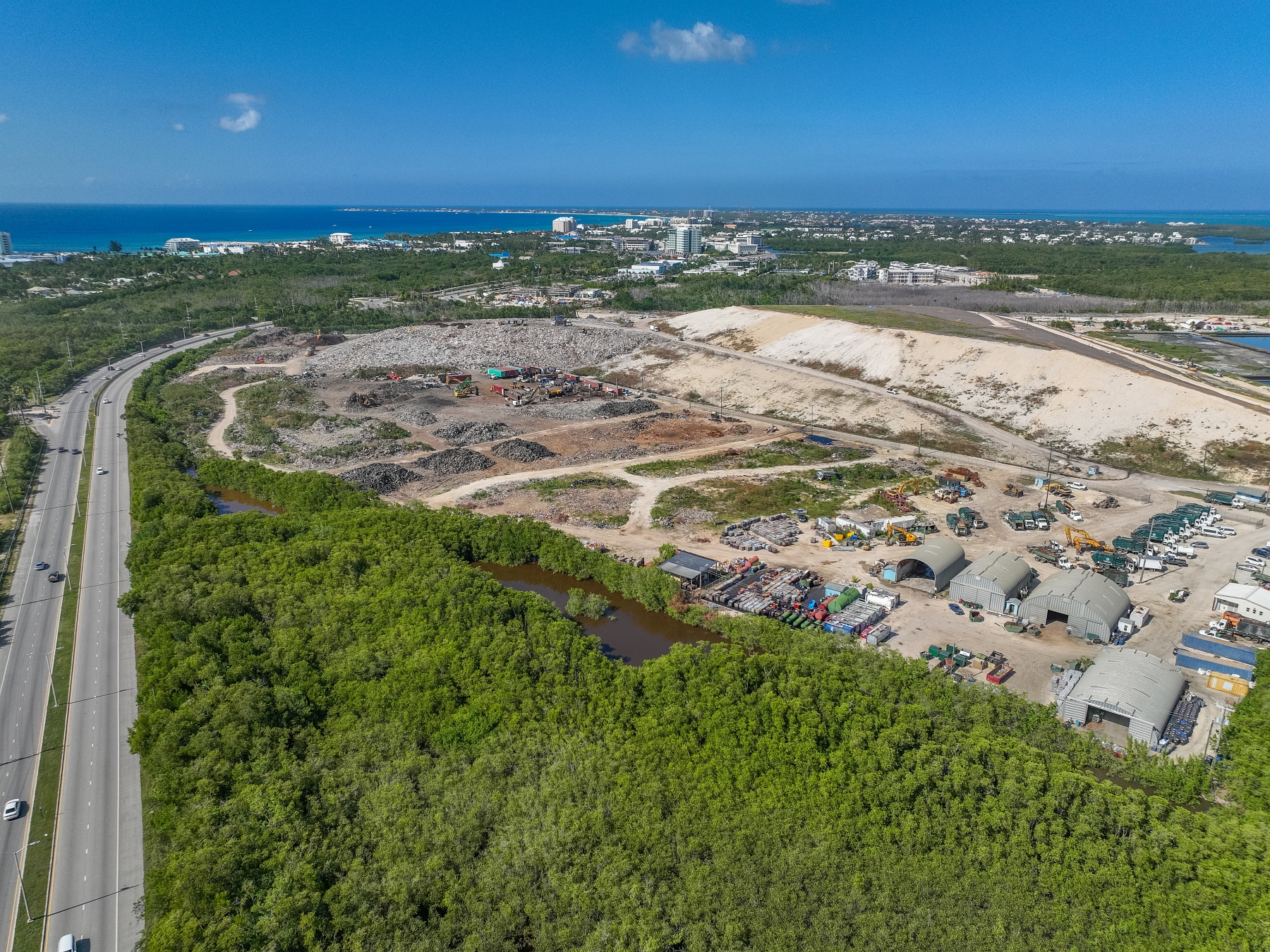
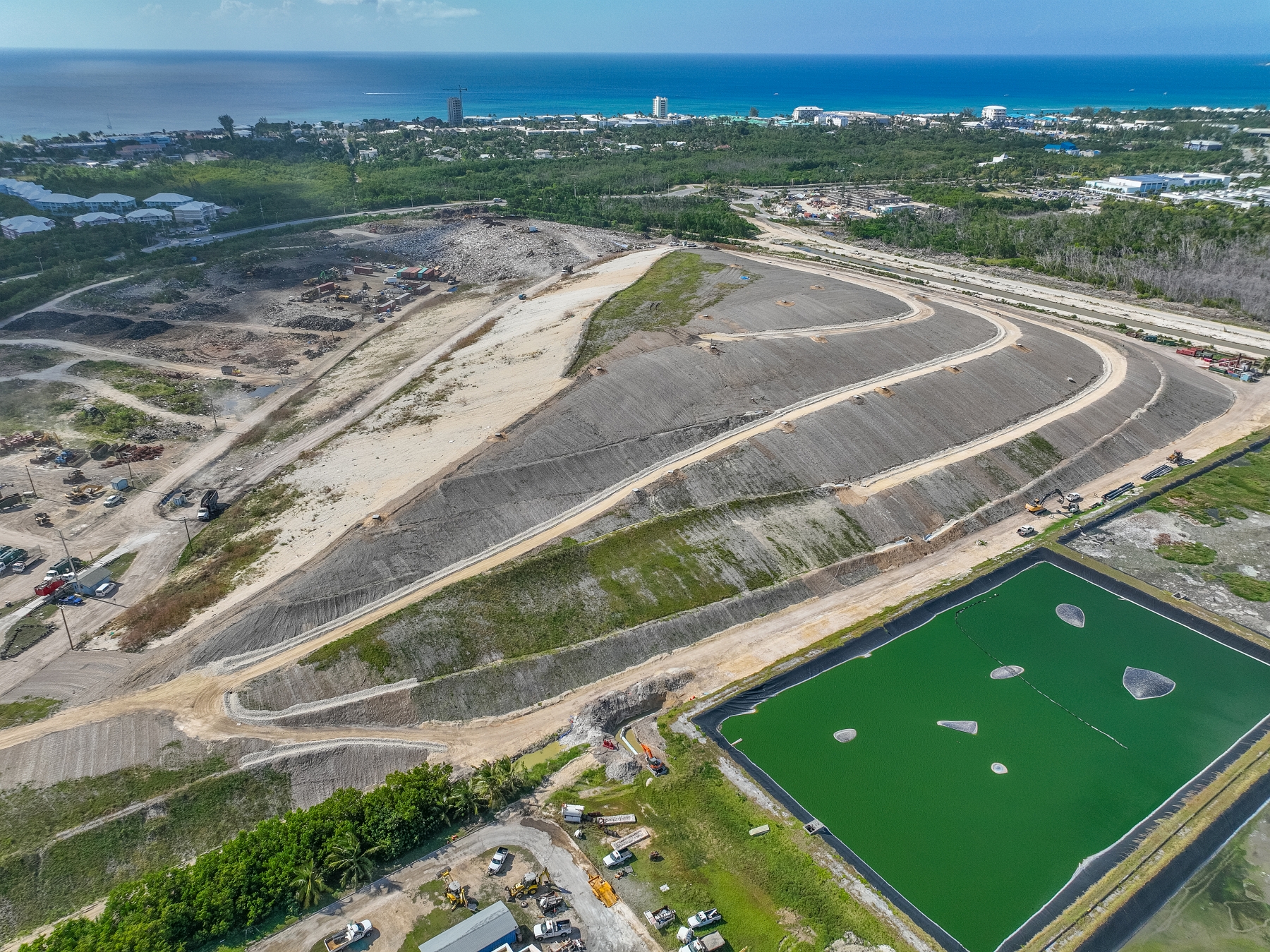
A plan to replace Cayman’s landfill site with a suite of waste-to-energy and recycling facilities had snowballed into an “unaffordable deal” that risks “bankrupting” the country, former Finance Minister Chris Saunders has claimed.
A Compass analysis points to a sizeable and unexplained discrepancy in figures being quoted around the project’s final cost and exactly how much it has escalated during the lengthy negotiations spanning two governments.
But there is deep concern among government accountants about the impact of the 25-year deal. At the same time, those issues are being counter balanced by a practical reality that the landfill is running out of space and there are few alternative solutions.
Now, Saunders has called for the ReGen agreement, which was initially announced in 2017 but has yet to be finalised, to be scrapped and for a new bidding process to begin.
Over the past six years, he said, the deal had changed so substantially that it was now a different and significantly more expensive project that needed to be put back out to tender.
Saunders estimates Cayman’s waste management costs, including repayments to the Dart-led consortium to build and operate the new facilities, would run to more than $2 billion over the next 25 years. While there is some pushback about that figure, there are significant concerns around the affordability of the project.
Citing Ministry of Finance budget forecasts, Saunders told the Compass the deal would saddle government with significant annual expenses that would exhaust its cash reserves within the first few years of the project. He said the project – as currently envisaged – would mean Cayman is unable to comply with the Framework for Fiscal Responsibility and risks losing control of its own budgeting process to the UK within just a few years.
He accepted there was some urgency to deal with the islands unsightly landfill, which remains a serious fire hazard as well as an aesthetic and environmental risk.
But he insisted he could not sign off on the deal.
“We are trying to buy a Rolls Royce when a Toyota will do the job,” he said.
Saunders has also urged the government to release a value-for-money analysis conducted by the Auditor General in December, 2021, suggesting its findings would support his position. The auditor has said she cannot release the report until the deal is signed.
Deal would mean Cayman couldn’t comply with FFR
As it stands, the ReGen agreement would mean government would be unable to comply with the Framework for Fiscal Responsibility – a set of legally-mandated constraints that limit how much debt government can incur and specify how much cash reserves it should have on hand.
Saunders said his team at the Ministry of Finance had crunched the numbers on six different scenarios that would have made the project more affordable, and none of them resulted in Cayman being able to comply with FFR standards.
Most critically, he said government was projected to run out of cash reserves by 2027, meaning it would need to borrow money to fund its daily operating expenses, including civil servants’ wages.
Even with substantial cuts to government spending and optimistic revenue projections, he said the deal would not work.
“We do need to sort out the dump but I am not prepared to bankrupt the country or risk the UK taking control of our budget to make this deal happen,” he said.
Under the FFR regulations, if Cayman falls out of compliance with a number of key financial governance measures, the UK can assume oversight of the islands’ budgeting process.
Saunders added, “My team looked at a number of scenarios and none of them work. There is no scenario where this is compliant.”
He added that, as well as being mandated by law, the framework regulations, were designed to keep Cayman on a sound financial footing.
“Imagine if there is another COVID, or a hurricane and we don’t have the money to help our people,” he said.
The former Finance Minister added that his dispute with Premier Wayne Panton over the ReGen deal was one of the reasons behind his departure from the PACT government. Panton has suggested Saunders was asked to resign over his own “conduct” but has not given specifics.
Official silence
The premier didn’t respond to questions from the Cayman Compass on the ReGen deal or on Saunders’ comments.
Jennifer Ahearn, the Chief Officer in the Ministry of Sustainability and Climate Resilience, also did not respond to our questions.
Representatives of the Dart group, which leads the private sector consortium negotiating the deal, said they could not comment.
‘Apples and oranges’
There are some question marks over the $2 billion figure, first quoted by Saunders in a widely circulated WhatsApp message on Monday. That figure appears to include other costs, not directly associated with the ReGen project.
Panton, speaking via social media on Tuesday, said Saunders was “mixing apples and oranges” in his missive, which encouraged people to compare the $2 billion cost estimate with originally published forecasts.
Panton said, “The project is likely to cost in excess of $1.5 billion over 25 years but that is not unexpected.”
He suggested earlier figures quoted for the cost of the project reflected construction costs rather than a 25-year estimate for its lifespan.
But he did not give any ‘apples for apples’ comparison that would demonstrate or explain the cost escalations.
In a video presentation from March 2021, when the preliminary deal was agreed, Peter Ranger, who at the time was Chief Project Manager in Government’s Major Projects Office, said the construction costs of the suite of facilities would be $205 million, financed by Dart.
This would be repaid by government once the facilities were up and running at a rate of $163 per ton of waste processed.
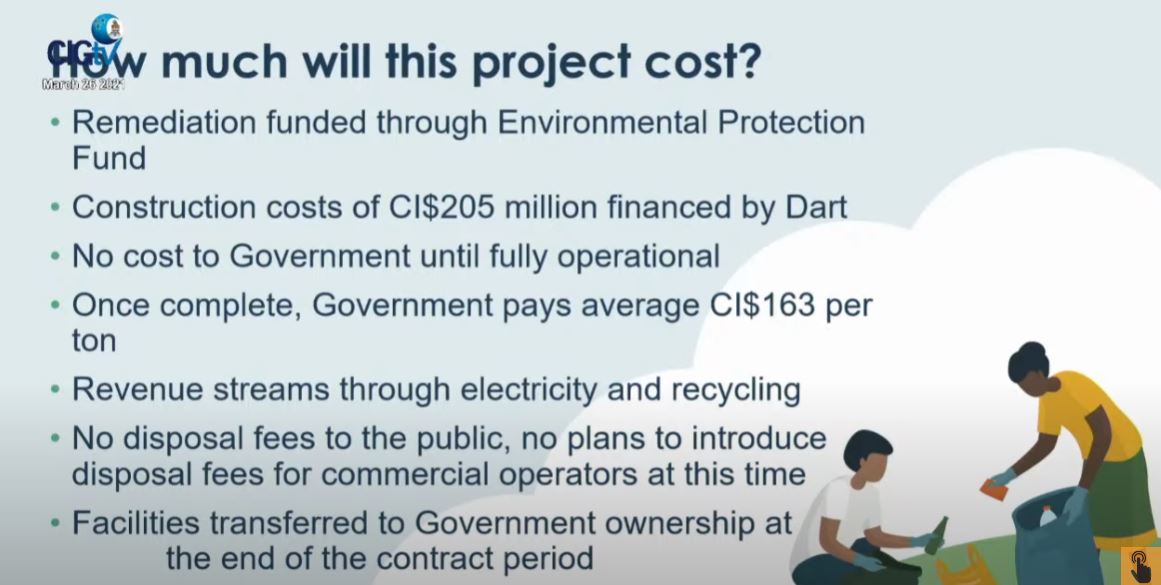
Assuming an average of 150,000 tons of waste (a significant increase on the 130,000 tons that goes into landfill right now) for the life of the project, that would have been $24.45 million per annum for 25 years – just over $600 million for the life of the project.
While there remains some doubt, that no-one involved in the deal has been prepared to publicly clarify, about the comparability of the figures quoted, there appears to be deep concern about the affordability of the project within government.
Multiple sources told the Compass the costs of the deal had escalated quite significantly though not to the extent suggested by Saunders.
However, it is broadly accepted that inflation, supply chain issues and economic turmoil has made the entire project a more expensive proposition that would put a strain on government finances for years to come.
Opposition: ‘Show us your figures’
Leader of the Opposition Roy McTaggart said he was puzzled by the numbers now being quoted and urged government to “show us your figures”.
McTaggart, who was Finance Minister in the last government, was not personally involved with negotiating the landfill deal.
But he insisted his government had left an affordable and workable deal, that would have cost government around $25m a year for 25 years, that just needed to be closed.
He said he couldn’t understand how or why the costs could escalate to the $2 billion figure given by Saunders.
McTaggart added that some transparency was now needed around what changes had been made to the project and the cost assessment.
He said Cayman’s landfill problem needed to be resolved, one way or another.
“There’s no other alternative on the table. I would have to see the details because I struggle to understand how the scope could have changed that much to justify those figures being quoted.
“People have been poring over these numbers for some time. It behooves all of them to put the figures out there for all to see.”
Panton, appearing on government radio on Monday, said the ReGen deal was close to being signed.
“The ReGen project is moving forward and we are very close to being able to finalise that,” he said.
Saunders released his own WhatsApp message to constituents Monday, saying he was seeking to shed light on the differences between himself and the Premier.
In that message, he cited an Auditor General’s report from December, 2021, which he urged the premier to release to the public.
“If the report is released to the public, you will know the truth and everything will be made clear to you,” he said in his message.
“My Friends, let me be absolutely clear. The last set of numbers that I saw makes this project unaffordable for the public purse and there is absolutely no way I would have signed off on that project when I was Minister of Finance,” he said.
“I see that there are already efforts in the public domain to promote that project and I implore you to reach out to your Members of Parliament and insist the Government does not move forward until the country knows the full costs.”
Asked to clarify how the $2 billion cost had apparently escalated from around $625 million, Saunders said he was “asking the same questions”.
Multiple sources indicated deep concern about the costs of the project within the Ministry of Finance, particularly estimates that show it will make Cayman non-compliant with FFR.
Saunders said he was advised that government would struggle to come up with a fiscal plan that could make it compliant without cutting its expenditure or raising taxes.
He argued that the deal now needed to be spelled out in black and white for the public and the Auditor General’s report released.
Auditor General Sue Winspear told the Compass she could not release the report until the final contract was signed due to “commercial sensitivities”.
“As the report will be so dated when it is eventually published, we intend to also complete and publish alongside it a short follow up report comparing what we recommended back then with what is in the final contract,” she said.
Related Videos