

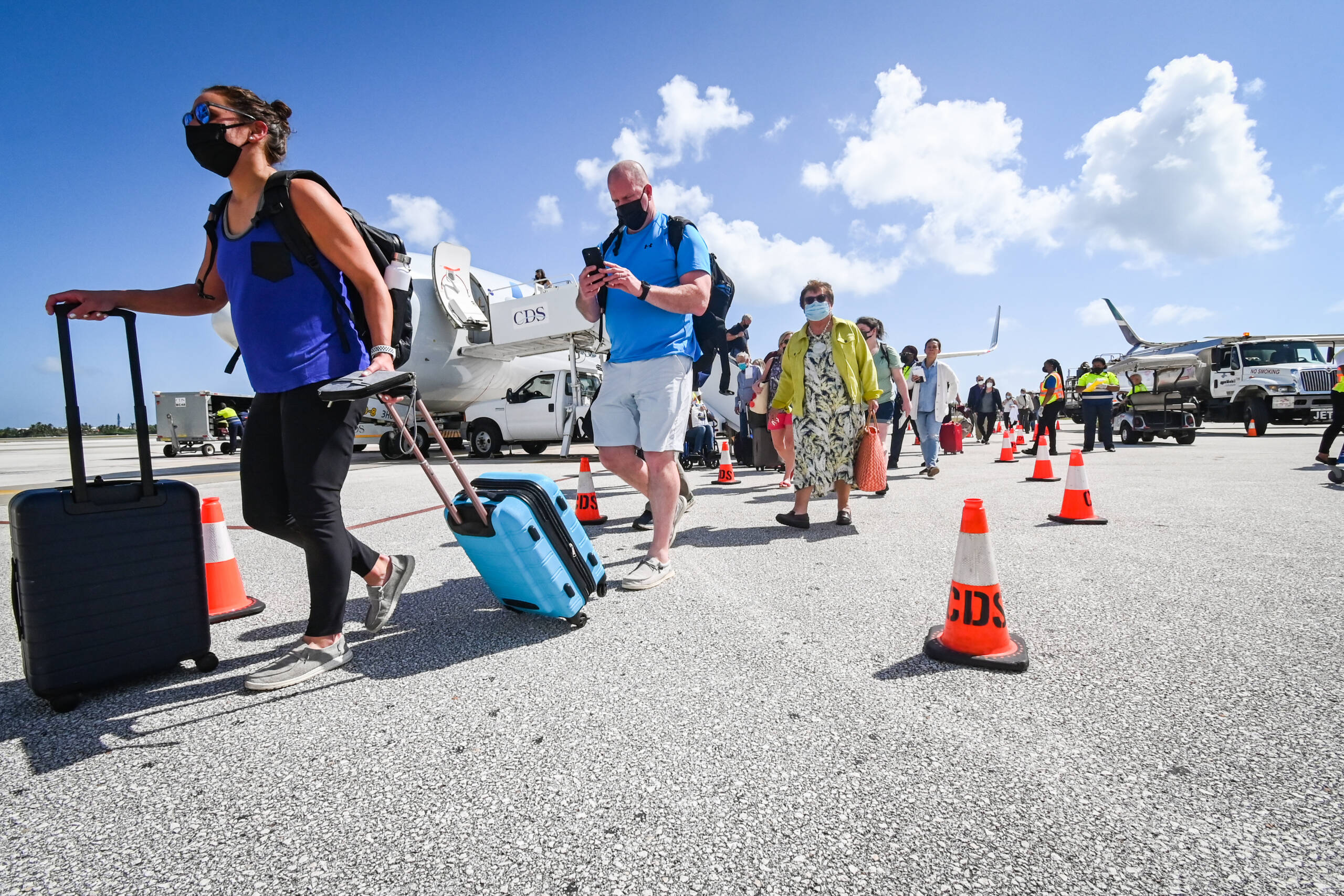
As airlines tackle staffing shortages, the rising cost of fuel and increasing airport fees, there are fewer seats and more expensive fares for travellers seeking to escape to sun destinations like Cayman, tourism officials say.
Airlines operating out of the US especially – Cayman’s largest market for incoming visitors – are battling to recoup inflation-driven expenses like aircraft fuel, while trying to hire and train enough pilots to operate their planes and recover from almost two years of effectively being grounded because of COVID-19.
According to a recent report by the US Bureau of Labor Statistics, airfares increased by 18.6% in April compared to March, the largest one-month increase since the bureau began taking records in 1963.
Along with the rocketing prices, there have been far fewer seats up for sale this year, compared to pre-pandemic levels – creating a problem for vacation destinations, such as Cayman – resulting in a lower number of visitors and fewer bookings across the board.
Statistics from the Centre for Aviation point to 70% of airports – 303 – across the US reporting either a loss of all service or reduced departures in the first quarter of 2022, compared to the first three months of 2019. Nine of those airports lost all air service.
Although US-based airlines began resuming regular flights to Cayman in November last year, a number of them delayed reintroducing their Cayman services until February and March this year, meaning even if tourists had wanted to come to Cayman during the busiest part of its high season, from December to February, they could not get here.
“We didn’t see the full potential of our high season,” Wendy Moore, the accommodations director of the Cayman Island Tourism Association, told government officials and fellow association members at a half-year CITA meeting on 1 June.
She is hoping the summer months will be busy, and acknowledged that a large percentage of summer guests come from Texas, “but with very limited direct flights, we’re missing out on a lot of those”.
Mounting challenges
Director of Tourism Rosa Harris, in her presentation at the CITA meeting, said that while a strong recovery is under way, “challenges are mounting” in the airline industry, as jet fuel prices continue to rise, inflation is high, and several airlines are “facing pilot shortage, historical levels of attrition, and training bottlenecks”.
Harris said higher fares could temper demand, especially with airlines operating with “capacity discipline”, meaning they are not adding more seats because they want to keep prices high.
“That’s a challenge for us as a premium destination if we’re not competing as well as we could be, because we don’t have enough seats available,” she said, noting that travellers tend to first book their flights and then book their accommodation.
 Citing Sabre Market Intelligence data, Harris noted that, as of May this year, the number of airline seats available to book to come to Cayman was at 80% of pre-pandemic numbers.
According to the data, the number of seats available will only return to 2019 levels in September this year.
“Carriers are working to keep capacity in check,” Harris said, while also noting that the appetite for international travel is “huge right now”.
Airline seat capacity
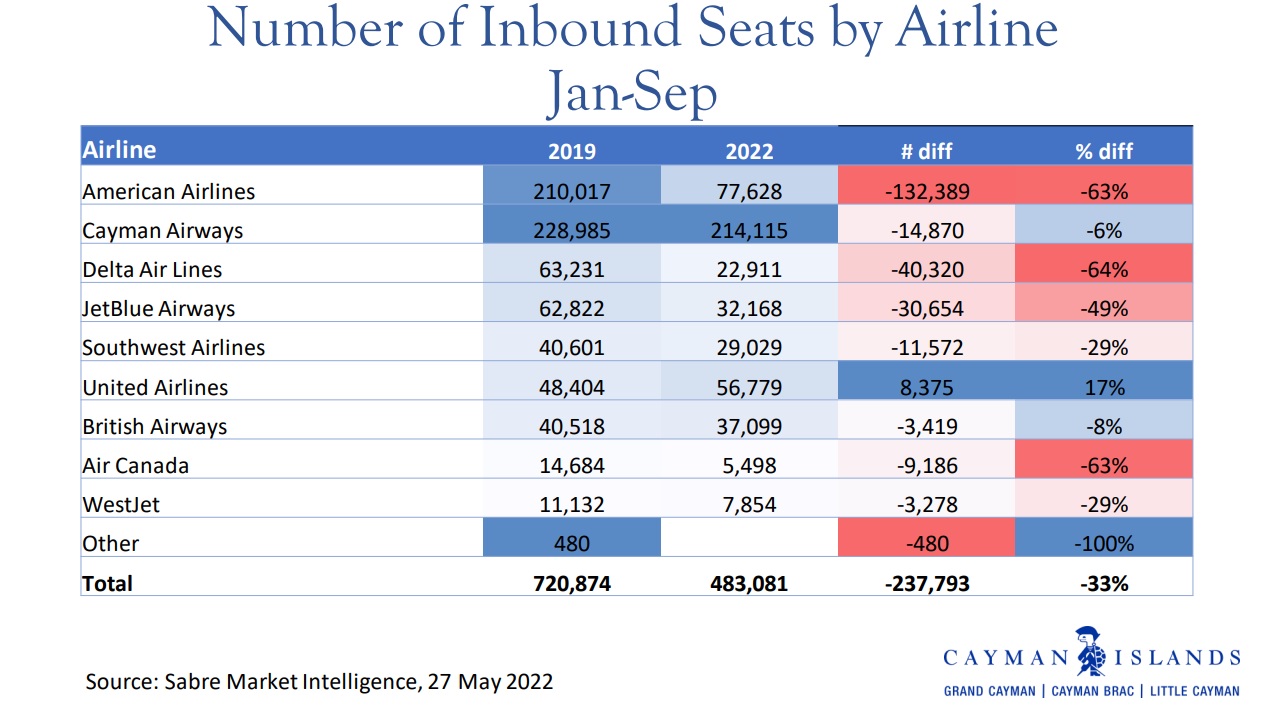 A breakdown of the number of seats available on each of the airlines currently serving the Cayman Islands between January and September this year, shows that capacity on Cayman routes was down more than 60% on American Airlines, Delta and Air Canada compared to the same period in 2019 – which was a record year for stayover tourism in Cayman.
American Airlines resumed its routes to Cayman in February, Delta returned in March and Air Canada began flying here again in early May.
Cayman Airways, the islands’ national carrier, has seen a decrease of 6% in the number of inbound seats available in the first nine months of this year, compared to pre-pandemic numbers.
The only airline which saw an increase in capacity was United Airlines, which shows a 17% rise in inbound seats between January and September this year. United resumed its operations to Cayman in February, with flights from Newark, Washington (Dulles), Chicago and Houston.
Even with the resumption of flights, several airlines have reduced the number of flights per week that they offer, though this may change as the high season nears and demand grows, industry members say.
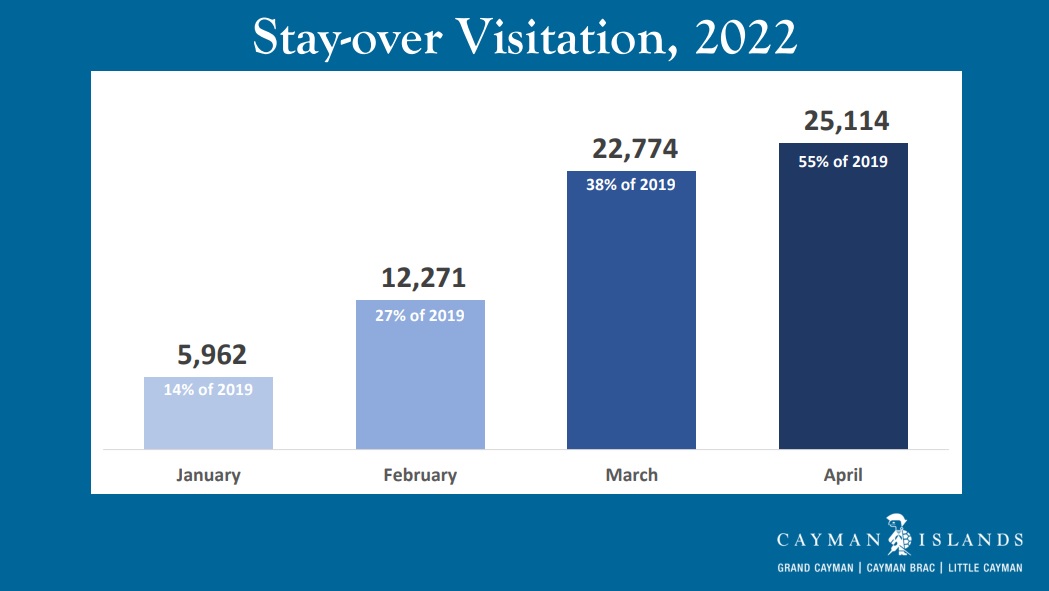
Since the start of the year, the numbers have been increasing month on month. Airlift numbers in January were at 30,921 passengers, or just 35% of January 2019’s levels. By March, that had increased to 55%, rising again to 76% in April. In May, it was at 80% of the 2019 figure, equating to 59,928 seats for the month.
Travel ‘last sector’ to return to full strength
The travel industry has been slowly returning to its feet ever since COVID-19 vaccines began rolling out in late December 2020, but it’s been a long-haul battle.
Deloitte, in its 2022 Travel Outlook report, noted, “Still, travel will likely be one of the last consumer sectors to see demand return at full strength. Pandemic concerns continue to curtail some plans, especially for international and corporate trips.”
While it make take some time for corporate travel to return to pre-pandemic levels, remote working is offering new opportunities for the tourism sector to cater to “laptop-lugging” travellers with “above-average buying power, greater flexibility on travel dates, and a unique set of needs”, Deloitte noted.
Harris echoed this in her presentation to CITA, urging local industry chiefs to note this development and target that demographic.
She said Cayman’s Department of Tourism has three offices overseas, in the US, Canada and the UK, and is in frequent talks with the airlines that serve Cayman, informing them of new tourism initiatives and developments.
“In these regular calls, we talk about what routes we want to prioritise, what do we need to do, what marketing we need to support,” she said, adding that the department was hopeful that the winter schedules will be “healthy”, but those have not yet been released.
A lack of information on how many seats will be available in the winter months to bring travellers to Cayman is concerning to the local hotel industry.
CITA president Marc Langevin, who also represents the association’s hotel sector members, said, “The problem is, people make their decisions far in advance,” and he’s worried that if travellers cannot book their winter trips now, they will look elsewhere.
DOT hires aviation consultant
The Department of Tourism has hired aviation consultant firm ASM to help it develop its air service networks and global aviation strategy.
Harris said, “They help us with a lot of business intelligence to talk about whether it’s distressed seats [seats in danger of remaining unsold], or how fuel prices are going to affect the industry, or what can we expect. Usually when there’s something new and developing, we’ll hear it first from them.”
Related Videos










Won’t return until Cayman gets like the rest of the civilized world.
Remove the portal. Get rid of the masks. Dump the testing before arrival.
It really is super simple. Until this is done, Mexico, USVI and Turks will get our tourism dollars. Christmas plans already made in Turks.
It’s a Catch-22. Until the outdated pre-arrival tests are dropped, less visitors will book. Less bookings = less airline seats to be made available. This article is essentially blaming the airline industry when the over-cautious Cayman Government is the body holding back progress. The US & UK have dropped pre-arrival tests. Cayman should act quickly to compete with other Caribbean nations who are goggling up our missing tourists.