As an educated and ambitious young woman, who has seen older female colleagues locked out of leadership roles, Jane is concerned that gender politics still plays an outsized role in Cayman firms.
Looking back over her legal career Jane admitted initially she was not worried that being a woman would hinder her progress, but six years later that view has changed.
Jane, not her real name, spoke to the Compass on condition of anonymity, as census data reveals women are still outnumbered in the highest paying roles in Cayman, despite female students having consistently better education results than male students.
When she started her career, she says she naively believed she would have the same chances as her male counterparts.
While she says her base salary and benefits are on a par with her male counterpart, she believes she had to work twice as hard and twice as long to get to a managerial level.
“Six years ago in my career [when asked] did I really feel different as a woman in the workplace? I always said ‘no way’, but I 100% disagree with how I felt [then]… I feel completely different now, just being a little bit less naive,” she said.
“You have to really work hard to get into that conversation (about promotion)… that’s probably been the hardest part.”
She believes businesses are starting to pay attention to the problem but have not yet done enough.
“I think you would not walk into leadership at any company and say that they’re not thinking about it or they’re not concerned about it, but I don’t know if there’s enough action happening… It takes a lot of planning and a lot of very deliberate action in order to really make the impact to solve [gender equality issues]. It’s a longstanding issue that we have,” she said.
Her belief is not without basis. Census data shows a pay gap between men and women across Cayman.
While that may reflect different job titles and categories, the data also shows that women are under-represented among the highest earners on the islands.
Advocacy groups and government officials agree the issue must be addressed.
Men outrank women
Jane’s observation is no different than the ones noted by a number of local women’s groups and women in the workforce who experience that lack of action on a daily basis, whether it be in terms of equal pay or equal opportunity.
Statistics from the 2021 census show women’s annual wages are on average almost $4,500 less than men.
Men earn an average annual salary of $51,724, and women $47,241. However, this difference is much more pronounced among expat workers ($48,450 vs $41,248) than among Caymanians ($56,586 vs $54,094,) based on the mean income released in the national population count.
In addition, more men hold managerial positions than women, according to the census, which lists 2,716 men as managers, compared to 2,203 women in those jobs.
Women overall are overrepresented in the lowest-paying jobs and underrepresented in the highest salary bracket, in particular the $100,000-plus-a-year income category.
While women make up 47.1% of the workforce, at the very top end of the pay scale they only present 37% of employees. And at the bottom end of annual salaries below $14,400, they outnumber men by a ratio of 2 to 1.
Gender Equality Act review
Karlene Bramwell, of the Gender Affairs Unit, says a review of the existing legal framework, including the Gender Equality Act, is scheduled to commence before the end of 2022.
“The Gender Pay Gap continues to be a challenge faced by many countries worldwide. There are a number of theories and arguments, as well as research that continues to be conducted on the root causes of the issue. It is clear that in order to address this complex issue, it must be tackled from various angles and involve several stakeholders including the government, businesses and members of the community. Intervention plans must take a holistic approach, as there is no one ‘quick-fix’ solution,” she said in her emailed comment.
Bramwell said the Unit intends to further analyse the recently published 2021 census data “utilizing a gender-lens perspective”.
Cayman gender survey
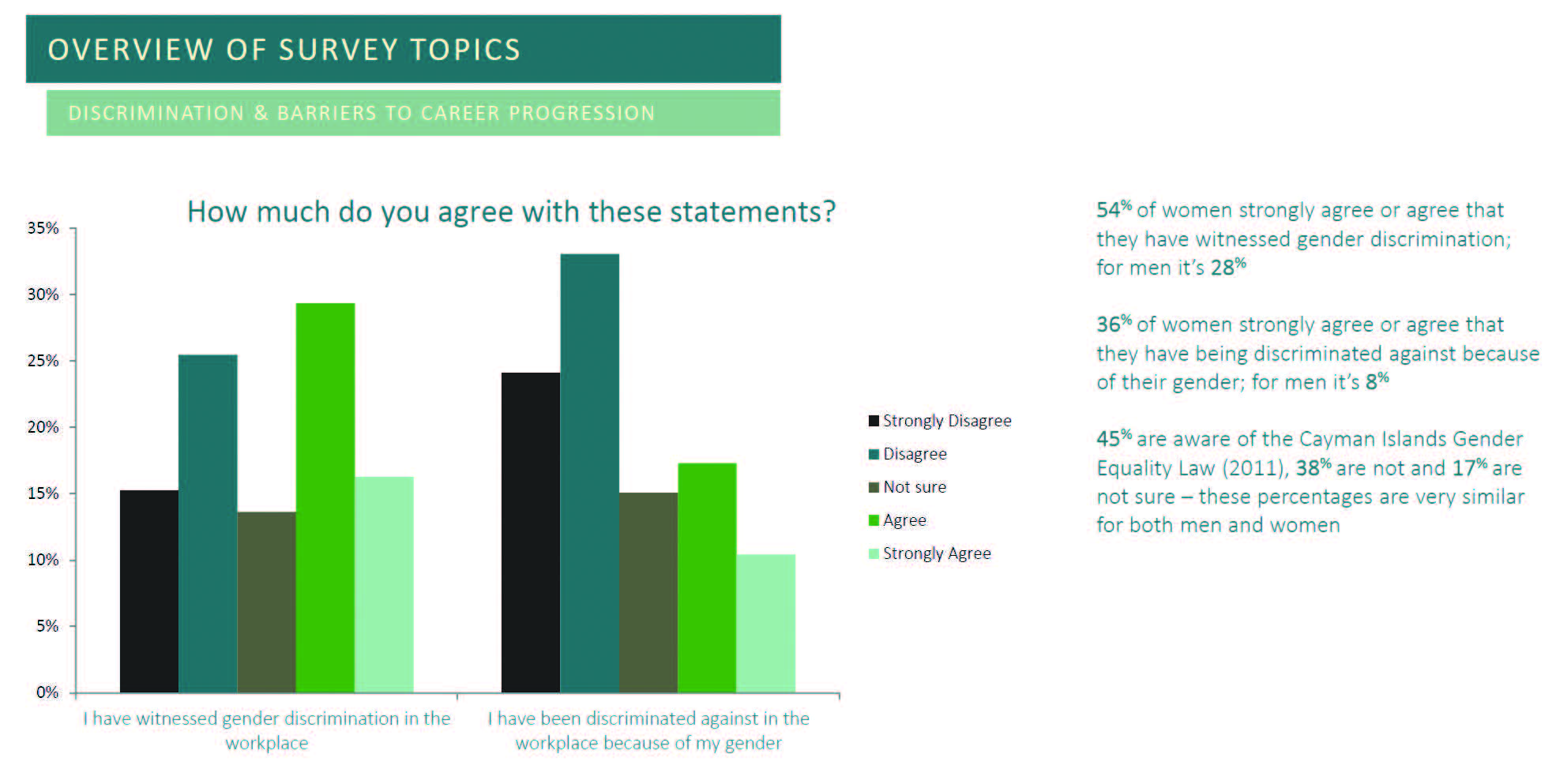
Non-profit Gender Equality Cayman conducted a survey of Cayman businesses last year.
For 67% of the 1,600 respondents, the most senior person in their organisation is male; for 32% it was female, with 51% having a male line manager and 48% having a female line manager.
According to that survey, “significantly, more men think they and their colleagues have the same career opportunities regardless of gender, compared to women… 76% of men agree with this but only 51% of women do”. When it came to promotions, slightly more men (21%) had been promoted in the last year (2020) than women (17%).
“Similarly, 33% of men have had a promotion in the last 2-5 years, compared to 31% of women,” the survey found. The survey concluded that ‘gendering’ of roles was common in Cayman, with doctors, lawyers and financial executives most likely to be male.
Change starts with opportunity
Jane believes that for Cayman to move forward on this issue, there needs to be more opportunities for people early in their careers and more encouragement for women.
“You have to start really developing and retaining talent young, so that you can have that pipeline of more senior members of management being female.”
She believes it is lonely at the top for female managers and there are fewer role models for aspiring leaders like herself.
“I think that’s really hard too from a woman’s perspective,” she added, “because there aren’t as many [women managers], so you just don’t have that kind commonality that you can share. That I’ve certainly felt.”
Related Videos