
Caymanians are earning more on average than expatriates, although the data is heavily skewed by an influx of foreign labour to fill in the lowest paying sectors.
An analysis of the Cayman Islands’ census data shows a majority of foreign workers in both the highest and lowest income bracket. In every other pay bracket, there are more Caymanians earning higher wages.
The trends emphasise two major types of immigration – white collar executives for Cayman’s finance industry, and servers and labourers to keep tourism and construction running. Meanwhile, Caymanians dominate in middle-income jobs, like the civil service.
In general, the data reveals a labour market that, for many of the trends, is divided into Caymanian and non-Caymanian workers. There are vast differences between the two groups in terms of salary, occupations, unemployment and gender salary gaps.
Caymanians outnumbered in the workforce
Caymanians make up only 45.2% of the 47,120-strong workforce.
A look at the population’s age structure shows why Cayman’s labour market is so reliant on foreign workers.
There are fewer Caymanians in the age cohorts of people in their 20s, 30s and 40s – which makes up most of the workforce – than there are Caymanians in their teens or 50s and 60s.
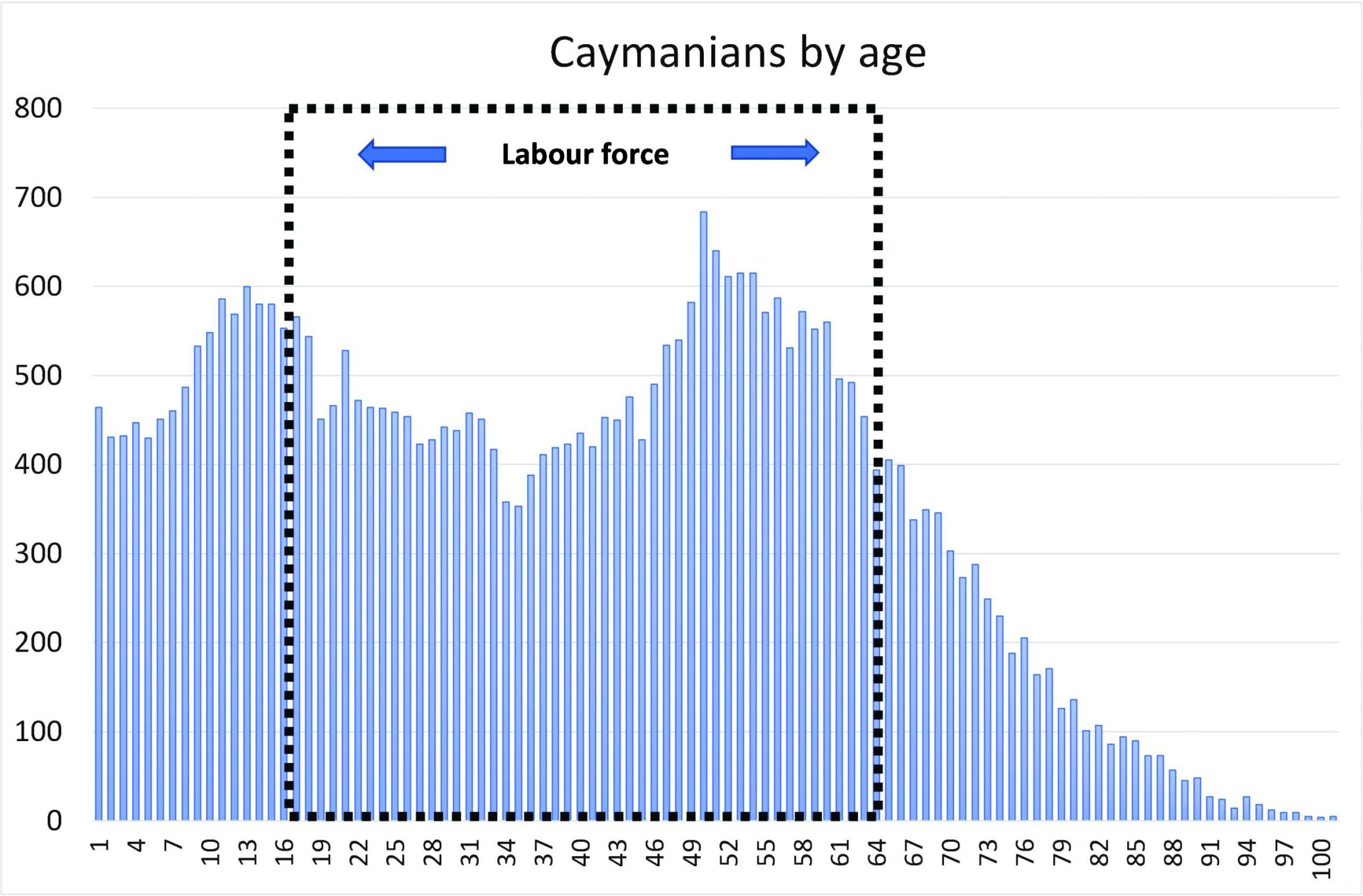
Politicians and business leaders have often argued that a workforce made up solely of Caymanians is not large enough to sustain and deliver all the services that are needed or desired.
This has a significant effect on the number of foreign workers that are brought to the islands and the types of jobs they occupy.
Expats dominate low-income jobs
Expat workers outnumber Caymanians in the lowest income brackets of up to $28,800 per year by a ratio of more than 3 to 1, compared to a 1.28-to-1 ratio for the total labour force.
In contrast, Caymanians are more strongly represented in the higher-paying wage categories between $43,200 and $100,800.
Only in the highest salary band, non-Caymanians outnumber Caymanians, albeit at a lower level (52.5%) than in the labour force as a whole (54.8%).
As a result, the average earnings for Caymanians are higher at $55,320 compared with $45,258 for foreign workers.
The difference in median salary, which indicates the point at which half of all people
earn more and the other half less, is even more pronounced.
The median salary among Caymanians is $45,594, 46% more than the $31,194 median salary for non-Caymanians.
The difference between the median salary ($35,994) and the average salary ($49,611) for the population overall is so high because the average is skewed by a relatively large minority pulling in six-figure salaries. Almost 9% of the workforce, or 3,921 people, earn in excess of $100,000 per year. The number may in fact be larger, as 2,153 people did not state their salary level during the census.
Gender income differences
The average salary for men is $51,724, while the average salary for women is $47,241.
The difference is much more pronounced among expat workers ($48,450 vs $41,248) than among Caymanians ($56,586 vs $54,094).
This does not necessarily mean that women are paid less for the same types of jobs.
Presenting the results, Deputy Premier Chris Saunders referred to the differences in earnings by gender and nationality within the same industries, stating that, “While I am aware that there may be positions with different levels of seniority; nonetheless we need to make sure that it is indeed based on seniority or type of role, and not anything else.”
Although gender discrimination cannot be excluded, the data shows that overall pay differences are predominantly a reflection of different employment structures not only between men and women but also between Caymanians and foreign workers.
Women overall are overrepresented in the lowest-paying jobs and underrepresented in the highest salary bracket, in particular the $100,000-plus-a-year income category.
While women make up 47.1% of the workforce, at the very top end of the pay scale they only present 37% of employees. And at the bottom end of annual salaries below $14,400, they outnumber men by a ratio of 2 to 1.
Men on the other hand, especially male foreign workers, are dominating professions in the medium- to low-wage categories between $14,400 and $43,200.
In contrast, Caymanian women outnumber Caymanian men in medium- to high-income categories between $43,000 and $100,000 per year. Overall, this trend is still visible but less strong, with women more heavily represented in the $57,600 to $86,400 salary brackets.
This can, in part, be explained by more women having attained degree level, post-secondary education.
Although just less than half of the population over the age of 15 are female, women represent 56.8% of all people with an associate degree, 55.2% of Bachelor’s degrees and 56.2% of Master’s degrees.
In some industries, for example construction, this translates into higher average earnings
for women, because they are employed in roles that require higher education.
While this makes the lack of women among the top earners all the more glaring, it may
be an indication of a general underrepresentation of women in senior executive roles.
In addition, self-employment, together with its potential for higher earnings, is much more common among men than among women. More than two-thirds of those self-employed are men.
In the labour force, just under 10% of people are self-employed and about half of those are business owners who employ staff.
The 55-hour working week
Part-time employment is relatively rare and a significant proportion are working well beyond the traditional 40 hours a week. Only 6.5% of all people in the labour force work for less than 35 hours per week. Most workers, 85.5%, clock in between 35 and 55 hours, and 7.1% say they work more than 55 hours each week.
Unemployment and labour force participation
Unemployment is consistently higher among Caymanians at 8.7%, especially young male Caymanians, than among non-Caymanians (3.4%).
While this could be the result of differences in training, education or workplace biases, it is certainly a consequence of Cayman’s immigration system, which allows unemployed foreign workers only a very short time to remain on island and find other employment, unless they are a dependent.
In other words, unemployment rates for foreign workers are artificially low because they ultimately must leave if they cannot find employment.
Conversely, the labour force participation rate, which compares the working age population to the labour force of people either working or actively looking for employment, is higher among non-Caymanians at 91.4% than among Caymanians (73.2%).
Overall, Cayman’s labour force participation of 82.1% is very high compared to the international average.
Construction the biggest job creator
The labour market shows a clear separation for many types of employment.
While traditional, personal service jobs, such as servers or domestic helpers, are clearly the domain of foreign workers, Caymanians dominate civil service employment and other government occupations.
Even the financial services industry employs significantly more Caymanians than expats. This is consistent with the findings of surveys carried out by industry body Cayman Finance.
Construction, the top-employing industry, relied largely on foreign workers at the time of the census due to its sheer size.
The top five occupational groups in terms of total employment were professionals (18.3%), service and sales (17.6%), craft and related occupations (14.1%), elementary occupations
(13.3%), technicians and associate professionals (12.6%).
Altogether, these five groups accounted for 75.9% of total employment, 63.9% of Caymanian employment and 85.6% of non-Caymanian employment.
The top five industries in terms of employment were: construction (14.2%), wholesale and retail (11.5%), professional, scientific and technical activities (10.5%), financial and insurance activities (8.2%) and public administration (7.0%).
These altogether account for 51.4% of total employment, 59.9% of Caymanian employment and 44.7% of non-Caymanian employment.
Related Videos