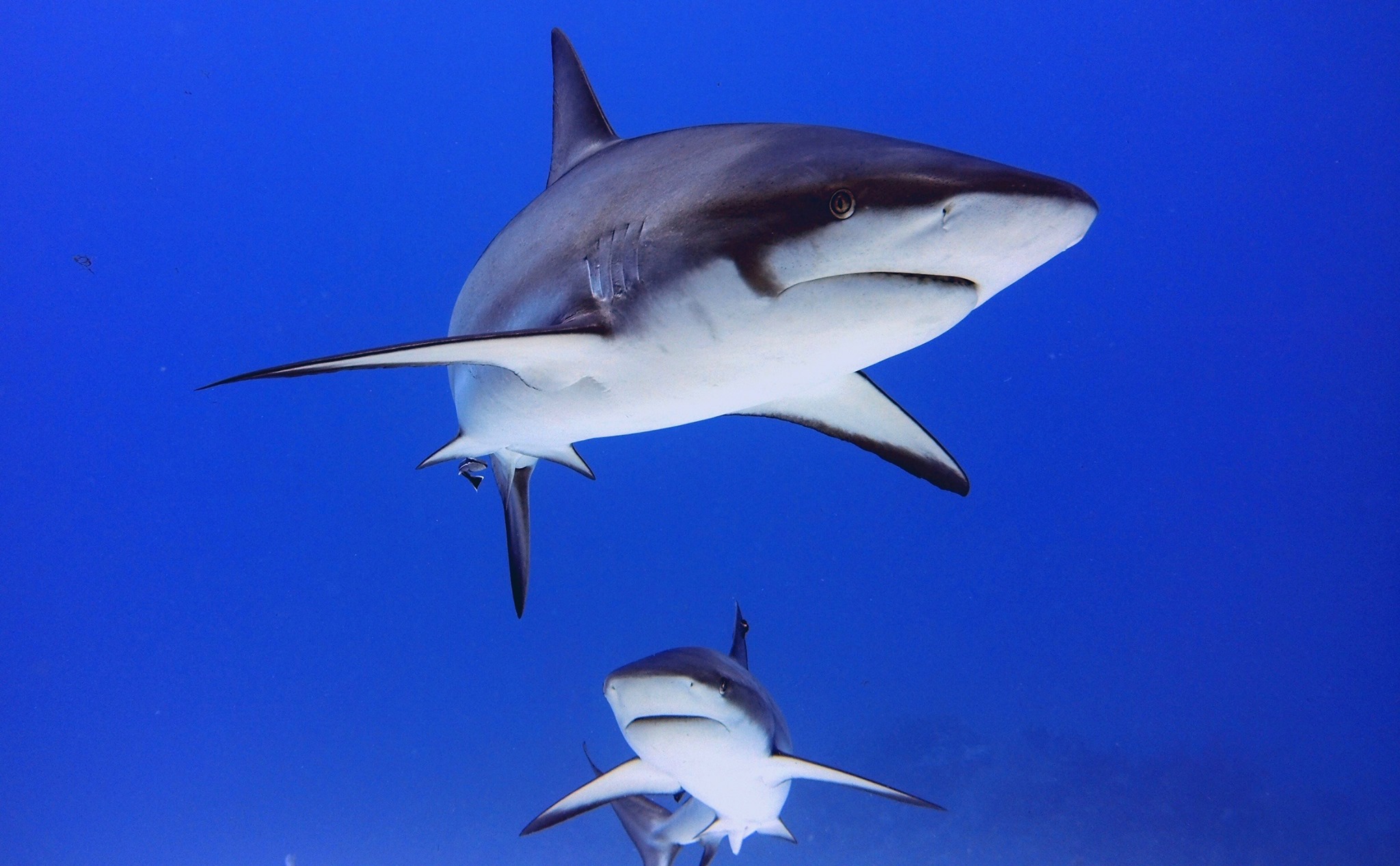
Divers who have been logging shark sightings have reported an increase in the number of the animals being spotted around the Cayman Islands.
According to a recent report by the Department of Environment’s Sharklogger Network, shark sightings by its small team of volunteer citizen scientists doubled in 2021 and 2022 compared to the numbers seen each year from 2017 to 2020.
DoE shark researchers say there could be a number of reasons why more sharks have been spotted over the past couple of years, and it’s not necessarily that there are more sharks in the water.
COVID may have played a role in the increase in sightings, the report notes, as the 2020 lockdown and the lack of tourists while the borders were closed in 2020 and 2021 meant limited in-water activities, “which could have resulted in sharks becoming more active in areas they previously avoided”, the DoE report noted.
“This could have resulted in more shark activity being seen by those persons who were diving from 2020 through 2022 without the actual number of sharks increasing,” it said.

DoE shark research has shown that sharks are more abundant in areas where there is little scuba diving, boat traffic, and fishing.
The report noted, “For example, sharks that might use the deep water below the dropoff (approx. 100ft/30m) to escape human disturbances on top of the coastal shelf might, during 2020, have re-occupied that shallower water ([less than] 100ft/30m) or certain shallow areas that they used to avoid. This would make those individual sharks more visible to divers in 2021 and even 2022 compared to previous years.”
The researchers also surmised that it could be possible that a change in the behaviour of the divers themselves could account for the rise in the number of sightings, as the shark loggers may be choosing to dive at sites where shark sightings are more common.
Whatever the reasons behind the increase in sightings, it’s far too early to say definitively if there are more sharks around the Cayman Islands, the researchers say.
“Due to the life characteristics of sharks, it takes decades for real changes in population number to become evident,” they noted in the report. “Therefore we cannot yet say if the increase seen after 2020 from the numbers of sharks reported before 2020 is a real change or merely a fluctuation in the data.
“Answering this will require continued monitoring of our local shark population. Such ongoing monitoring by various methods is critical for the continued protection and conservation of sharks within Cayman waters.”
More sightings, fewer species
While the number of sharks being seen by the shark loggers showed an increase, the number of species of sharks being recorded by them fell.
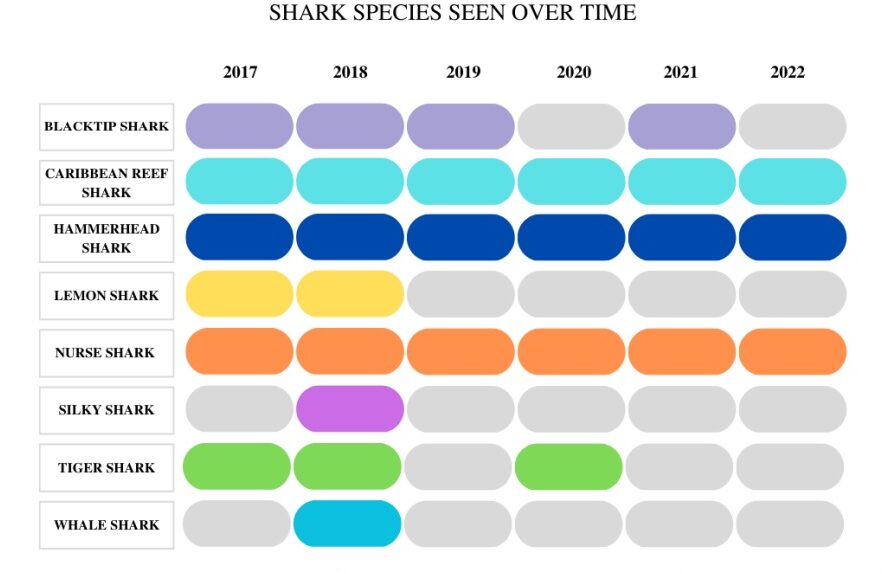
with colour imply the presence and grey tiles indicates the absence of a particular species in each
year. – Source: Department of Environment
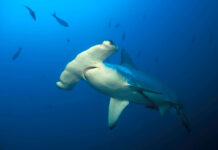
In 2017, six different species were spotted, while the following year, eight species were sighted – the maximum recorded in a single year since the Sharklogger Network was set up in 2017. In 2019, 2020 and 2021, though, four were reported each year, and in 2022, just three species – Caribbean reef, nurse and hammerhead sharks – were recorded.
The DoE researchers pointed out that in Cayman, the total economic value of sharks to the local economy is estimated to be between US$80 million and US$130.7 million annually, noting that this “encourages both a healthier marine environment and sustainable management of these important species”.
Species spotted in Cayman since 2017
- Nurse shark
- Lemon shark
- Caribbean reef shark
- Blacktip shark
- Tiger shark
- Hammerhead shark
- Whale shark
- Silky shark
2022 results
In 2022, a total of 3,383 dives – 2,902 in Grand Cayman, 125 in Little Cayman and 356 in Cayman Brac – were logged by 23 resident divers and snorkellers.
The DoE says it is worth noting that despite a decrease in the number of participants – down from 38 in 2021 – the mean number of dives (282 a month) logged each month was three times higher in 2022 than that reported in 2021 (91 dives/month).
Across all three islands, divers and snorkellers spent a total of 3,200.05 hours (13 days, 8 hours, 3 minutes) underwater.
The Caribbean reef shark was the most commonly recorded shark in 2022, with a total of 1,389 sightings, followed by nurse sharks with 217 sightings. Participants recorded 19 hammerhead sharks throughout the entire year.
Caribbean reef shark sightings were highest in the summer months, from July to September, with the fewest being spotted in February and October.
The researchers said previous surveys have shown that sharks are more mobile in summer than in winter, and that while this might make it less likely for divers to encounter sharks in their usual home range during the summer months, the high mobility of individual sharks could also increase the chance of seeing a shark anywhere around Cayman.
The sharks have been spotted by divers and snorkellers in water as shallow as 10 feet and as deep at 120 feet – the maximum depth to which recreational divers are advised to descend.
More volunteers wanted
The Sharklogger Network continues to invite volunteers to help keep track of the number of sharks in local waters.
Divers, snorkellers, and even boaters who are on the water very regularly and are interested in becoming a citizen scientist for the Sharklogger Network, can sign up by emailing [email protected].
Related Videos