

The National Conservation Council has the ‘final word’ on planning applications that are likely to have adverse effects on marine parks or other environmentally protected areas, the Court of Appeal confirmed in a judgment handed down Friday.
The decision means that planning approval for a developer to rebuild a crumbling cabana and seawall on the edge of Seven Mile Beach Marine Park is quashed and will go back to the Central Planning Authority for fresh consideration.
In its initial decision to approve the renovation project, the authority failed to properly comprehend its legal obligation to consult with and then follow the directive of the conservation council on the application, the panel of senior judges ruled.
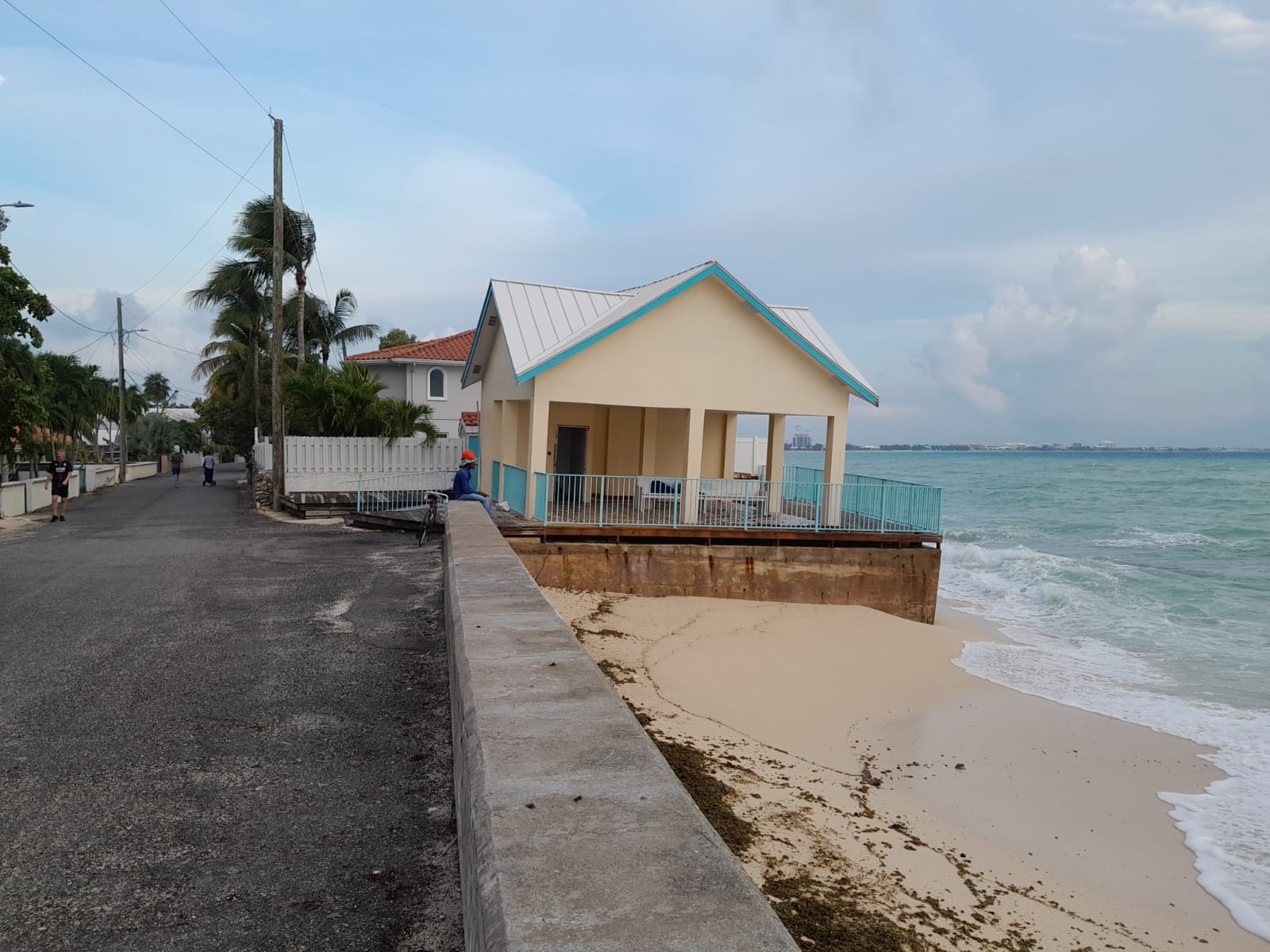
The dispute stems from a 2021 application from Cayman Property Investments to rebuild the painted yellow cabana and seawall next to the ocean on a severely eroded part of the beach along Boggy Sand Road.
The CPA approved the plan, despite a directive from the conservation council that it be rejected because of the likely harm to the marine park.
The authority had indicated it believed rebuilding the deteriorating structures would be less harmful than leaving them in place.
Experts at the Department of Environment disagreed, suggesting there was no way to adequately protect the marine environment from such an extensive project so close to the water.
The appeals panel did rule that the conservation council had been “premature” in instructing the planning board to reject the controversial proposal, before it was consulted on the matter.
But it indicated this breach of procedure did not remove the legal obligation for the authority to examine the potential for harmful environmental impacts, to seek the council’s approval and to follow its directive.
The ruling brings some clarity to what was considered a grey area in the respective remits of the government bodies responsible for planning and conservation.
When it comes to developments that could have negative impacts on protected areas, including marine parks, or on protected species, it is the National Conservation Council and not the Central Planning Authority which has the final say.
The law requires the council to “direct refusal of planning permission” when it believes those negative impacts could not be satisfactorily mitigated by conditions, the judgment states.
However, there remains a possible area of contention over the process of deciding which applications are referred to the council and who makes that call. The judgment indicated that while this decision rests with the Central Planning Authority, they must take into account the advice of experts – including the conservation council – and provide “cogent and compelling reasons” if they deviate from that advice.
In this instance, the judgment, written by Sir Alan Moses, indicates the authority failed to have regard for its duties under Section 41 of the National Conservation Act and made a “fundamental error” in its appreciation of the issues it had to consider before granting planning permission.
Planning authority vs conservation council
The case pitted two government entities against each other in the courtroom. And despite comments on both sides, following Friday’s judgment, that greater collaboration is needed in future, there are still some areas of dispute over how the judgment should be interpreted.
The CPA and the Ministry of Sustainability and Climate Resiliency released conflicting press releases in the aftermath of Friday’s decision, with both claiming at least a partial victory.
Premier Wayne Panton, who was environment minister when the National Conservation Act was passed in 2013, welcomed the ruling and hailed it a “victory for the people” in a release from his ministry.
He said, “This latest ruling once again confirms the legal basis for factoring environmental concerns into decision-making processes across the Cayman Islands Government, particularly where actions may or are likely to have an adverse effect on a protected area or protected species critical habitat.
“I am comfortable that the Courts have settled this matter once and for all and there can be no more room for debate.”
The ruling confirms what the Department of Environment and National Conservation Council have said since the passage of the law – that the council has the power to direct government entities – including but not limited to the CPA – to refuse applications for works that will negatively impact protected areas and species.

Gina Ebanks-Petrie, the director of the Department of Environment, said, “Since the National Conservation Act was passed unanimously by Parliament in 2013, the NCC has always been able to direct government entities to refuse a proposal that could have a negative impact on a designated protected area or the critical habitat of a protected species, where conditions of approval are unable to mitigate those adverse effects.
“What these rulings have clarified is that government entities that do not follow those directions are acting unlawfully.”
She said the power was used sparingly by the council and was only applicable in specific circumstances.
“The NCC may only direct conditions of approval or refusal in very limited circumstances – when the proposal could have a negative impact on a designated protected area or the critical habitat of a protected species.
“For the vast majority of planning applications we are only able to make recommendations.”
Though the council has final say on such applications, the Court of Appeal indicated it could not act unilaterally.
Even in cases where “the NCC has the last word” that “should not exclude full discussion as to a difference of views before that point is reached”, the judgment indicates.
Planning authority: ‘DoE erred’
In its own press release, the Central Planning Authority focused on a different aspect of the judgment, highlighting that the ‘DoE erred in law’ when it directed that the application be refused without having first received a referral from the authority.
“It is for the Central Planning Authority to determine for itself whether an adverse effect is likely, before it refers the matter to the National Conservation Council,” the release stated.
On that point the justices did rule that the DoE’s initial directive was premature and therefore ‘unlawful’.
But it indicated that did not remove the obligation of the CPA to consider if adverse impacts on the marine park were likely and seek approval from the council.
“The moral of this appeal is that the CPA must follow the route prescribed by section 41(3) and the guidance issued by the NCC,” Justice Moses wrote.
“It must consider whether any permission it proposes to grant would or was likely to have an adverse effect, excluding from consideration the question whether conditions might ameliorate or eliminate the risk. It must set out its reasons for its answer to that question.
“Once it has reached its conclusion, the question whether the duty to seek approval under section 41(4) will become obvious.
“If it considers that harm can be reduced or eliminated by conditions, it may propose them to the NCC and argue for its conclusion, recognising that the final decision as the efficacy of such conditions is for the NCC.”
In its press release, the authority indicated that it understood the judgment to mean it had to provide detailed written reasons in future if it chose not to refer such applications to the council.
“This means that the Central Planning Authority will have to consider the planning application again, taking account of the Court of Appeal’s guidance. In so doing, the CPA will endeavour to provide more detailed reasons for its decision regarding its consideration of Section 41 of the National Conservation Act.”
The planning authority also sought to clarify its reasons for approving the controversial application in the first place, saying the existing structures were unsound and could collapse into the ocean.
It said it had decided the proposed development would be less of a threat to the environment than the existing structure.
It remains open to the CPA to appeal the judgment to the Privy Council and it indicated it could still take this approach.
The authority acknowledged it could have a better working relationship with the conservation council, adding that the process should be “streamlined and enhanced so as to operate on a more cooperative basis”.
Related Videos












The court ruling: “When it comes to developments that could have negative impacts on protected areas, including marine parks, or on protected species, it is the National Conservation Council and not the Central Planning Authority which has the final say.”
THANK YOU, NCC, for being a WatchGuard and protecting this beautiful island called home.
The cabana has been undergoing demolition since the weekend.
Good for the NCC. I am pleased with the Court of Appeal ruling. I’m sorry for the owners, but its unfortunate that the cabana and other new homes along the sea in front of Boggy Sound Road were approved in the first place as they shadow and dwarf what used to be one of the nicest traditional Caymanian roads.