The Department of Environment, in a statement this week, said it is not to blame for the drawn-out Port Zeus environmental impact assessment.
The time it has taken for the eco-analysis to progress on the Cayman Brac marina, port and village project is down to the developer, the department said.
“There is a misinformed idea that an EIA is a lengthy process conducted by the Department of Environment,” the statement said.
“But an EIA is in fact carried out by the project proponent or applicant, with oversight from an environmental assessment board.”

Back and forth
The response came following a Compass article on the project, in which Frank Schilling of Developer FS said the whole process is taking longer than expected.
“This project isn’t like waste to energy or the East-West Arterial road where new environmental ground is being broken,” he said last week.
“We are applying to build an inland safe harbour in an existing quarry loading zone and it has taken nine months for DoE to come back to us with an agreed terms of reference.”
He added: “That just feels unusually long for something that should not be contentious.”
But the department responded that the “months-long gap” was actually the time it took for the developer and his consultancy firm to prepare the EIA’s draft terms of reference.
A spokesperson said that the first draft terms of reference took 11 months for the consultants to prepare, from August 2022 to July 2023.
“Then it required revisions, because it was incomplete and not at the level of detail expected for this stage,” they said.
The DoE received a revised draft terms of reference in late December 2023 and it is currently under review.
Schilling later told the Compass that his team needs interaction from the DoE on coastal works mitigation fees “as those will guide parts of our EIA”.
However, the DoE said that is incorrect.
“Coastal works applications are always considered by Cabinet, who decide coastal works mitigation fees when they decide on whether or not to approve an application.
“However, they will not consider the application until the EIA is complete,” the department said.
Timeline
The EIA process and the timelines are set out in the National Conservation Act’s EIA directives.
The National Conservation Council initiates the assessment, then the development project team conducts the EIA for review by an environmental assessment board.
That board is formed specifically for each project and composed of relevant government authorities, including the DoE.
“The length of time an EIA takes is usually controlled by the proponent and their consultants and depends on the nature of the project,” the DoE said.
The terms of reference are an integral part of the EIA and include all of the studies needed to fully inform the final report.
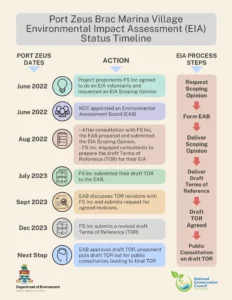
Once the draft terms are finalised, they go out for public review through a consultation process organised by the developer and their consultants.
This ensures transparency and the opportunity for the public to comment and identify any important considerations which were missed and should be addressed by the EIA.
When the EIA is finished, the Central Planning Authority, Development Control Board or Cabinet then considers it and decides on whether the development should be approved.
“The EIA process is an integral part of sustainable thinking and planning before major development projects begin,” the department statement said.
It ensures “all of the impacts to people and nature are considered within the framework of the project”.
Related Videos