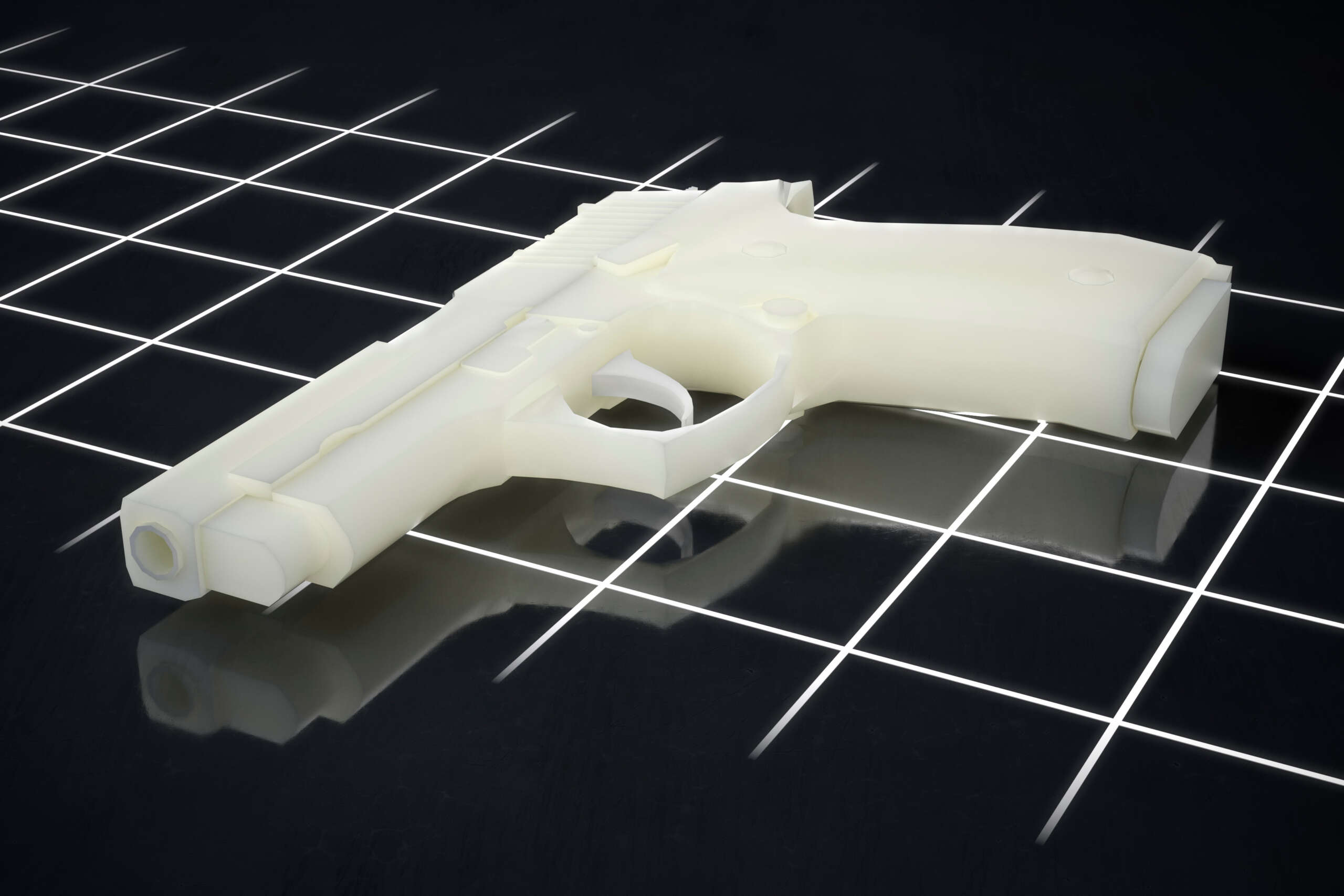
The definition of firearms is being amended in local legislation to include homemade weapons created on 3D printers and from assembly kits.
Substantial amendments are being made to the 2008 Firearms Act “to address some of the current challenges faced in enforcing the law relating to firearms”, according to a memorandum accompanying the proposed changes.
The memorandum noted, “The inclusion of privately made firearms which are created by the use of 3D, or three-dimensional, printing technology is in recognition of the global challenge being faced by law enforcement where access to software facilitates the printing of firearms using easily accessed 3D printers.”
In a recent series the Compass ran on gun-trafficking in the region, experts noted that untraceable ‘kit guns’ and 3D-printed weapons were a growing issue for law enforcement, though few cases have been reported in the region.
The proposed amendments ban the assembly, manufacture or supply of any firearm, ammunition or firearm parts kits, as well as the downloading of software with which a firearm may be printed.
Anyone found guilty of doing so could face a fine of $250,000 and/or 35 years in prison, according to the proposed amendments.
The revised legislation also notes that no licence or permit will be granted for any privately made firearm which is assembled from a firearm parts kit or from component parts, or for any firearm not bearing a serial number or bearing a mark which has been altered.

Another new section of the law empowers the police commissioner to collect and store physical and digital ballistic signatures and information relating to firearms in Cayman.
Cayman has seen an increase in gun violence in recent times. In the most serious case, a gunman opened fire on a group of people at the Ed Bush Stadium in West Bay in February this year, leaving seven people injured.
A few days after that shooting, Police Commissioner Kurt Walton told a public meeting in West Bay that police were aware of the existence of 90 different guns on island, based on ballistics data.
Changes to wording on importation
Amendments are also being made to the legislation regarding the importation of weapons to Cayman.
Earlier this year, a court found the wording of the existing law could be interpreted as meaning the firearms could be imported without a licence being in place.
High Court Judge Marlene Carter ruled in February that the current legislation, which appears to deal with transient travellers, could be interpreted to mean firearms can be brought into Cayman by individuals so long as they declare them and surrender them to Customs and Border Control officers at the airport, giving those individuals an opportunity to apply for a firearms licence.
This led to the Office of the Director of Public Prosecutions dropping its case against Canadian-Russian national Anton Parygin in March this year. He had been charged with illegally importing multiple firearms into Cayman.
However, under the amended legislation, prior to arriving on island, a traveller must notify and receive approval in writing from the commissioner of police to bring the weapon to Cayman. Any traveller arriving in Cayman with an unlicensed firearm must make a declaration on the relevant form, and deliver the weapon (or ammunition or bullet-proof vest) to a Customs and Border Control officer in a sealed packet.
In the event that the traveller has a licence for the firearm, the weapon or ammunition will be returned to him or her by Customs and Border Control.
If a traveller fails to provide a permit or the commissioner’s written approval authorising the importation of the firearm, it may be forfeited to the Crown, the revised legislation notes.
The reworded legislation does not give a specific timeframe for which Customs and Border Control officers can hold onto a firearm once it has been handed over to them – an issue that was covered in the Parygin case.
The maximum penalty for illegally importing a weapon into Cayman remains the same under the proposed amendments – a $100,000 fine and/or imprisonment for 20 years.
Other amendments
The proposed amendments also empower Cabinet to permit the importation of prohibited items “when it sees fit”.
The Firearms Bill also seeks to introduce a new offence relating to the alteration of a firearm or conversion of anything into a firearm. It “prohibits anything that alters the ballistic signature of a firearm and prohibits tampering with any mark on a firearm”, and anyone convicted of doing so would be liable on conviction to a fine of $100,000 and/or imprisonment for 10 years.
It also would outlaw the stockpiling of guns and ammunition. Anyone possessing two or more prohibited weapons or 20 or more pieces of ammunition could face a fine of $250,000 and/or a jail sentence of up to 20 years.
Related Videos