

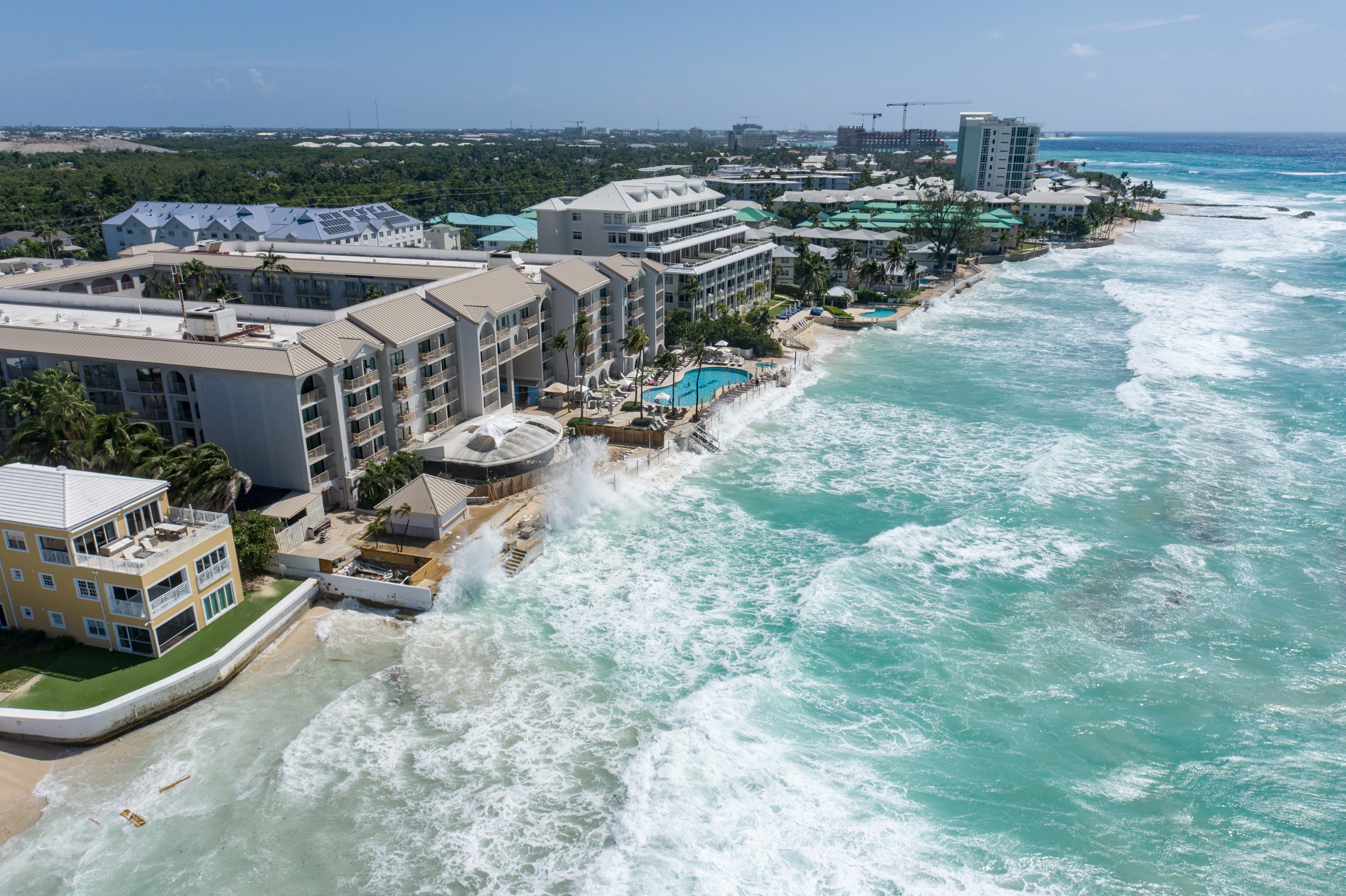
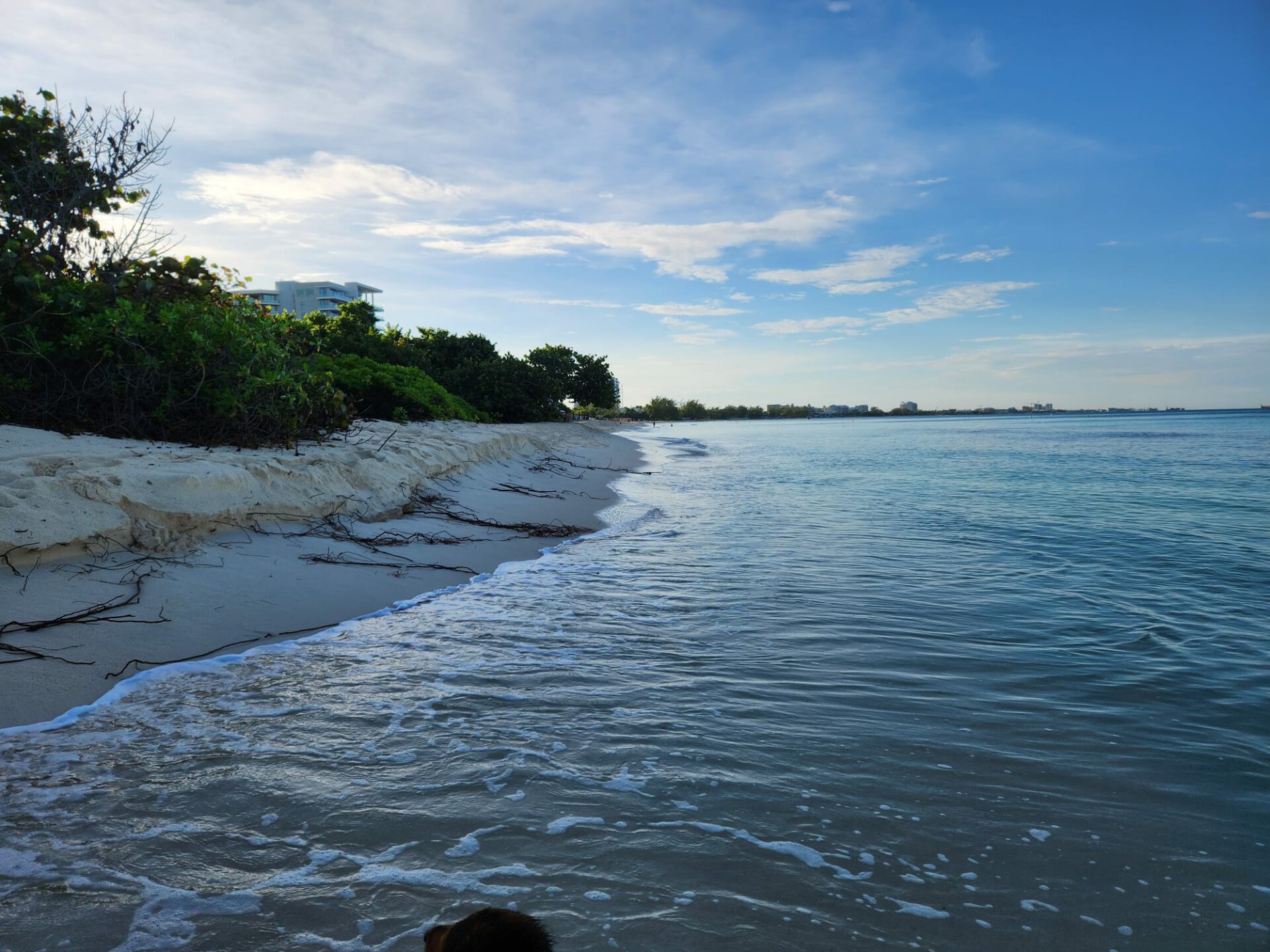
Seven Mile Beach contributes $1 billion annually to the Cayman Islands economy, according to a new report that makes the case for immediate action to replenish sand lost to erosion at the iconic attraction.
The socio-economic study, authored by Caribbean economist Marla Dukharan, indicates that hotels and vacation rentals at the severely impacted southern end of Seven Mile Beach are already losing money.
As the beach continues to slip away, she warns that restaurants, realtors, construction firms and homeowners will also see significant erosion of their businesses.
Government revenues are already impacted and will continue to diminish.
Over time, she projects, the issue will influence the entire tourism industry, as well as the quality of life in Cayman.
Her report highlights a potential knock-on effect on the financial services industry, which leverages Cayman’s desirability as a destination to attract business.
“The risks and implications of Seven Mile Beach erosion are severe,” she wrote.
“Protecting the shorelines of the Cayman Islands could be one of the most important capital investment priorities to ensure the long-term wellbeing and continued prosperity of the people of the Cayman Islands.”
Dukharan’s report, commissioned by Dart Enterprises, was presented to politicians last week as they grapple with the escalating problem.
Hurricane Helene, which passed hundreds of miles to the west of Cayman earlier this month as a tropical storm, brought wave impacts that washed away sand from the already depleted southern end of the beach.
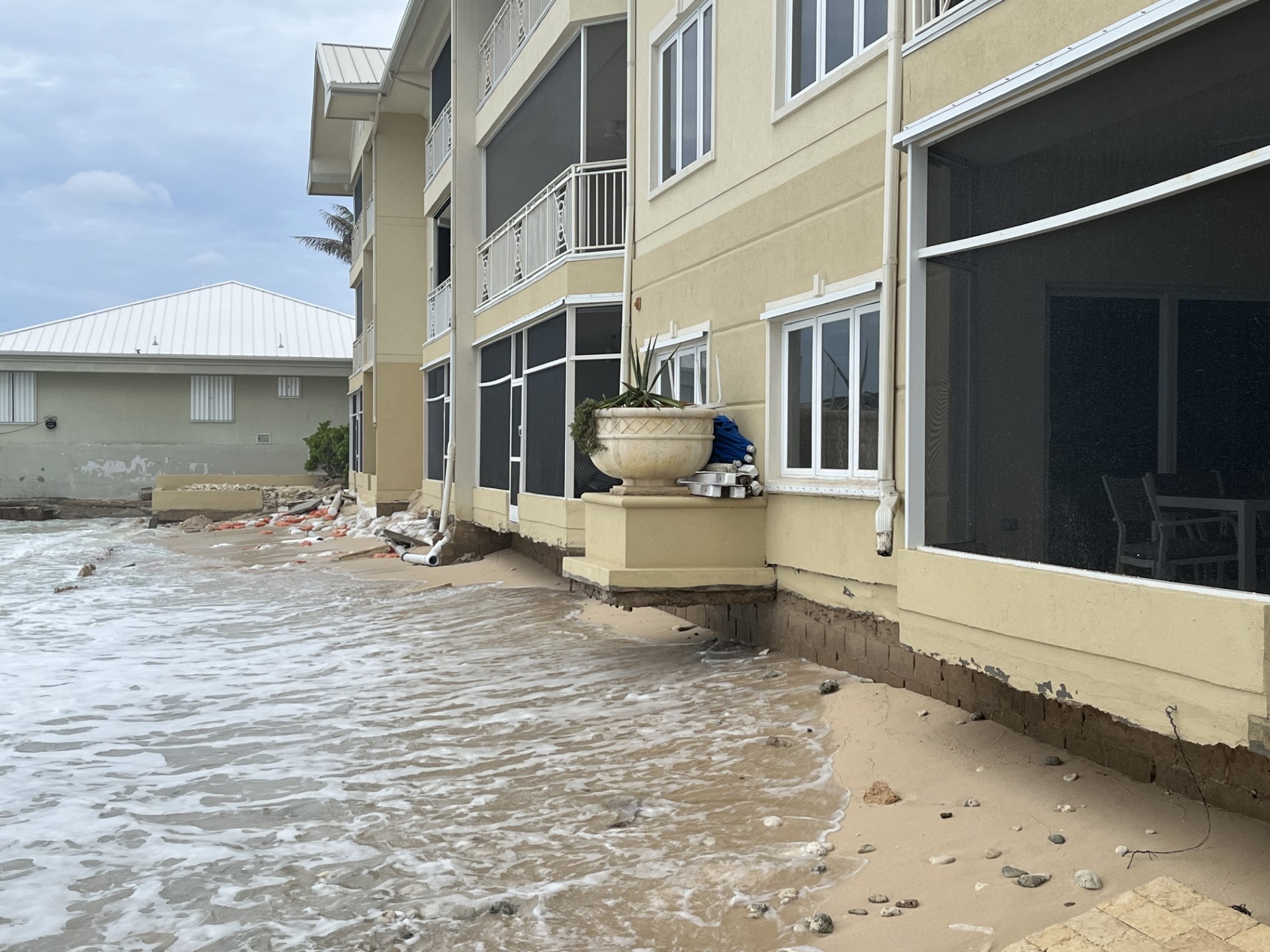
Video footage taken by the Compass shows once pristine beach transformed into a Venice-style waterfront, with boats able to moor against perimeter walls of hotels and condos.
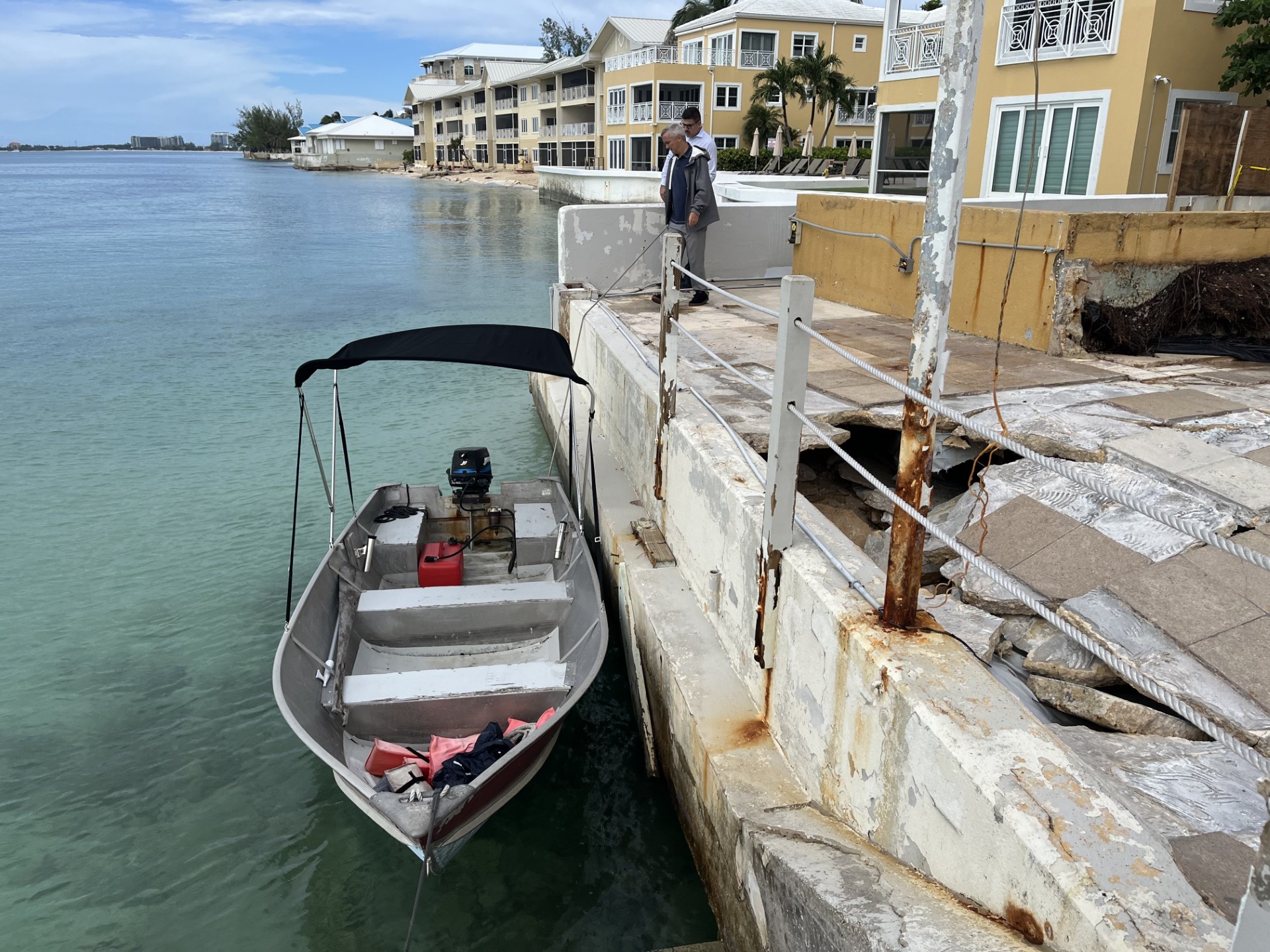
The shocking images – a visceral escalation of an already well-documented issue – appear to have prompted new energy from government on the much-discussed problem.
The matter was on the agenda at Cabinet and caucus last week, with a partnership between the government and private-sector interests, including the Dart group, on the table.
As a result of the talks, fallen trees, broken foundations and twisted rebar left scattered along the storm-battered shorefront can begin to be cleared after government decided to waive the permit process. Government, which previously allocated $21 million for beach replenishment, had pulled the funding amid uncertainty over how to proceed.
Private landowners, including Turkish homeowner Ergun Berksoy who pledged US$3 million to help save Seven Mile Beach, have indicated a willingness to commit funds to restore the beach.
Dukharan’s report bolsters the case for beach renourishment and indicates the expense would pay for itself in improved room rates, property values and government taxes.
It also indicates that the expenditure – estimated at an initial $21 million, with further anticipated costs of around $5 million every five years – would provide a buffer against further losses by protecting the rest of Seven Mile Beach and the businesses and workers that rely on its spin-off benefits from further impact.
“The cost of beach nourishment pales in comparison to the potential losses associated with a do-nothing scenario,” the report concludes.
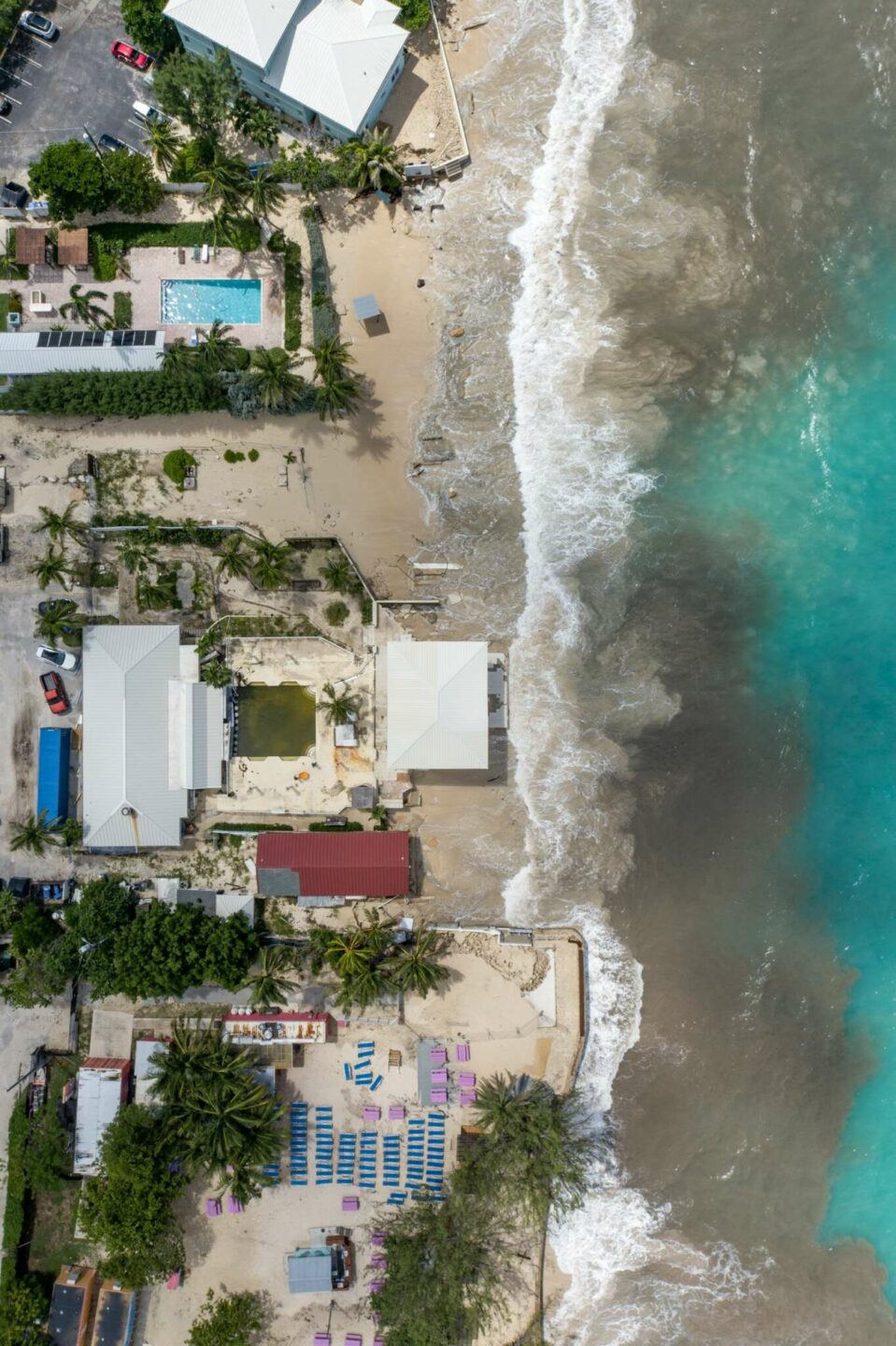
Funding a nourishment solution will only get more expensive and complex over time, the report warns, suggesting sourcing suitable sand will become more challenging.
“When neighbouring islands are also grappling with beach erosion, their ability to provide sand for exports will be severely compromised,” it said.
To a large extent, Dukharan’s analysis puts facts and figures behind a fairly intuitive point – Seven Mile Beach is crucial to Cayman’s appeal as a place to live, work and visit.
It also dives deeper on key issues, including the extent to which erosion has already impacted the bottom lines of business owners from Royal Palms to George Town.
Some of her key conclusions include:
1. Seven Mile Beach generates $1 billion annually for Cayman
The report indicates that the appeal of Seven Mile Beach is the driver of almost $1 billion worth of economic activity in Cayman each year.
That ranges from spending in hotels, room taxes to government and tourist spend in restaurants to job creation in the construction sector, real estate sales and work permit fees.
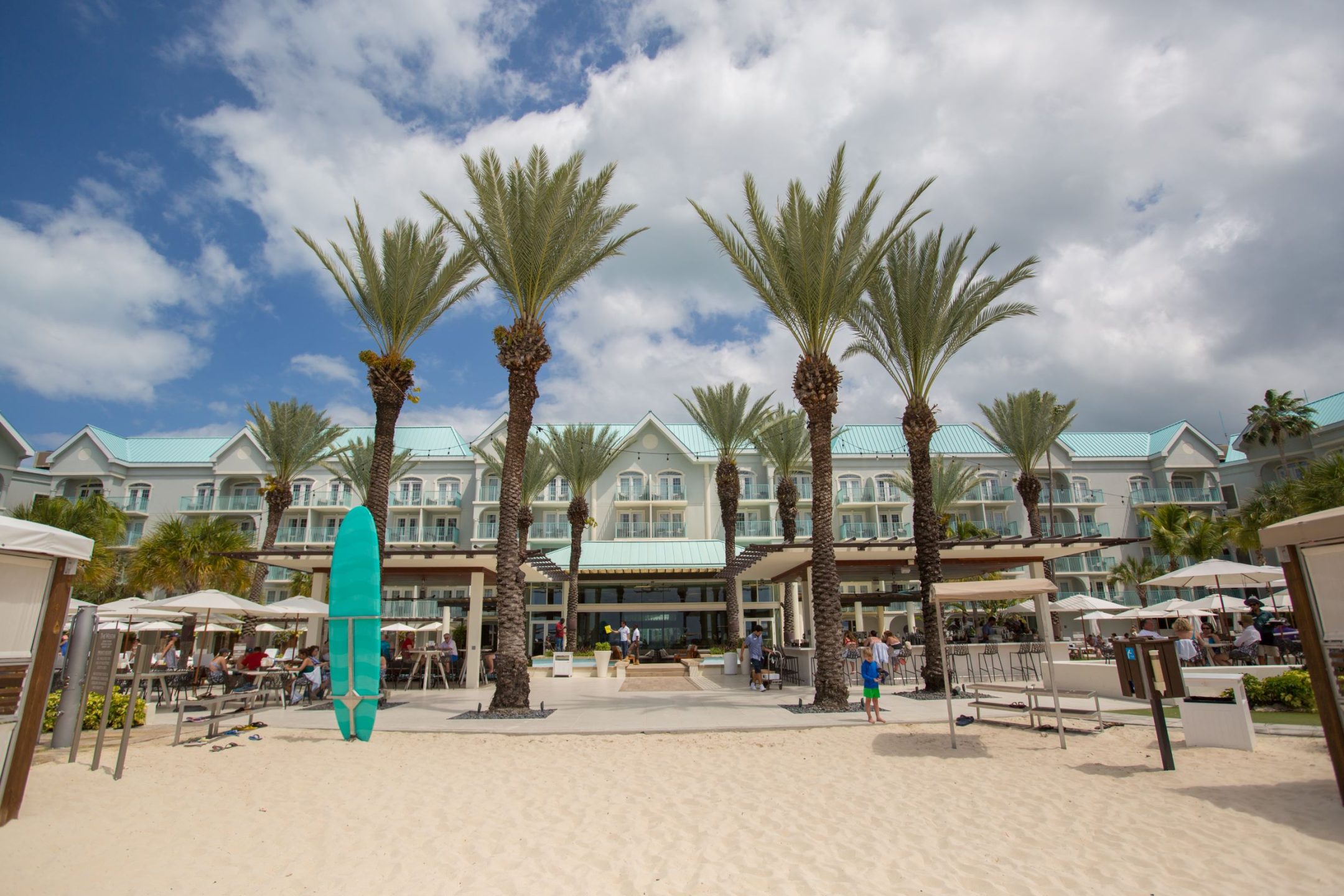
Its impact spirals beyond tourism to the destination as a whole.
Dukharan writes, “The allure of Seven Mile Beach, which attracts thousands of visitors annually and contributes significantly to the local economy, is at stake. Without a thriving shoreline, the appeal of the Cayman Islands overall will diminish, leading to a decline in tourism and overall economic activity.”
2. South Seven Mile is feeling the pain already
An analysis of changing daily room rates on the southern end of Seven Mile Beach compared to the northern end clearly demonstrates how the income has ebbed away with the sand.
Some of the statistical methodology is complex, but the headline facts and figures are simple.
Hotels and vacation rentals on the southern end of the beach – defined for the purposes of the study as anywhere south of Royal Palms – used to generate more income than those on the northern side. Now the opposite is true.
In a more detailed analysis of short-term rental properties, Dukharan concluded that vacation rentals on the southern side of the beach were losing $13,000 each year as a direct result of erosion.
“A do-nothing scenario means the beach erosion can begin spreading further to the north and affecting attractiveness across Seven Mile Beach,” she wrote.
3. Comparative data shows property value impact
Data from real-estate economists cited in the report evaluated house price sales based on an index that looks at repeat sales at specific properties.
That index – designed to ensure a like-for-like comparison – suggests that the value of homes on the eroded southern end of the beach has flatlined over the past six years.
The report indicates a “notable departure” in values between north and south beginning in 2018. It acknowledges that further research would be needed to link this directly to erosion.
It concludes, however, that comparable properties on the as-yet unimpacted northern end of the beach are currently valued at 35% higher on average.
4. Government is losing revenue
Government currently generates around US$33 million every year from Seven Mile Beach properties via the tourism accommodations tax, currently charged at 13% per night.
Stamp duty on property sales adds another US$27 million annually, while work permits directly attributable to the Seven Mile Beach economy add another $14 million, the report indicates.
That total of $74 million going directly to government coffers can be expected to diminish alongside the revenues of the businesses that pay it, it warns.
5. Almost half of Cayman’s restaurants are located on Seven Mile
Beyond the immediate impact on the beach, Cayman’s reputation as the culinary capital of the Caribbean could also be at stake.
Just fewer than half of Cayman’s 200-plus restaurants are located on or around Seven Mile. One in four of those is on the deeply impacted southern stretch.
Collectively, those on the southern end generate $10 million in economic impact for the island, the report suggests.

Restaurants, bars and small businesses would suffer a knock-on impact of continued erosion.
6. A $21 million investment in beach nourishment would be well spent
The report indicates that replenishment would be needed on an ongoing basis because of the threat of rising seas and continued erosion caused by storms.
Using data from an earlier report, commissioned by Dart and compiled by DHI, the paper uses an estimated up-front cost of $21 million alongside a figure of $5 million for maintenance every five years.
Dukharan calculates that as $59 per stayover tourist or $20 per cruise tourist every year.
She suggests that this could be one way of helping fund the necessary investment, adding that increased room rates and the parallel increase in government revenue would likely enable “recovery of at least a portion of investment and maintenance cost”.
Set against the negative impacts of doing nothing and letting erosion take its course, she indicates it would be money well spent, however funded.
“These costs are small relative to the overall property values on Seven Mile Beach and the potential for losses in the absence of renourishment,” she said.
Editor’s Note: The Cayman Compass is a subsidiary of Dart Media and Entertainment.
Related Videos









Why doesn’t DOE buy a few rolls of sand fence and install in a few different patterns to see which way works best? Guess spending a few hundred dollars to do something that works isn’t as good as spending a few million for a “study” and then haul in foreign sand by the millions.
This problem isn’t going away We need a barge filled with fine silica sand from Cuba or the Bahamas, like next week. Can we get Thompson’s black barge to head up there to get it and at least do a trial of a few loads? Note: One barge won’t cut the mustard, but 10 round trips to the isle of youth for some fine white silica might give us a sense what we can accomplish in the southern part of the beach before we have any structural loss. I walked down there and figure we are less than a year from losing a major building down there.
You’re right, the problem isn’t going away so why throw good money after bad?
Nothing in the recommendations states, retreat or tearing down existing walls which would be an immediate fix without a cost to the public purse. A lot I read is scare mongering of lost of $1 billon of revenue which was created by the same developers and buyers beware when told not to build so close to the sea. The locals were banned from gaining access to the beach and now we should pay for replenishing it. Question, when we pay for it and if the beach does come back (unlikely with climate change) will the locals be able to enjoy without being harassed by your security guards?
The locals don’t need to pay for it. The owners along the beach will gladly pay for the replenishment. Berksoy has committed 3 million. I am sure Dart would contribute substantially more. Each of the other property owners would be happy to commit a million dollars to get back their beach. The real estate is worth over a billion dollars, and 21 million is only 2% of that. Any property owner will stand to gain much more than 2% so the economic decision is very clear for them.
Thanks for this article, Cayman Compass and James Whittaker. My team and I are grateful for the coverage and hopeful that the stakeholders take action and pursue beach renourishment with urgency. The ‘do nothing’ scenario is terribly costly and damaging, in more ways than we could quantify.
Repeat of my prior comment in related articles: Why not consider devoting revenues from a national lottery toward beach restoration?
They’ll study it, and debate it, and ponder it, do environmental assessments and then people will protest it, like they do other recommendations to help tourism, and then it will die. Just like the cruise ship port. And so will 7 Mile Beach and all the businesses along 7 MB and all the people who rely on tourism to make a living. Not to mention all the jobs lost in the industries that support tourism, maids, servers, landscapers, car rental agencies, etc etc. All talk and no action, it’s a pattern we’ve seen over and over.
BUILD THE WALL Again I suggest instead of just putting sand which will just wash away build a wall from the edge of Sunset Cove to the edge of The Sovereign and fill it with sand A on time fix
If one looks at photos from the 70s there was a very deep beach in front of the Marriott, Royal Palms, Regal Beach, Laguna de Mar etc.
I personally owned a front, ground floor unit at Tamarind Bay. One could step outside and walk down a gently sloping beach to the sea. There was no sea wall.
Properties were NOT built too close to the sea. Instead the sea has washed away. NOT the fault of the property owners.
Immediate action is required to prevent substantial loss of tax revenue.
I would propose the affected properties should pay 2/3 of the cost by way of a levy on every affected property owner.
Let’s say the cost is $30 million.
That should be $20 million from the property owners. The cost per property should depend on their running foot frontage.
Then divided for condos depending on the square footage of each individual condo.
This is peanuts compared to the drop in value of the properties.
I have heard that the ground floor condos at Laguna de Mar have halved in value and the occupancy of the Marriott is way down.
If you look at Google earth satellite images from 2005/2006, the beach at Tamarind Bay, Marriott, etc was very narrow. Back to 2004, in front of Laguna Del Mar and Regal Beach was almost gone, and Cayman Sands was non-existent. Point being, this isn’t new and just because the beach was abundant back in the 80s doesn’t mean property owners didn’t build too close. Now with rising sea levels, it will only get worse and dumping new sand seems to be throwing good money after bad.
Exactly! I agree.