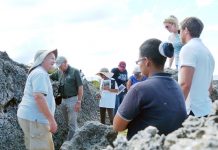
With Cayman’s high school students sitting internationally accredited exams, the education curriculum has by necessity been outward looking, meaning the teaching of local science and history has been downplayed.
“Our students lack knowledge about the local geology and rocks of the Cayman Islands and we want to help change that,” Water Authority-Cayman water resources engineer Hendrik-Jan van Genderen told the Compass, at the end of the recent Geology Education Week.
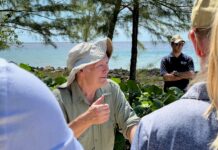
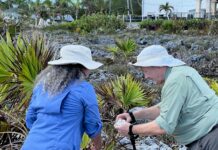
Geology professor Brian Jones, of the University of Alberta, has been helping to bridge that information gap. “We were fortunate again this year to have Dr. Brian Jones, geology professor and author of ‘Geology of the Cayman Islands ’, come down [to Cayman] to give lectures about our local geology,” van Genderen said.
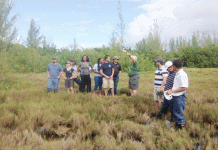
More than 300 high school students attended the geology presentations, held from 7-11 Oct., which also included professional development sessions held by Jones to enable teachers to cover topics in their classrooms including rocks and earthquakes that are specific to the Cayman Islands.
Jones, who has been coming to Cayman for more than 35 years, has also played a key role in ensuring the the availability of fresh water through the taps in each household.
There are no rivers in the Cayman Islands and, in the past, water for drinking and other domestic purposes traditionally came from rainfall, which would come off the roofs of people’s houses and be collected in cisterns. In some areas, there were also shallow wells supplying a certain amount of drinking water, especially during the dry season, which sometimes resulted in empty cisterns.
The first company to start providing drinking water in Grand Cayman was the Cayman Water Company, launched in 1973 to provide the Governors Harbour area with water services.
According to a Compass story on Cayman’s water supply, “Back then [in 1973], the method for converting saltwater to fresh water was distillation. The seawater would be boiled, and the resulting vapor would be collected and cooled.”
This method was expensive, and it required a lot of heat from diesel generators to boil the water to get rid of the salt and other impurities. But while distillation was not necessarily economically efficient, it was the best process available at the time.
The article continued, “Cayman Water was slowly able to ramp up its production and storage capacities over the next few years, and in 1979 it was granted an exclusive 20-year license to process and supply water.”
By the early 1980s, government also decided to get involved with the water infrastructure and, in 1983, the Cayman Water Authority was established, and reached out to Jones to help ensure they could safely and efficiently make fresh water.
Reverse osmosis
“We wanted to develop a reverse osmosis plant, and we wanted to know if it was even possible, and if so, where we going to get the water from,” van Genderen told the Compass in explaining the history.
“One of the main concerns related to the geology. We wanted to extract the salt water from the ground rather than the sea, due to the dangers associated with hurricanes and also because rock acts like a filter and removes the sediments, but there was also the issue of where we were going to put the brine after the salt was removed,” van Genderen said, adding that “after processing, the water would be very salty, so it would likely kill coral and even harm plants if it was not disposed of correctly”.
Jones was able to identify the right depth to extract the water from the ground, and, most importantly, he also located a geological layer to act as a natural barrier below which it was safe to return the highly salty brine back into the ground, so it did not mix with the water being extracted for processing.
“The process can only be done once, so for every 10 gallons of sea water we pull out of the ground, we can make four gallons of fresh water,” Jones told the Compass. “So once the brine is returned underground, it now has a much higher salt concentration, and it is not possible for us to process that again to make freshwater. It is therefore critical that the two different water layers do not mix.”
Today, most of the potable water in the Cayman Islands comes from desalination plants, with rainwater collection and groundwater use playing a much-smaller role. The islands’ reliance on desalination enables the water supply to meet the needs of Cayman’s growing population along with visitors, whose numbers fluctuate over the year.
The history of the water supply in the Cayman Islands reflects the islands’ transformation, from a small and relatively isolated community with fewer than 11,000 people in 1970, to a tourist and financial hub, for a population approaching 90,000 in 2024, that depends on efficient and sustainable water systems.
Related Videos