


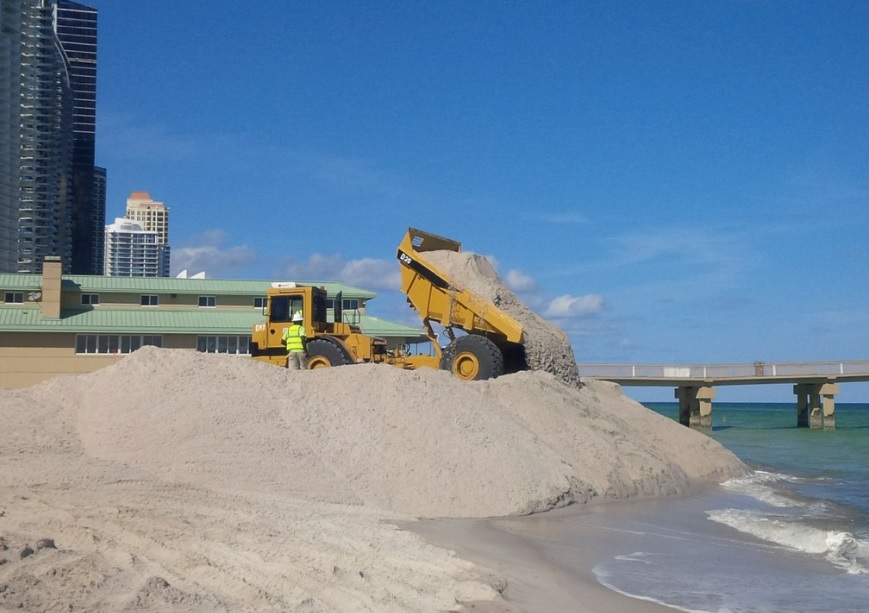
Tourism Minister Kenneth Bryan has acknowledged government “dropped the ball” on beach erosion and insisted it is time to act to replenish the southern end of Seven Mile Beach.
Speaking during a tourism panel discussion Friday, Bryan said, “The simple solution is to put the sand back.”
Deputy Premier Bryan described the current bid process, being steered by the Department of Environment to find a coastal engineering consultant to design a solution for the severely eroded section of the beach, as an important step towards getting the job done.
He accepted that various studies had been done on the subject when a task force had been put together in 2021 and $21 million was budgeted — but never spent — to remedy the issue.
Acknowledging that an election was around the corner, he said he hoped the issue would not become a “political football” and plans to put sand back on the beach would be prioritised by the next government.
“I feel hurt that we were not able to resolve this matter,” said Bryan, citing the departure of Wayne Panton as premier as one of the reasons the momentum on the issue slipped off the radar until further storm action put it back at the forefront of the national conversation.
“We dropped the ball on that but I think we have to resolve it,” the deputy premier said during the panel discussion at the Chamber of Commerce’s economic forum at the Kimpton Seafire Resort on Friday.
Compass reports on beach erosion
- Report: Extensive beach nourishment needed to save Seven Mile
- Going, going, gone: Erosion reaching crisis point on Seven Mile Beach
- Special Report: Taking sand to the beach
- Seven Mile erosion poses a billion-dollar problem for Cayman
- Video: Southern Seven Mile now only accessible by boat
- The disappearing beach: Coastal boundary line is in the water
“I think it is obvious that we have to put sand back there with a strategy of keeping it there for the long term.”
Asked about the report that consultants for the Dart group, DHI coastal engineers, had already produced, recommending a beach replenishment project alongside a strategy of using “sand engines” to pump sand back onto the beach periodically, Bryan said he liked the idea, but government has to go through its own process.
“It sounds practical but we don’t make decisions that way,” he said, referring to the regulatory requirements and tendering process government must follow before embarking on this type of project.
“We want the fastest, cheapest and the most environmentally friendly way to do it, and unfortunately, that’s going to take a lot longer than we think.”
He added that the Department of Environment is guiding the tender process, something that he believes should make the project less susceptible to a political change of heart by a new government. A project of that scale would need to be approved and budgeted by the new administration, however.
Knocking down coastal properties is ‘ludicrous’
Bryan dismissed the notion that property owners should be asked to take down walls or rebuild condos further back from the coastline, describing the concept as “ludicrous”.
“I hope that persons who have extreme positions on the environment don’t derail or slow the process down because they want some of the walls to be knocked down. I think that’s what’s happening behind the scenes and I think it’s a silly idea,” he said.

“You think you can go to multi-billion dollar owners of those properties after the Cayman government gave them permission to build there and tell them to knock their building down? It’s not going to happen.
“We’ve got to be realistic about this. So let’s get forward and get past that and just put the sand back. This is not something novel to the Cayman Islands. It’s happening everywhere in the world.”
While there have been some calls for walls and buildings to be removed, the more nuanced approach, supported by the cross-government task force that examined the issue, was to combine sand replenishment with new planning policies, including stricter setbacks and a standardised coastal reference line to avoid future development encroaching on the restored beach.
It is acknowledged, however, that more immediate action is needed along the southern end of Seven Mile.
Bryan said Cayman needed to support the hotels, businesses and property owners in that area and protect the brand of Seven Mile Beach for the good of Cayman as a whole.
Troy Leacock, former president of the Cayman Islands Tourism Association, agreed that government should act fast to resolve the issue.
“We cannot underestimate the impact of this. And it is not just an issue for the Marriott or those properties. This is an issue for the tourism industry, and it’s an issue for Cayman,” Leacock said.
He said the island could not afford for it to become a “them and us” issue, adding that the images of the eroded beach hurt the entire tourism product.
Related Videos










The property developers didn’t build too close to the water.
As postcards from the 1990s and photos show;when these properties were built there was 100 ft of sand in front of them.
The previous governments and Planning Board made the mistakes to allow vegetation to be removed and replaced with walls. It may be ludicrous to request owners to retreat in a safe manner instead of in the middle of a storm which are projected to be worst each year. Mother Nature has a way to claim back what is rightfully hers and then, the insurance companies have their way not to pay.
The Ball was dropped or never taken up a generation ago when Planning did not understand how beach and coastal areas worked.
Depending on the Season, Storms and Nor’Westers, there is Erosion and Replenishment. For replenishment, there needs to be enough space for a natural run-off of the sea surf/waves and deposit of sand. Either wall or building were built on the coast which prevented the natural process.
Much of the SMB coast was in an unnatural state. Recent frequent Storms would come and erode the little sand that was backed up against the walls/buildings. Nobody saw this recent wave of Storms with certain specific direction that cause devastating erosion. A few knew this would happen. There are two (2) options to mitigate the impact bad Storms have on beach erosion. Constantly replenishing the sand or a more permanent artificial reef made of Jacks or such break-water.
As we are anticipating more frequent and bigger Storms, replenishing with sand is expensive and temporary. (That is if the Walls are not coming down – Bring down the walls Madame/Mr. Premier). A longer term future generation solution would be artificial reef using Breakwater Jacks or such. This will provide a habitat for marine life. There will be need for one-off sand replenishment. However, a lot of thought and planning has to be put into this to avoid waste and knee jerking solutions.
From my observation, most of the sand eroded from South SMB deposited around Central and North SMB coast. They are rejoicing.
As always lots of talk and NO ACTION… How many more years will this BS be going on for?????
Again build a wall the hight of the ocean from the tip of the cove a Sunset Cove to the far side of Coral Beach
I’m actually really proud of this headline and the minister for speaking this way. The biggest mistake in life is not making a mistake. It is hiding behind ego and creating a false narrative, untruth or defensive posture to support that untruth. We made a mistake. To err is human. Now, let’s roll up our sleeves and order some sand or pumping equipment or both to fix this and make our wonderful Seven Mile Beach GREAT AGAIN.
Talk is cheep. You got $ 21 million back in 2021, with interest it is now much more, and doing nothing to help. Stop all the BS ( I can even smell it as it read about it ) and get the sand back on the beach.