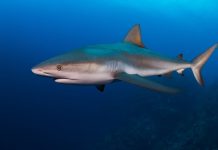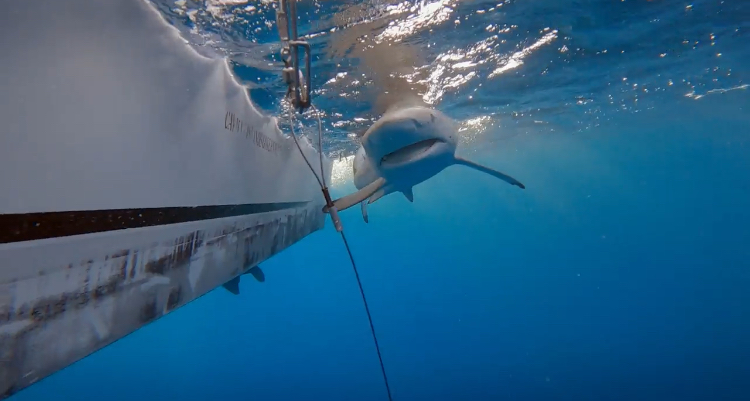
The work of Cayman’s shark taggers is the subject of a new documentary, ‘Tagged & Tracked’, that premiered this week.
The film, by James Dartnall, which features the shark monitoring efforts of the Department of Environment, had its pre-release showing at the National Gallery of the Cayman Islands on Monday night, launching the start of ‘Cayman Shark Week’.

Playing to a crowded room in the Dart Auditorium at the gallery, the documentary followed the DoE’s shark research coordinator Johanna Kohler and her team over a number of months last year when they tagged and tracked eight black tip and Caribbean reef sharks.
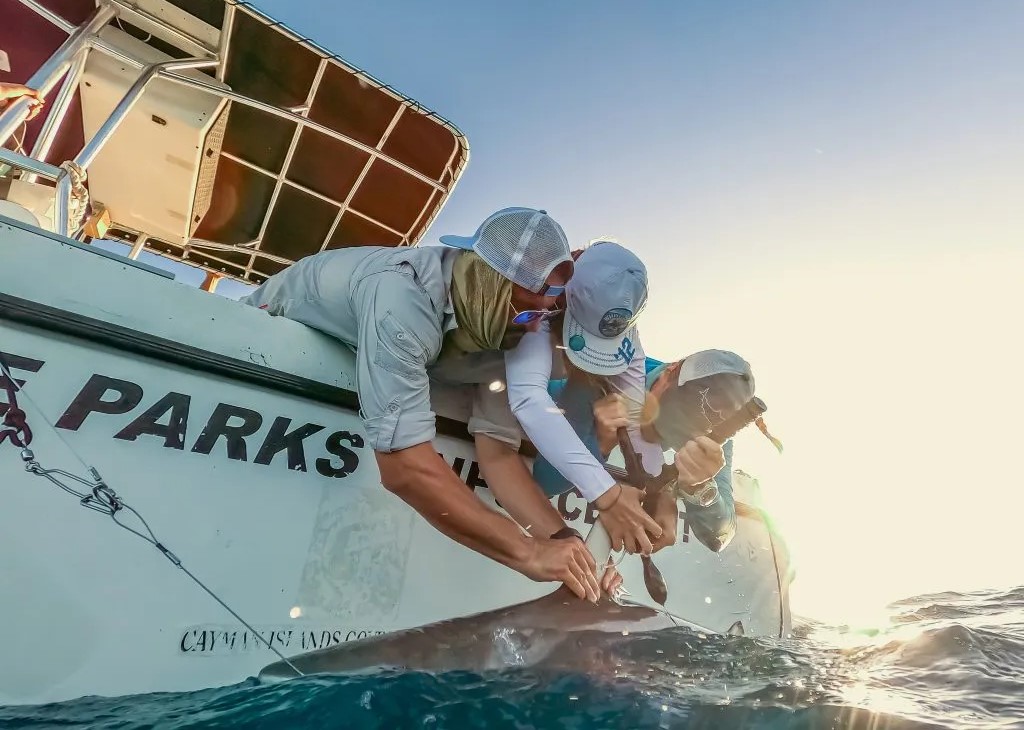
One scene shows Kohler and colleague Anne Veeder as they expertly hook a shark, place a rope around its tail fin, pull it close to their boat, turn it upside down so it goes into a relaxed state, attach a satellite tag to its dorsal fin, and then set it free. It’s a step-by-step, finely tuned and oft-practised manoeuvre that, once the animal swims away, is celebrated happily by high-fives and cheers afterwards.
The pop-up archival satellite tags, or PSATs, are specially designed to monitor animals that do not spend much time at the ocean’s surface. The major advantage of using them, Kohler says, is that they don’t need to recapture the tagged shark to retrieve the data, and the tag detaches itself from the shark at a pre-programmed time.
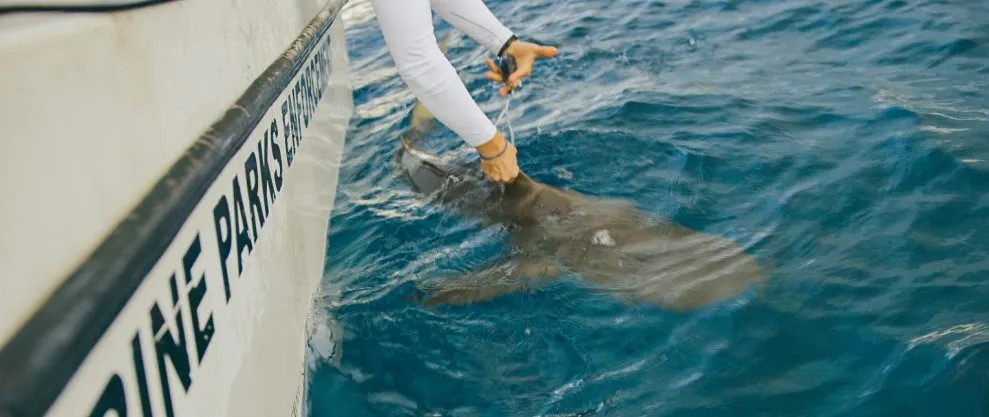
Dartnall admitted the calmness of the process of catching and tagging the sharks initially took him by surprise. He said with shark videos, people almost have an expectation to see an aggressive animal, recounting that another filmmaker involved in shooting footage for Discovery’s Shark Week had told him, “You’ve got to show a shark biting something in the first three seconds.”
But, he said, he’d wanted to make a film that showed the sharks in a “peaceful light”.
The first time he went out on the boat with Kohler’s team, and they caught a shark, he said, “I was, like, you’ve got a shark! OK, cool, let’s go!’ And they just went, ‘Right, let’s sit down.’ … They were so calm… It was fantastic, it was like a dance, the way they move, they know exactly where [the shark is going to be].”
Diving habits of sharks
The data collected by the pop-up archival satellite tags showed some previously unknown habits of sharks. For one, the Caribbean reef sharks went deeper that anyone had expected, with one making the deepest dive recorded in the region.
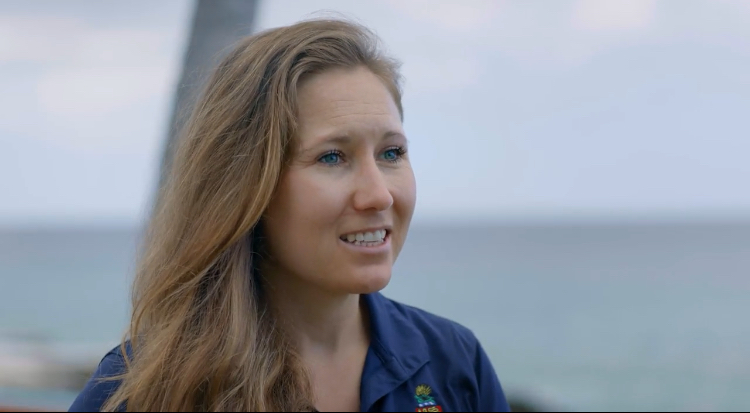
It also found that the Caribbean reef sharks go far off land and to very deep water during hurricanes, while the tagged black tips sought shelter in shallow sites in Grand Cayman during the storms. In fact, the tags the scientists attached were designed to “pop off” if the sharks spent a long time in very shallow water, at constant depth, or in very deep water, as that may be an indication that the shark has died. When the tags started popping off and floating to the surface in hurricane season, Kohler, in the film, says she thought something had gone seriously wrong with the equipment.
The data collected also showed that black tips typically head to deeper water at night, going out just after sunset and staying deep for about 10 hours, before coming back up to shallower water shortly after sunrise. But immediately following the passage of a hurricane, it appears they are more reticent, going out to deep water for shorter periods and spending more time in the sound, “almost like testing the water,” said Kohler, who holds a PhD in marine biology.
She says this is the first time the behaviour of sharks during hurricanes has been recorded.
The ‘Jaws’ effect: Changing people’s perception of sharks
Kohler says there are 18 species of shark that have been recorded in local waters – with some resident and other appearing seasonally. The most abundant, by far, are the Caribbean reef shark and the nurse shark.
The biggest threat to sharks in our waters, based on an analysis of reports between 2008 and 2025, is the effects of fishing, she says. In 2015, sharks became a protected species in Cayman, and anyone who accidentally catches a shark is required to release it. However, unintentional catches have still led to the deaths of sharks, she said, as the animal often undergoes severe stress or gets injured in such cases.
“One of the biggest challenges for shark conservation was, and still is, changing the public’s perception of and behaviour towards sharks. It begins with a natural fear of predators, and perhaps movies like ‘Jaws’ and other blockbusters have fed into this instinctive fear and amplified it,” she said.
Outreach programmes in schools and working with the fishing and angling communities locally has helped spread the message about the importance of sharks to the marine eco-system. Fishermen are advised that if they catch a shark, they should keep the handling time to a minimum and release it as soon as possible, to use circle hooks to avoid gut hooking, and to utilise non-stainless steel hooks.
“And to my personal delight, the outreach campaign seems to be successful,” Kohler said. “As the years progressed, we received more and more reports of people actually releasing the sharks.
“I know it’s disheartening to see sharks with the remains of fishing encounters, such as hooks and fishing lines, but it is evidence that anglers and fishers are doing the right thing and releasing the sharks.”
The change in behaviour is reflected in the data, she noted. In 2017, the Department of Environment received reports of 21 dead sharks, but the numbers have been reducing year on year since then, with last year seven being reported, and none being recorded so far this year.
An even more encouraging sign of the recovery of the shark population is sightings of baby sharks in local waters, she said, which indicates that sharks are giving birth, or pupping, in the Cayman Islands.
She pointed to a video shot in Smith Barcadere last year, showing a little shark swimming right by the beach. “When you listen to the audio online, you will notice that no one was alarmed or panicked, and that’s a great sign that people’s perception is shifting.”
The film is screening at the Cayman Islands Brewery from 6-8pm (door opens at 5pm) on Saturday, 5 April. Entry is free.
Related Videos