

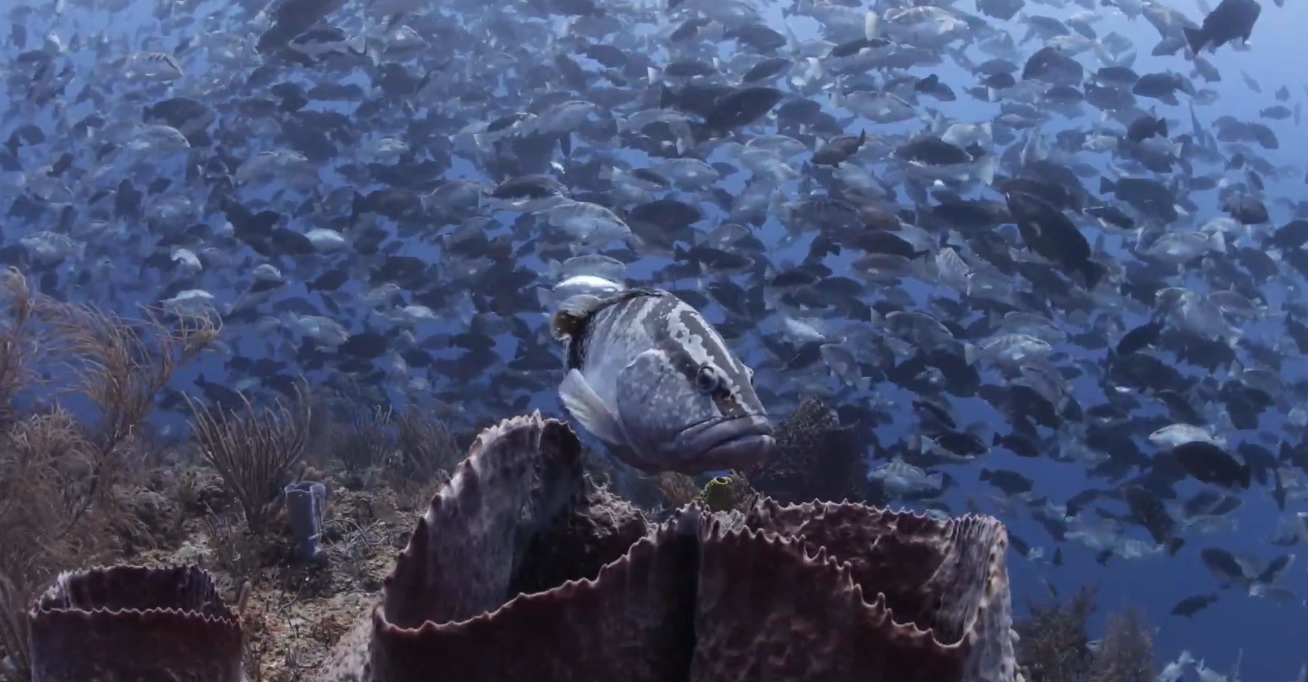
Evolving technology over the past quarter of a century has helped marine scientists monitor and manage Nassau grouper’s spawning grounds in Cayman.
Since 2001, Cayman’s Department of Environment kept tabs on the Nassau grouper population at spawning sites. It has worked with overseas academics and marine biologists on what has become known as the ‘Grouper Moon Project’, to track and record spawning aggregations of the endangered species.
The ability to count and track the fish, and examine their behaviour, has been central to the project. From the early days of tag and recapture, scientists are now using techniques like AI facial recognition and environmental DNA to garner a better picture of what’s happening under the waves during the once-a-year aggregation.
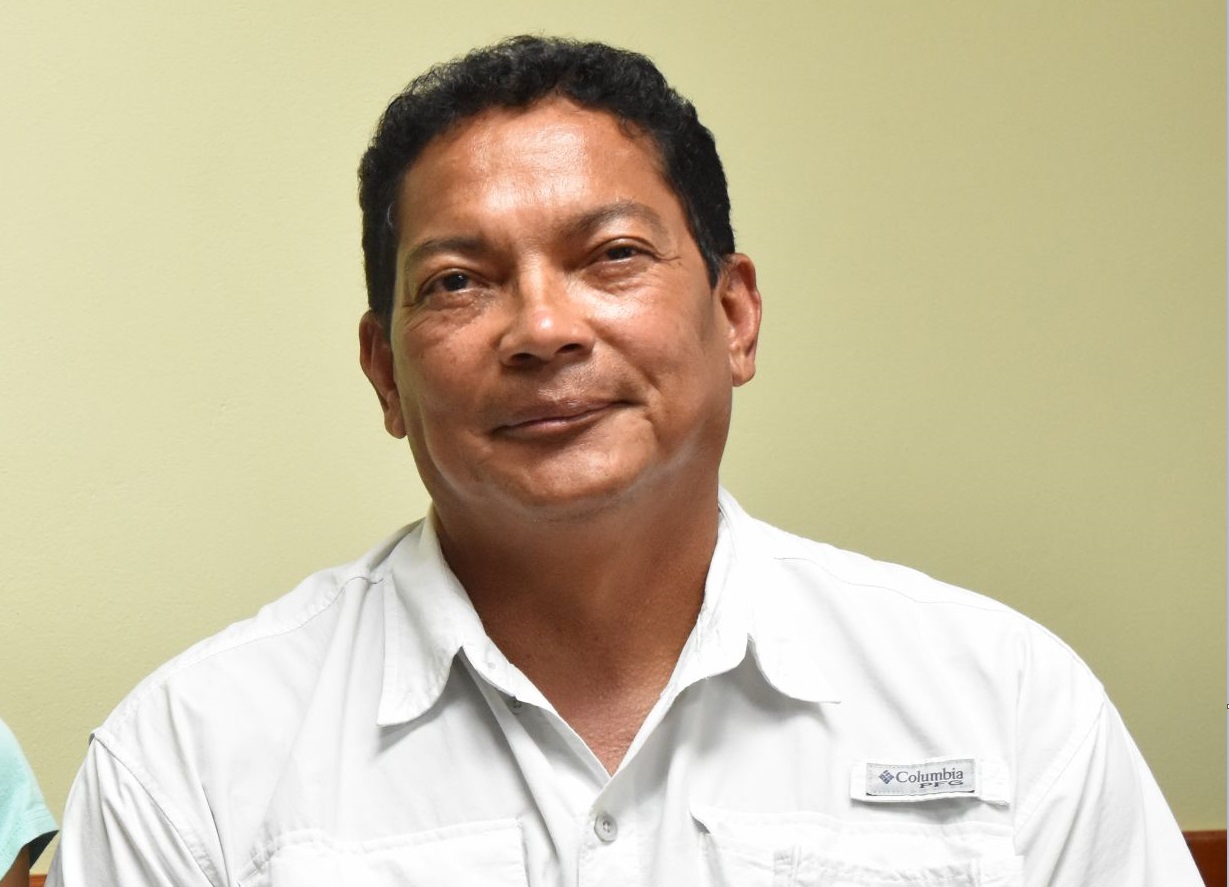
Croy McCoy, research manager of the Department of Environment’s Research and Assessment Unit, is among the multi-agency team members that will head back to Little Cayman next month to keep an eye on this year’s spawning.
“Originally, we used to do tag and recapture, and also video and count fish, where graduate students would sit there in front of [the footage] and count each fish, but we graduated from that a long time ago,” McCoy said.
“Now we’ve gone into fish faces with AI, and that’s an amazing tool,” he said, explaining that each fish is unique, and just like with facial recognition with humans, AI tools can identify each individual grouper.
“We put a huge team in there, and over three or four days, we just take as many photos as we can and run it through AI facial recognition, much the same as those used at airports.
“What used to take hours and hours, we just run it through AI, and we know that same fish was here last year and the year before and such. They’re all individual, they all have their own patterns.”
Scientists on the project are also beginning to use environmental DNA, or eDNA, to determine what species, and in what concentration, have been in a particular area of water. With this method, a sample of water is taken and analysed, and any DNA shed from a fish or animal that has passed through that site can be identified.
That method is still being perfected, McCoy said, but he added, “We’ll get there.”
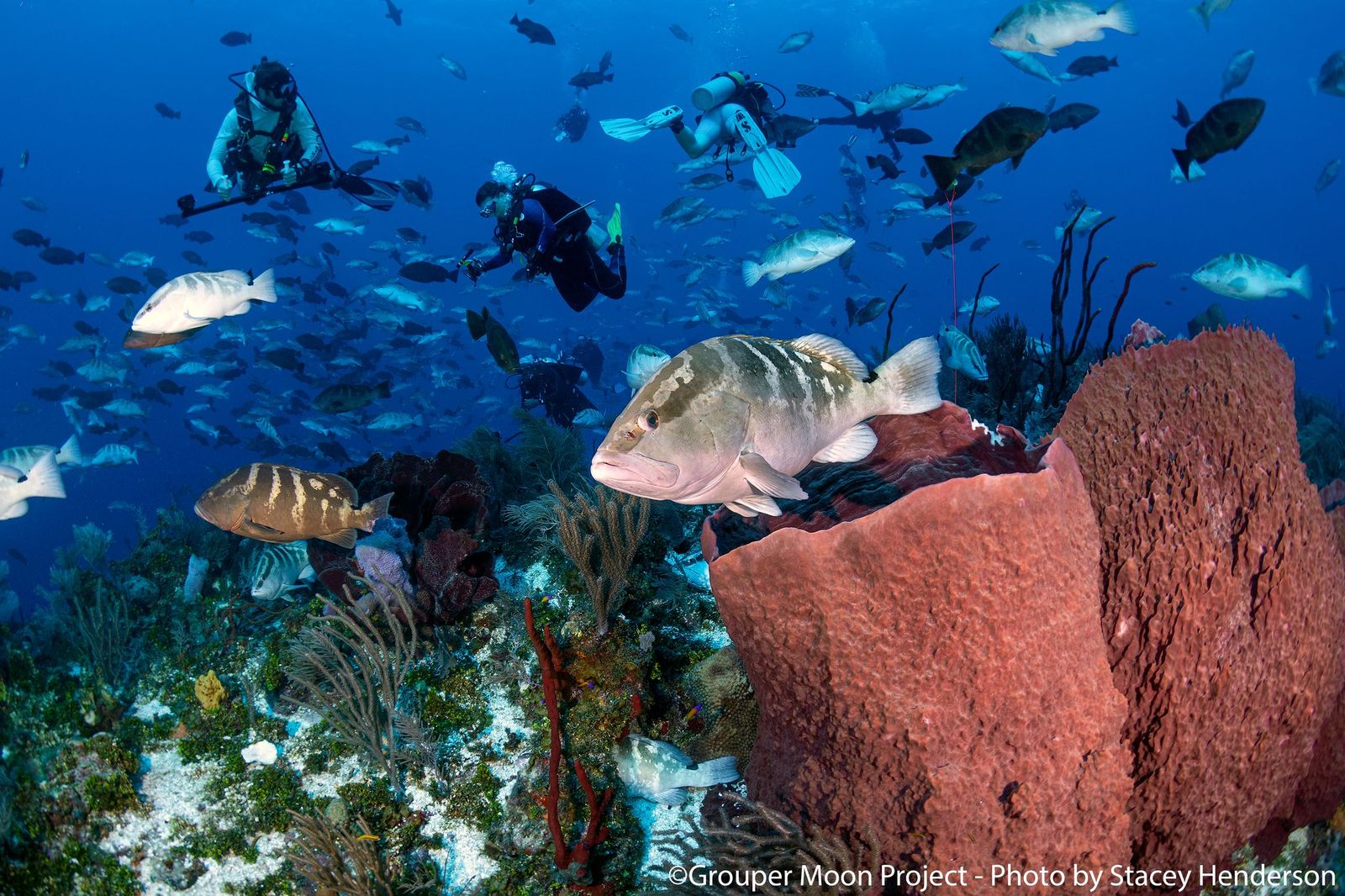
Protecting the ‘maternity wards’ of the ocean
Overfishing of spawning sites had led to a massive drop in the population of Nassau grouper numbers across all three islands. However, a ban on fishing at the known sites from 1 Dec. through 30 April each year has seen numbers grow, especially on Little Cayman.
Little Cayman has been the main focus of the Grouper Moon Project over the years, in part because of the accessibility of the spawning site there, as conditions on Cayman Brac and at East End in Grand Cayman are far more challenging, and those sites are tougher to access, McCoy explained.
The site at the west end of Little Cayman was discovered by fishermen in 2001 and was estimated to have an aggregation of about 7,000 Nassau groupers at the time. Within a couple of years, two-thirds of that population had been fished out, leading to the government’s seasonal ban on fishing at aggregation sites.
“The Nassau grouper is an iconic species of the whole region,” McCoy said. “At one point, they were as common is any other fish you see on the reef. Due to their nature of not only aggregating in one particular spot at a certain predictable time of the year, but the fact that they taste good … they’re very vulnerable.
“They’re like the puppies of the ocean … they’re very easy to catch. You know, they always say about fishing in a barrel. They’re easily extracted, because just about anything you put in the water, they’re going to try to eat, and that has led to their demise.”
McCoy, who holds a PhD in ocean sciences, describes the aggregation sites as the “maternity ward” for the reef and ocean, as they’re not only breeding areas for Nassau grouper, but for several other species as well. At one point, he said, he spent 13 months monitoring an aggregation site and counted 27 separate species that spawned there.
“It’s not rocket science to understand the fact that if you take the mothers and the fathers, mainly the mothers going to the maternity ward, you’re not going to have a population anywhere in the world,” he said.
McCoy commended the Cayman Islands government for implementing and then later extending aggregate site fishing ban indefinitely, as well as the fishing community for adhering to it.
He described Grouper Moon in Little Cayman as “one of the most successful fisheries restocking projects in the world”, adding, “Little Cayman has the largest known Nassau grouper aggregation in the region that is known.”
The project, which was established by the Department of Environment and the Reef Environmental Education Foundation, or REEF, is called the Grouper Moon Project because the annual aggregations occur around the full moon.
Other organisations, including the Scripps Institute of Oceanography, Oregon State University, University of Southern California and the US National Oceanographic and Atmospheric Administration, have also come on board.
‘Homegrown’ on local reefs
The research carried out by McCoy and the Grouper Moon team over the years has enabled the scientists to prove what that the grouper population is “self-recruiting”, meaning the Nassau groupers on the local reef come from Cayman and do not drift in from other places. This knowledge lent a lot of weight to the argument for a fishing ban at the local spawning sites.
This proof was garnered with the use of underwater microscopes following ‘drifters’ – oceanographic devices that float on the sea surface to track currents – that were released to accompany the grouper larvae following spawnings.
“We know now that our fish are homegrown, the majority of them,” McCoy said.
“In my 30 years of being a marine biologist, this is probably one of the, not only amazing, but most fulfilling and proud-of projects I’ve been involved with,” he said, adding that he is glad to have played a part in ensuring Nassau grouper will remain on local reefs for future generations.
Related Videos








They should ban fishing there for 24 months straight Then there will be more fish for everyone
There needs to be a permanent Grouper fishing ban in the Cayman Islands.