

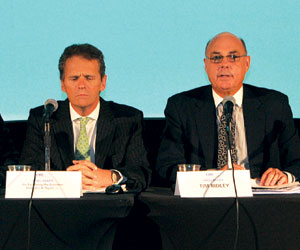

The speakers at the ninth annual Fidelity Cayman Business Outlook conference gave a mixed view of whether or not the global financial crisis was ebbing and what role China would play in the near future.
The conference took place at the Westin Casuarina Resort on Thursday, 19 January, and attracted nearly 400 people, the largest attendance ever.
Fidelity Group Chairman Anwer Sunderji set a sombre tone in his opening remarks.
“At the risk of sounding like Dr. Doom, the outlook is … clear, but not pretty,” he said, adding the continuing recession in Europe, along with anaemic job growth in the US and a sharp slowdown in economic activity in China did not bode well for a global economic recovery.
He said estimates are that 40 per cent of US homeowners will have negative equity in their homes, leading to a continuing trend where Americans will spend less and save more and since the US economy – and other world economies – relied heavily on American consumption, an economic recovery would be slow.
Keynote speaker George Friedman, author and founder and chairman of Stratfor, was not as gloomy in his economic forecast, but he spoke of the changing world economic landscape that has occurred.
He said what began in 2008 as a financial crisis has now become a major geopolitical crisis, which concerns two of the major players of the world: Europe and China. He argued neither of those powers will emerge from this period the way they or the world expected them to.
The financial crisis in Europe is only a reflection of the deeper crisis that the European trade regime is inherently irrational, he argued, predicting that the differences in competitiveness between Germany, the world’s second largest exporter, and smaller periphery countries will lead to tensions over the question of national sovereignty. How the crisis will pan out no one knows, Mr. Friedman said, but “the idea of a United States of Europe counterbalancing the United States geopolitically is not going to happen”.
China will have to deal with the problems of poverty and unemployment, as 80 per cent of Chinese households still earn less than $6 a day, he said. Meanwhile, Chinese exports are becoming increasingly less competitive, despite their already low profit margins. Mr. Friedman noted “a global dispersion of baseline production out of China to other countries”.
“China is an amazing story, but the idea that this is the eternal growth machine flies in the face of what we know about business, which is the faster you grow, the more inefficiencies you create. You must slow down to clean out those inefficiencies. If you don’t, you pile them up and they become more difficult to deal with,” Mr. Friedman said.
Financial Times journalist Gideon Rachman agreed with Friedman that 2008 was a turning point, but summarised his different take on the largest players in the world by saying he was “more negative on Europe, more negative on the US and more positive on China”. Because 2012 will see election in France, the US, Russia and China these countries will be consumed by internal politics and inherently unpredictable.
Mr. Rachman retraced the evolution of globalisation, beginning with the opening up of China in 1978 and an age of optimism, characterised by a coherence around a global capitalist system. Since the financial crisis, however, the notion that globalisation is a win-win proposition has become more open to challenge and a zero sum logic is taking hold, he said. According to this logic, one country’s gain is another country’s loss and not all countries will benefit from globalisation and openness. This is providing a fertile ground for tensions and conflict. Trade imbalances and the sovereign debt crises could lead to new trade barriers, Mr Rachman said. Economist Alex Tabarrok disagreed on that point, stating that the lack of new tariffs and trade barriers after the crisis showed that we have learned from the past. Mr. Tabarrok’s presentation called for the US to transform itself from warfare-welfare state, dominated by the largest items of expenditure for the US government, to an innovation nation, which takes advantage of new information technologies and improving the quality of education.
This argument was underlined by speaker Anthony Williams, who presented examples of how businesses can benefit from social media and the way the Internet has widened the potential for collaboration, organisational and business model flexibility and the sourcing of services.
The conference ended with a panel discussion titled “Politics, Good Governance and Transparency”. The panel was moderated by former Maples & Calder and Cayman Islands Monetary Authority Chairman Tim Ridley. The panel included Cayman Islands Governor Duncan Taylor, Information Commissioner Jennifer Dilbert, Auditor General Alastair Swarbrick, People’s Progressive Movement Chairman Anton Duckworth and attorney Michael Alberga.
The panellists all agreed that good governance is key to the economic success of countries.
With regard to transparency, Mrs. Dilbert said one of the reasons the Cayman Islands wants government transparency is so that we can have “informed public partnership in government decision making”.
Although Cayman has legislation to create entities that promote and protect good governance and transparency, Mrs. Dilbert said it was important to have “smart” legislation that is properly managed. Mr. Alberga cautioned that Cayman, with a small population, has to be careful about creating good-governance promoting institutions that are modelled on similar institutions in countries with populations of 30 million or more.
“We have to be careful we don’t build institutions that countries of 50,000 to 60,000 can’t afford,” he said.
Mr. Duckworth said that while the cost of these institution is important, the need for them is also important “especially if a lot of your economy comes from abroad”. He said a recent opinion article authored by former Cayman Islands Monetary Authority director Richard Rahn comparing the economies of Cayman with Belize, attributed Cayman’s success to good governance.
Governor Taylor said he sympathised with Mr. Alberga’s comment about the cost of good governance institutions and initiatives, and cited the Public Management and Finance Law as something Cayman had instituted for reasons of good governance, but “clearly the system is not working”.
Mrs. Dilbert said while there are costs involved in establishing institutions for good governance, there were also cost savings derived from government entities knowing they can be held accountable through freedom of information requests.

Related Videos












Governor Taylor said he sympathised with Mr. Alberga’s comment about the cost of good governance institutions and initiatives, and cited the Public Management and Finance Law as something Cayman had instituted for reasons of good governance, but clearly the system is not working.
Mrs. Dilbert said while there are costs involved in establishing institutions for good governance, there were also cost savings derived from government entities knowing they can be held accountable through freedom of information requests.
The information shared from this conference is informative but not particularly enlightening for those of us who try to keep up with international financial and political affairs…and not just local political issues and gossip.
Basic arithmetic says 11=2, 1-1=0, basic primary school counting but also a universal principle; you cannot overload the world’s economy on one side of the equation, China and India, because of cheap labour and production markets by robbing the higher-expense but also higher profit margins economies of the USA and Western Europe and expect that any profits gained are going to compensate for the losses incurred.
In this respect, as this conference has admitted, globalization has been a failed experiment as the economy of China cannot, by itself, drive world economic recovery.
The conference’s position that creating a United States of Europe, to counterbalance the trade inefficiences between the vastly divergent economic and political positions of the countries within the European Union is a sound economic analysis but it does not take into consideration the political realities of the European situation as they stand now.
That the European Union is headed in the direction of becoming a federal United States of Europe is a foregone conclusion…the politicians in Brussels have already embarked upon this irreversable course and in only a short few years from now, the world will be dealing with a totally-unified European Superstate, more than likely, and hopefully, excluding the United Kingdom.
Where this conference had good sense is in excluding any participation of Premiere McKeeva Bush, embarrassment that he is and has been in such forums…
And included the most qualified professional civil servants to present unquestionable facts, not political rhetoric, on behalf of the Cayman Islands.
Governor Duncan Taylor is proving to be the most lame-duck, non-action Governor that the Cayman Islands has had in recent memory…he is again attempting to pass the buck by admitting that the checks and balances in place to control the local politicians abuse of the system under the Public Management and Finance Law is not working but failing to acknowledge that it is his responsibility to oversee and discipline the local politicians when they abuse their power and fail to abide by this law; he has sat in his ivory tower and done absoluyely nothing at all, in this regards.
Any local voters having the foresight and intelligence to read this report should come to a few wise conclusions in their next decision-making exercise, which comes around again in 2013.
First of all, avoid any political candidate who comes promising unrealistic results and projections for economic paradise in the Cayman Islands…this conference says that this is totally unrealistic and impossible.
Also, avoid any political candidate who cannot at least prove some level of educational qualifications, at least up to tertiary degree and professional qualifications standards; Cayman’s political leaders now need to be of a younger, more educated and in-tune with today’s realities standard and less susceptible to special interests temptations.
If Cayman’s voters are going to continue with this outdated system of excluding qualified non-Caymanians from running for political office, then they must realise and take responsibility for the fact that they, themselves, are their brother’s keeper, in every respect.
The future of themselves and their Caymanian brothers and sisters continue to lie solely and squarely in their own hands.