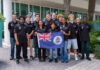
Sponsors and supporters of the Central Caribbean Marine Institute were thanked last Wednesday at a reception held at the Governor’s house.

Governor Stuart Jack, centre, with Dr. Carrie Manfrino, president of CCMI, left, and Peter Hillenbrand, chairman of the board of CCMI, at a reception held at the Governors house last Wednesday. The event was an opportunity for CCMI to thank sponsors and supporters. |
The reception offered the ideal opportunity for CCMI board members to mingle with guests and update supporters on the organisation’s progress over the past year.
Established in 1998, the non-profit organisation, which is based in the Cayman Islands, aims to sustain bio-diversity of coral reefs through research, education and outreach.
Dr. Carrie Manfrino, president of CCMI, gave a presentation, bringing guests up to date with the organisations activities. It’s been a busy year for CCMI.
A major milestone was CCMI’s opening of its 6,000-square-foot Research Centre on Little Cayman. The centre, designed by local architect John Doak, houses labs, multi-media classrooms, living quarters for students and visiting researchers, as well as a well-stocked library.
Since its opening date, over 30 researchers from across the globe have used the facility as they explore and collect data on Cayman’s reefs. This week, a scientist from California is arriving in Cayman to look at bio-diversity of fish in Cayman and the regeneration of coral.
‘The research centre has been very warmly embraced, by both international researchers and the local community,’ said Melissa Wolfe, director of development at CCMI.
Cayman’s Twilight Zone is one of CCMI’s most recent projects. Completed at the end of May, the project carried out research of the coral reefs, and creatures living on the reefs, at depths of up to 300 feet. As a result of the research, scientists now have a better understanding of the connections between shallow coral reefs, common to recreational divers, and reefs at extreme depths.
Projects coming up include the installation of the Noaa Icon Station, funded by the National Oceanic and Atmospheric Administration.
The station, based off Little Cayman, will house instruments to monitor the surrounding water and air, forecast and predict storms, enabling the CCMI to better understand stress to coral reefs.
The work of CCMI is not just about research. Education is central to the organisation’s work, and as such there are numerous educational programmes running at any one time.
The popular Sea Camp, now in its eighth year takes place this August and gives high school students the opportunity to learn more about marine biology.
Cayman Scholars pairs high school and college students interested in marine research with early career scientists, while Eco-Weekends at CCMI’s research centre aim to give high school students an understanding of the importance of coral reefs and what can be done to conserve them.
Ocean Literacy is an ongoing project of CCMIs. The project aims for every child to have a basic understanding of the importance of the sea world by the age of 12 and for basic Ocean Literacy to be taught in schools as part of a national curriculum.
To find out more about CCMI visit www.reefresearch.org.
Related Videos