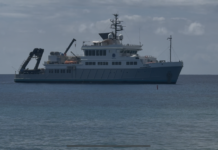
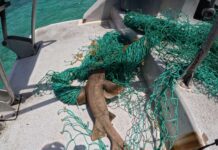
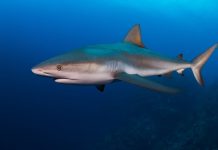
Researchers on the ‘Deep See Cayman’ project have spotted a rare glow-in-the-dark kitefin shark, the first such sighting of the species locally and in the Caribbean.
DoE shark project officer Johanna Kohler, who holds a PhD in marine biology and ecology, confirmed the sighting, telling the Compass it was “significant” as it was the first time it had been recorded and videoed for the Cayman Islands and the region.

“We, at the [Department of Environment], are excited about this new finding,” she said.
The kitefin shark, which was recorded for the very first time locally over the summer, is typically found in the Atlantic, Indian and Pacific Oceans, according to the Shark Research Institute.
This makes the Deep See footage of the unique shark even more significant.
The shark, the DoE said Friday, was discovered below 1,000 metres/3,200 feet of depth as part of the Deep See Cayman project using baited underwater video systems.
“This species is by far the biggest bioluminescent shark and vertebrate found on the planet to date. Kitefin sharks have been known about since the 18th century, but it was an exciting surprise to see one in the Caribbean. Another bioluminescent shark recently discovered in Cayman deep waters is the rare blurred lantern shark (Etmopterus bigelowi),” a DoE post on the discovery said.
‘Historic’ discovery
Kohler, in reflecting on the moment she saw the shark on the video, told the Compass, “My mouth dropped.”
“It looked incredible – graceful and strange at the same time. After some research to confirm the species, we realised this is a historic discovery for Cayman. This is to show how little we know about Cayman’s deep waters. We have so much to look forward to discovering,” she said.
The Deep See Cayman project, which began in March 2022, is the first effort to explore the islands’ deep seas (depths of about 2,000 metres/6,600 ft), she said.
“It has been very rewarding including new records of three shark species in Cayman and data on ecologically and socio-economic important species such as deep water snapper and sharks,” Kohler said.
Blurred lantern sharks, just two feet long and covered in light-emitting photophores that allow them to thrive in the murky depths of the deep ocean, had never been recorded in the Caribbean before.
Kohler said gathering data and footage in the project is of great importance to the Cayman Islands and its environment.
“Knowing the local biodiversity of species and understanding their ecology will place the Cayman Islands at the forefront in managing deep-sea activities like mining and fishing and enhance the island’s sustainability while also adding to the minimal knowledge of the distribution of these species throughout the Western Atlantic Ocean,” she said.
The Deep See research is being conducted in partnership with Beneath the Waves, Marine Conservation International and Heriot-Watt University, and is funded through a Darwin Plus Grant from the Department of Environment Food and Rural Affairs of the UK government.
The project, Kohler said, receives additional support through sales of White Tip beer from the Cayman Islands Brewery.
Related Videos