

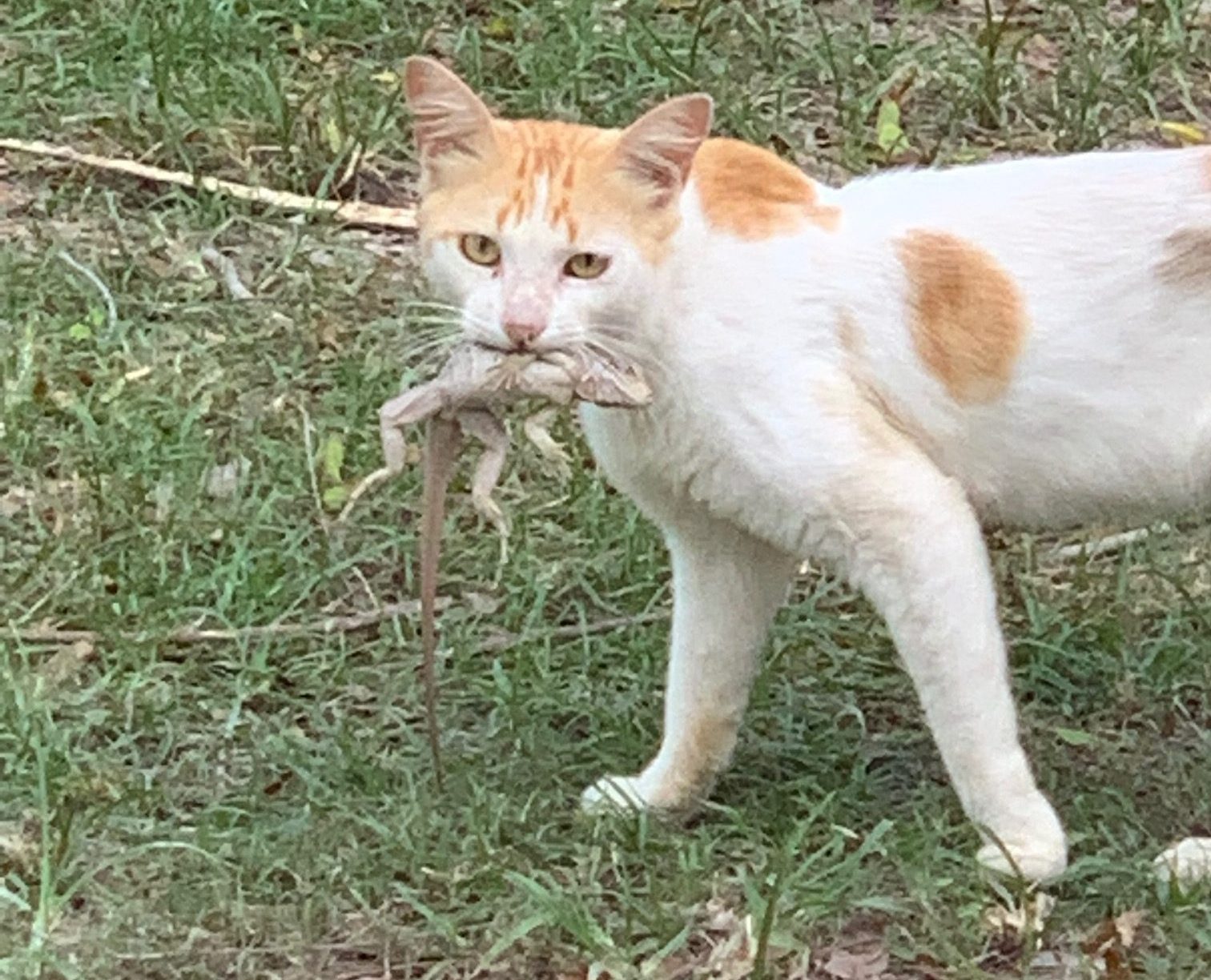
The National Conservation Council has approved updated procedures for managing feral cats in Cayman’s environmentally sensitive areas, after evidence showed that targeted control on the Sister Islands led to dramatic gains for native wildlife.
At the 17 Sept. general meeting of the NCC, Fred Burton, head of the Department of Environment’s Terrestrial Resources Unit, announced that intensive control efforts have wiped out more than 85% of Little Cayman’s feral cats.
The results, he said, have been “truly extraordinary”, with the critically endangered Sister Islands rock iguana making a strong comeback and brown booby nesting success on Cayman Brac showing marked improvement.
Previous reports show that after most feral cats were removed, Little Cayman’s rock iguana population surged from roughly 1,000 in 2022 to around 3,500 by 2025.
“The Sister Isles rock iguana population has been in catastrophic decline for quite a considerable while,” Burton said.
“Once we removed those cats, the population went back up into growth phase and it’s more than tripled in the last two years. We’re also hearing a lot of feedback from the community on Little Cayman that they’re seeing other species in numbers and age classes they hadn’t seen before.”
The feral cat problem
Documents published with the NCC meeting agenda note that feral cats are linked to at least 14% of global bird, mammal and reptile extinctions and remain the main threat to nearly 8% of critically endangered bird species.
The Department of Environment has confirmed these impacts across Cayman, citing camera footage of cats preying on wildlife across all three islands.
Priority areas identified for feral cat control include all of Little Cayman colonial seabird and rock iguana nesting sites, all National Conservation Area protected lands and surrounding areas, as well as the National Trust’s major reserves.
The need for humane control of feral cats
The new procedures expand the Department of Environment’s toolkit for feral cat management. To date, the DoE has relied on live trapping and veterinary euthanasia to manage the population.
Alongside control measures, the council highlighted the importance of improving access to veterinary and other support services to promote responsible pet ownership.
On Little Cayman, all pet cats have been registered, microchipped and sterilised, ensuring they do not contribute to the feral population.
“We’ve got records of their owners and the microchips, so if we catch somebody’s pet cat, we return it to the owners,” said Burton, noting that while traditional measures have helped control the feral population, they are not enough for total eradication.
“The Little Cayman community is very supportive of the idea that we should proceed to an eradication,” he said, stressing the need for humane measures. Trapping and transporting cats, he explained, is stressful and involves inhumane steps such as confinement and restraint.
The new measures aim to reduce suffering by allowing on-site humane gunshot euthanasia, night-only use of PAP (para-amino-propiophenone) toxic bait and restricted use of soft-jaw leg-hold traps on raised platforms to minimise risk to non-target species.
“We basically have to be able to get the last few cats out of the wild,” he said.
Burton estimated there are roughly 50 feral cats left on Little Cayman and said nighttime bait sweeps could reduce that to single digits. PAP, he stressed, degrades quickly in the environment and poses no secondary risks to other animals.
Burton underscored that eradication tools are only used in controlled situations where feral cats threaten species of high conservation value.
He pointed to the global record of cats driving extinctions and warned that without intervention, Cayman Brac’s brown boobies and Little Cayman’s rock iguanas could face the same fate.
The updated procedures were adopted by the National Conservation Council with one abstention.
“This is a step in the right direction of treating animals feral or otherwise humanely and protecting our native species,” Burton said.
Related Videos










Now, please take the same attitude towards feral chickens which have been a scourge throughout Cayman for years. Unhygienic, dangerous, an eyesore, and disturbing sleep with early morning caterwauling. The problem continues to multiply.
confinement and restraint.
The new measures aim to reduce suffering by allowing on-site humane gunshot euthanasia, night-only use of PAP (para-amino-propiophenone) toxic bait and restricted use of soft-jaw leg-hold traps on raised platforms to minimise risk to non-target species.
“We basically have to be able to get the last few cats out of the wild,” he said. I say this is a pathetic state of affairs when you have to go to such extremes, to cut down on a population. Typical of island mentality. Have you heard of spay, neutering enforcement. You do the same with dogs. Disgusting. Try educating society, with neuter and spaying and respecting living creatures, and employing a program that doesn’t make you all look like heartless slaughterers. Respect.
Dammed if you do, damned if you don’t. Louise B, I respect your sentiments about using inhumane methods but I also respect Fred Burton as a professional.
In cases such as protecting the LC rock iguana, booby and indeed other species, the urgency is clear. Thus, I gather, why lethal measures are employed. Cats which can’t breed still eat; dead cats, not so much. Trapping and neutering/spaying seems like a more timely (and costly) method.
I imagine those factors feature highly on the feral cat control program.
But expanding the program in any form to GC would be welcomed. I nominate my neighborhood in WB as the starting point.
And the DOE thinks “culling” cats and dogs is better than spaying and releasing? How cruel!!! Let the cats have their kittens, then use them for target practice. So what if the odd one gets away, wounded, and dies a slow, painful death. This is barbaric.