
At a glance
- Professor Mushfiq Mobarak of Yale University delivered a speech to UCCI on the impact of imported labour on Cayman’s economic growth
- He addressed the emotive topics with data from around the world, showing how other countries have been impacted
- First deciding what kind of country Cayman wants to be should be the basis of policymaking on immigration, culture and the economy
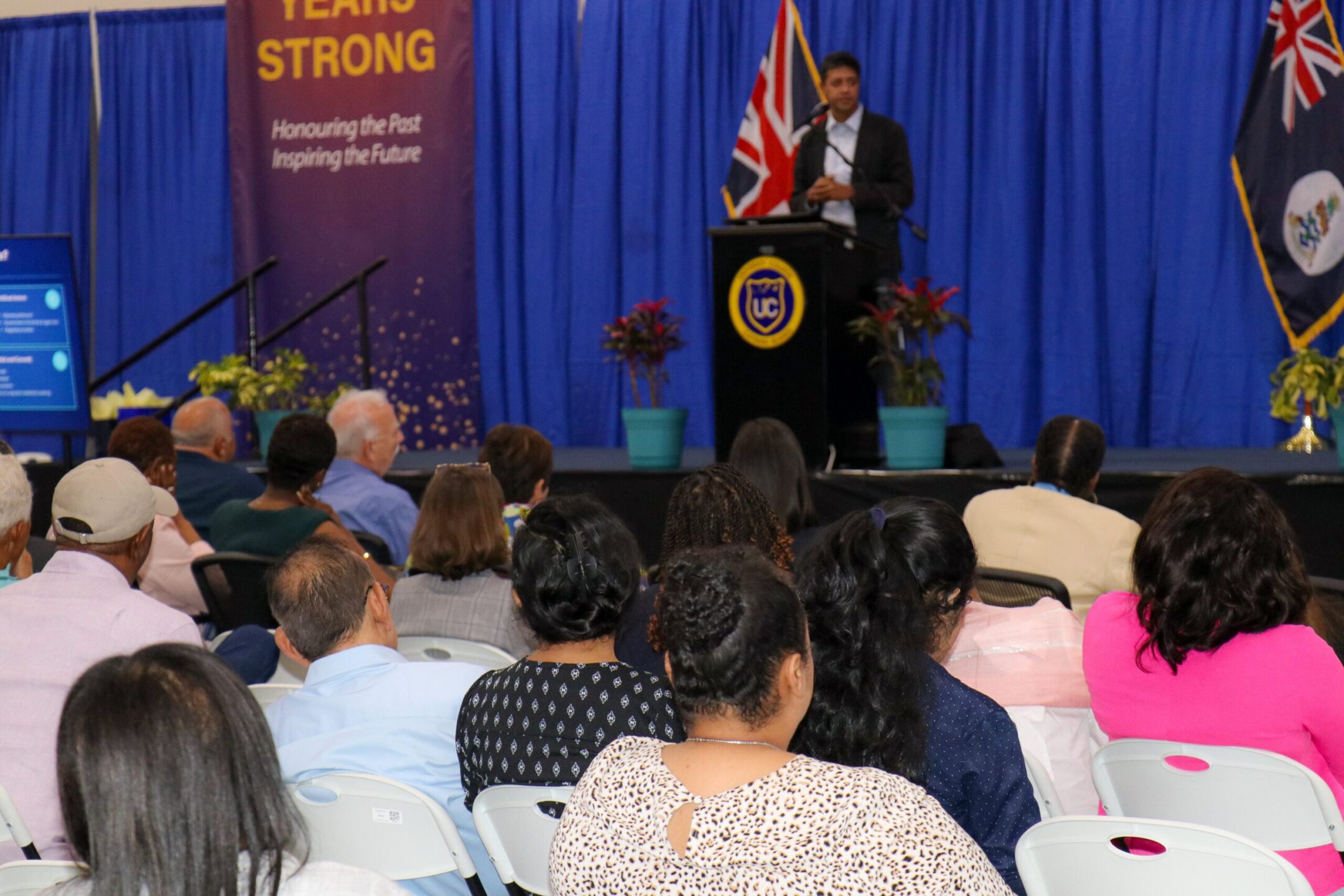
Internationally renowned development economist and Yale professor Mushfiq Mobarak didn’t shy away from tough topics when he delivered a speech at at the University College of the Cayman Islands titled Imported ‘Labour: Implications for Caymanians’ Long-term Economic and Human Development’ as part of the institution’s 50th Anniversary celebrations.
Introducing his topic, Mobarak acknowledged that it was an emotive and often controversial subject, saying, “I have not met a Caymanian who has not thought about immigration and does not have some feeling about it. … By choosing this topic, it was like putting my head in an alligator’s mouth and asking it not to bite.”
Putting the issue in context
Mobarak said he wasn’t going to tell the Cayman Islands what its policy should be, but he would try and give some wider context to the debate based on data from other countries.
With that in mind, he contrasted differing approaches from Japan and the US to immigration, with the former having a more closed policy which saw population growth stall and the ratio of non-working dependents such as children and the elderly increase, while the US continued to grow by bringing in working people to contribute.
“The fact that more than half the population are immigrant workers in this country is not an accident,” he said. “They’re there because the country needs them. If you are a small business owner, you need them. But that doesn’t mean that we should be necessarily letting immigrants in and have a policy of open borders.”
Countries differ in their capacity to bring in more people, he said, and whether they were net importers or net exporters of workers.
“What’s happening in Japan is finally the country has realised it needs workers,” he said. “That creates opportunities for countries like Philippines and Bangladesh, which have a large, young workforce, to take up those jobs. And why does Japan need workers? So it turns out, mortality rates in nursing homes in Japan are higher when the patient-to-care worker ratio is too high. The Japanese are literally dying from the lack of workers.”
Mobarak spoke about how immigration could affect the opportunities for Caymanians. “That’s the worry here, right? If you let a lot of Filipinos in, what does it do to our wages, our work opportunities for native workers?”
According to the data, he said, while you might expect wages to fall if more workers are coming in, studies actually show this doesn’t happen.
“Generally speaking, influxes of immigrants don’t have much of an effect on the wages of the native population,” he said.
Opportunities
While immigrants could put a downward pressure on wages, they also create opportunities.
“You see lots of restaurants operating in the Cayman Islands. If we were to just put a stop or put restrictions on migrant labour coming in, I don’t think the number of restaurants or the number of job opportunities in restaurants for Caymanians would actually go up. The restaurants just wouldn’t run,” he said.
Whatever the data showed, people tended to believe something very different, he said. “People’s beliefs are overwhelmingly that migrants come in and hurt our work opportunities.”
But any adverse effects, if any, he said, tended to be on other immigrants.
“It’s not easy for an immigrant to come in and displace a Caymanian or American in a customer-facing role,” he said. “It’s much easier for a Filipino to come in and displace a Nepali person who has a security guard job. One of the things we’ll have to think about is … do recent immigrants actually want more immigrants to come in or not?”
He said immigrant labour can have a positive effect on economic growth in various ways, such reducing the price of childcare and providing outside skills.
While immigrant labour is often a fiscal cost to a nation in the short-term, it’s a net benefit further down the line, he said, citing as an example the studies that have shown that children of immigrants in the US are higher tax contributors than the children of US-born citizens.
However this message is often lost, not just in media coverage, but because having an overall benefit might be harder to spot than the immediate impact of hearing someone has lost their job.
Path to citizenship
Mobarak also raised the point of how other countries disconnected the concept of working somewhere leading to greater rights. In the United Arab Emirates, 87% of the population are immigrants, but are kept as guest workers, he said.
“There’s no green card path to citizenship, except for a very small number of exceptional circumstances,” he said. “That’s a very different social contract with immigrants, and that’s what allows them to actually have up to 90 per cent of the population, because the natives don’t feel like, ‘Oh, I’m letting somebody in, and soon I’m going to have to share my political rights with them’.”
One side gets cheap labour and the other is able to make more money than they would otherwise, and once their productive life is over, they go back home.
Immigration spectrum
“I’m not trying to endorse the immigration policy there,” he said. “I’m just pointing out that immigration policy can be a spectrum. The US has chosen a particular point on the spectrum. UAE and Qatar have chosen a very different point on the spectrum. And we don’t need to choose one or the other. We could try to figure out what point on that spectrum actually works best for us. It might be something in the middle.”
As far as Cayman was concerned, he said different people will have different views depending on circumstances. While there were many benefits, such as providing skilled workers for hard-to-fill occupations, or allowing Caymanians to start more businesses, there are other effects, too.
“What I have noticed is Caymanians being pushed farther and farther east with longer and longer commutes to get to George Town for work,” he said. “That has an effect on people’s quality of life – how many hours a day you spend stuck in traffic – and there has been a very visible change in that in the last 30 years.”
Economics wasn’t the only thing that mattered, he said, noting that many Caymanians “feel that their country is being taken away from them. … The presence of immigrants in our country might change how we do things, and it will depend on who they are; whether they’re assimilating to the culture or not … whether they follow the social norms that are here.”
A good policy would be one that successfully maximises those positive externalities and minimises negative ones, he said, highlighting skill transfers from other nations as well as benefiting Cayman in the long-term.
Related Videos