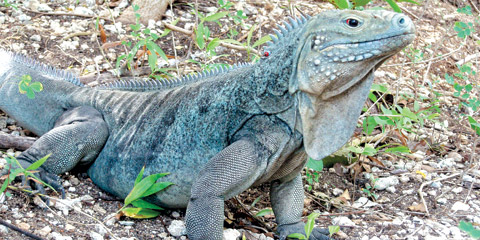
Grand Cayman is home to the Blue Iguana, a unique and magnificent creature. It is endemic to Grand Cayman – meaning it is found nowhere else in the world. Unfortunately, the combined effects of habitat loss, hunting, predation by cats and dogs, and road kills have resulted in a very close brush with extinction.
The Blue Iguana Recovery Programme, which started as a small project of the National Trust, and is now an international partnership, has been successful in rescuing the species from the brink; several hundred captive bred individuals have been released into protected areas in the wild and breeding populations have been reestablished.
Endangered
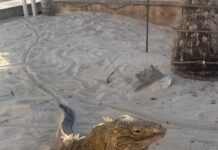
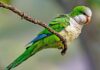
Despite these efforts, the Blue Iguana remains an extremely rare and critically endangered animal. The same cannot be said of the Green or Common Iguana. These animals are not native to the island, but were originally introduced as pets and now breed prolifically in the wild. Unlike the native Blue, these iguanas evolved in the presence of many predators and thrive in suburban areas where Blue Iguanas would never survive. They far outnumber the endemic Blues, and are frequently sighted, often being confused with the Blues, which are almost never seen outside of the protected areas.
The National Trust receives many phone calls each year from members of the public wishing to report sightings of Blue Iguanas. We attempt to confirm the identity of the animal over the phone but often callers remain convinced of their assessment and we conduct a field visit. Unfortunately, almost without exception, the iguanas turn out to be the invasive Greens.
Actually, the name Green can contribute to the confusion as only the juveniles are reliably green in colour. The adults come in numerous hues including brown, grey, orange and even blue. We therefore try to promote the use the alternative name, Common Iguana, and in offering identification assistance over the phone, one question that we seldom ask is the colour of the animal!
Iguanas have been protected under the Animals Law for many years. At the time the law was written, Blues were the only significant population of wild iguanas, and the law was not specific to them. When Common Iguanas started to spread invasively there was uncertainty regarding the legality of controlling them. A recent change to the law has removed that ambiguity, but has increased the risk of Blue Iguanas being mistakenly killed. It is therefore all the more important for the public to be familiar with the differences.
How to tell them apart:
Common Iguana has spines on the dewlap (the skin flap under the chin). Blues never have spines there.
Common Iguanas have a very long, whip-like tail, with vivid black bands. Blues have a thicker tail, without obvious bands.
Common Iguanas have a large circular scale, like a cucumber slice, on the cheek beneath the ear. Blues have their cheeks covered with cone-shaped, pointed scales when they are old, and never have a large circular one.
Apart from these differences, Common Iguanas are agile climbers and are frequently found high up in trees or on the walls of buildings; only juvenile Blues climb significantly. Common Iguanas are also excellent swimmers and are often found in and around bodies of water; Blue Iguanas rarely swim. Common Iguanas are often found in groups; Blue Iguanas tend to be territorial and solitary. Bear in mind that unless you are near the Botanic Park, or at the east end of the island, there is very little chance of spotting a Blue Iguana in the wild, but keep you eyes open as it could happen, perhaps once in a Blue Moon!
As a final note, Common Iguanas have not yet invaded Little Cayman, so if you see an iguana on the road, please slow down. It is virtually certain to be our endemic Sister Islands Rock Iguana. Due to increased development of the Sister Islands, and to the success of the recovery programme, this iguana is now even more endangered than the Blue.
This column was submitted by the Natioanl Trust for the Cayman Islands. Protect Cayman’s Wildlife! For more information or if you would like to contribute to the Blue Iguana Recovery Program, please visit www.blueiguana.ky or call the National Trust for the Cayman Islands at 749-1121.
Related Videos