

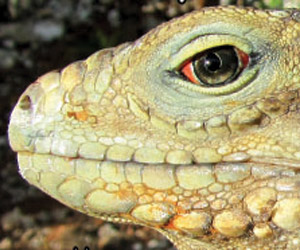

People who come across green iguanas on Cayman Brac and Little Cayman are being advised not to kill the reptiles themselves, but to contact the Department of Environment or the Iguana Hotline instead.
Bonnie Edwards, who is involved in a survey programme to track and count the number of native rock iguanas on the Sister Islands, said some people may not be able to differentiate between the green invasive species and the indigenous rock iguanas, so they should not attempt to cull the green iguanas themselves.
“The colours of adult iguanas may look similar depending on their body temperatures and surroundings,” she said. “It would be a catastrophe if a rock iguana were accidentally killed.”
“It could also lead to criminal charges against a person who killed a member of the protected iguana species,” Ms Edwards said.
There are plans to create and distribute posters that will help educate people about distinguishing between the species, “but, for now, citizens should not kill iguanas,” she said.
She said by contacting local authorities about green iguanas, it also makes it easier to track how many are on the Islands and where they are located, thus adding to information that could later help to deal with the invasive species.
The Department of Environment treats all sightings of green iguanas on the Sister Islands seriously as it is still possible to prevent the species from getting a foothold there, like they have on Grand Cayman, said DoE Manager of Terrestrial Ecology Mat Cottam.
“As far as we know, whenever a green iguana has been seen [on the Sister Islands], we’ve got it,” said Mr. Cottam, adding all sightings should be reported so that the Department of Environment can identify “hotspots” where iguanas may be hatching or where other green iguanas might be present.
Green explosion
The green iguana population in Grand Cayman has exploded over the years, partly because for several years after they first showed up on the Island, it was illegal to kill them, as they received the same protection of the indigenous blue and rock iguanas.
By the time the law was changed in 2010, green iguanas had become a common sight throughout Grand Cayman, but are still relatively rare on the Sister Islands, with only a handful being spotted – and subsequently culled – in recent years.
Mr. Cottam said members of the public on Little Cayman and Cayman Brac should not attempt to kill green iguanas themselves, to avoid cases of mistaken species identity.
“Here on Grand Cayman, we have very few blue iguanas and a lot of green iguanas and there’s quite a high level of public education about the Blue Iguana Recovery Programme, which has been running for more than 10 years,” he said.
The once critically threatened Grand Cayman Blue Iguana has been saved from extinction by the recovery and breeding programme that has led to 650 of the creatures now living in the wild.
They have been released into reserves in remote and rugged terrains on Grand Cayman where humans rarely venture. Green iguanas, however, are far more commonly seen in grassy and tree-filled areas, where humans are more likely to encounter them.
“There’s been a lot of education and awareness and most people on Grand Cayman can identify a green iguana from a blue iguana,” Mr. Cottam said.
He said: “There’s not much chance of bumping into a blue iguana … if you see an iguana in West Bay or George Town, it’s almost certainly going to be a green iguana. The difference in the Sister Islands is that there are a lot more of the native rock iguanas in the wild and also the level of education about the green iguanas has not been that high because they’re relatively new to the Sister Islands,” Mr. Cottam said.
Like what you see?
Local company Signs of Paradise has produced business cards as part of the initiative to count the number of native species – and track down any of the invasive kind. The cards carry the message: “Like what you see? Call me,” with the Iguana Hotline number displayed. They will be distributed throughout Little Cayman and Cayman Brac.
“We are very happy to do our bit to support Cayman’s wildlife in this way,” said John Kirksey of Signs of Paradise. During the count of the rock iguanas, in which volunteers identified and tagged the iguanas, 82 individual rock iguanas were found on Cayman Brac. “The Cayman Brac community assisted greatly in the Big Brac Iguana Count earlier this year,” Mr. Cottam said.
“The Department is also largely dependent upon their vigilance and reporting as an early warning system against the establishment of green iguanas on the Island. In this case, community support is not only appreciated, it is invaluable.”
Department of Environment staff dispose of the green iguanas once they confirm that the reported animal is a member of the invasive species.
Anyone who encounters what they believe is a green iguana on either of the Sister Islands should call the Iguana Hotline on 917-7744 or contact Department of Environment enforcement officers.

Related Videos













This is bad advice. Another example of government treating people as though they were stupid, and to make matters worse the government is nowhere near actually succeeding in dealing with the problem.
catchandrelease
People are stupid!
I’ve seen Greenies that are very much brownish at times and if people do not know the difference between a rock and a greenie then the result of an uneducated kill would be devasting to the remaining population on the Sister Islands.
But, on the other hand, if it’s Lime Green (and that’s not too hard to recognize)then take it out any way you can.
Lime Green Kill.
Brown, call the DOE to verify!
Simple.
Banana Republic, I agree that the lime greens should be killed any way they can be but please, on the Sister Islands where we still MAY be able to control the problem, call and report the location to DOE or the Iguana Hotline (917-7744) so that we can use the data in working toward the solution.