

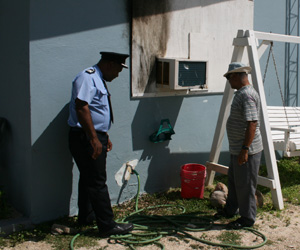
Kipling Street nightmare becomes horror for local woman

It was terrible enough that Bodden Town resident Ben McLaughlin had large rocks hurled at his home on Kipling Street over a period of more than a year, causing injury to himself, members of his family and damaging his property.
The nightmare situation got worse after the Royal Cayman Islands Police Service arrested a woman in connection with the rock throwing when, according to court documents filed in February, they could not have “reasonably suspected that it was [the woman] who had committed the offence of rock throwing either at the McLaughlin residence or at the police”.
“The officers’ hand-cuffing and man-handling [the woman] was oppressive, arbitrary and unconstitutional,” according to the lawsuit filed on 21 February, 2012 in the Cayman Islands Grand Court.
The claims made in the lawsuit have not been proved in any court of law; therefore the Caymanian Compass will not reveal the names of the officers allegedly involved in the matter. They are accused of numerous breaches of legal and professional procedures, as well as potential criminal acts and violations of basic civil rights against the lawsuit’s plaintiff; the woman who was arrested in connection with the rock throwing.
The defendants are named as the commissioner of police and the attorney general of the Cayman Islands.
The Compass will also not reveal the name of the woman who filed the suit, even though publicly available court documents identify her.
At the time of her alleged wrongful arrest by police in 2008 she was 60 years old. She is barely 5 feet tall and weighs less than 120 pounds. Yet she was accused by police of hurling large rocks onto the roofs of houses in the Kipling Street area.
She was eventually released in the matter without charge in 2009. Some of the officers involved in the arrest and subsequent confrontations with the woman have since left the RCIPS.
‘Living hell’
The rock throwing incidents in Bodden Town were well-publicised in the local press between 2007 and 2008.
According to court records, there were 34 various complaints made to the police about it between October 2007 and February 2008 “with no apparent police success in apprehending the criminal or criminals involved”.
“Some of the rocks thrown were said to be ‘half cement blocks’,” the lawsuit stated.
The civil court filing quotes a 3 August, 2008 article in the Caymanian Compass on the matter: [Then]-Bodden Town MLA Osbourne Bodden visited the scene of the crime Thursday morning to hear Mr. McLaughlin’s concerns. He said there were a few clues in the neighbourhood, but nothing was certain about the identity of the rock hurlers.
“It appears to be focused primarily around Mr. Ben’s (McLaughlin) son,” Mr. Bodden said. “He has been employed previously with the prison. He’s also been an immigration officer for the past two years, and was just recently released. In those jobs it’s quite easy to cross people who are not necessarily going to be great fans of yours.”
Mr. McLaughlin, the home’s owner, told the Caymanian Compass in 2008 that he and his family, which included his wife, his son, his son’s wife and his five grandchildren, were all afraid to go outside.
“I’m to the point now where ‘what is the use of you living in a place where you’ve got to live like a prisoner?’” he told the newspaper in 2008.
The February 2012 lawsuit over the matter claims: “There is no evidence that police ever investigated this possible source of the rock throwing i.e. some sort of grudge against Mr. McLaughlin, or in fact anyone else with a possible grudge against a member of the McLaughlin family.”
April-May, 2008
A police officer responding to Mr. McLaughlin’s Kipling Street residence on 18 April, 2008 stated the a rock landed on the property while she was there investigating a report of rock throwing.
Two police officers proceeded to the plaintiff’s residence, according to the lawsuit, and observed her getting ready for bed. She responded to the officers when they came to her door and told them she had been outside briefly to fix her drain and that none of the tenants on her property would throw stones.
“There is no evidence the officers searched the area looking for suspects at this time,” the lawsuit states.
Another rock throwing incident was reported about a month later, 16 May, 2008, led to the police pursuing criminal charges against the lawsuit plaintiff, who lived on the next street over from the McLaughlin’s home. The two properties were partly adjoined and separated by a fence.
During the 16 May, 2008 incident – which occurred around 10.30pm – Mr. McLaughlin said he had been hit by a rock.
“Although Mr. McLaughlin later claimed that he nor any of his family had ever had any problems with the plaintiff … he nevertheless on this occasion told the police when they arrived that the rock which had hit him in the side of the head had come from the direction of the plaintiff’s house,” the lawsuit indicated.
Police officers who responded said other rocks were falling in the yard when they arrived on the scene that night. It was during this incident that one RCIPS officer said she had seen the plaintiff hurling rocks at the McLaughlin residence “with her own eyes”.
“The plaintiff would have had to have thrown fairly large rocks in excess of 100 feet or more in order to quickly rush inside her house so as not to be seen,” the lawsuit claimed.
A number of police officers went to the plaintiff’s home, noting the woman raised her voice in protest to the officers but that no offensive language or swearing was reported. She had just gotten out of the shower, according to court records.
“The officers forced their way onto the plaintiff’s premises, pushing the plaintiff back physically and arrested the plaintiff on suspicion of assault causing actual bodily harm, whereupon they pull off the plaintiff’s towel leaving her naked … and ordered her to dress in a bath robe.”
The woman was then taken to the police station.
‘Fabrication’
The lawsuit also accuses two of the officers involved in the 16 May, 2008 arrest of “fabricating” a conversation with the woman they arrested.
The existence of the conversation was “not supported of any of the officers attending the scene, but was used during the interview with [a police officer] on 23 May, 2008”.
“The conversation alleged centered around the plaintiff’s response when asked by [an officer] ‘why she threw the rocks’; the plaintiff allegedly replying that it was because ‘the woman next door was evil’ and ‘so what if I did?’
“This alleged conversation never took place,” the lawsuit states.
At the Bodden Town Police Station that night, the lawsuit claims the woman who was arrested was asked to sign various forms which she could not read without her glasses. Police refused to let the woman contact her attorney, according to the lawsuit.
“The plaintiff was placed overnight in a cell for a total of 12 hours in full view of several shift officers coming and going and anyone else that visited the station,” the lawsuit states. “All the time, the duty officers and others were laughing at the plaintiff’s predicament and calling her guilty. The toilet urinal in the lock-up was in full view and after numerous requests, the duty officers took a long time to come and take the plaintiff to a more private toilet.”
The woman was eventually allowed to call friends, who picked her up at 10.45am the next day.
“There was, of course, no way that [the officer] or the complainant, Mr. McLaughlin, could reasonably ascertain with any degree of certainty that a 5 feet tall, petite 120 pound woman who just happened to live to the rear of the McLaughlin residence in Kipling Street, suddenly with no provocation and/or motive for doing so, and after living in the same residence for some three years previously, and keeping very much to herself, and never having any previous confrontation with the McLaughlin family whatsoever, would suddenly decide she would not only throw heavy rocks at the McLaughlin residence, but … would continue to throw rocks at the McLaughlin residence before discreetly returning back into her house.”
‘Wrongful arrest’
On 30 June, 2008, another report of rock throwing on Kipling Street was received by police. A man visiting the McLaughlin residence said a rock was thrown into the home, almost striking him.
Police went to the 60-year-old female plaintiff’s home again around 8.30pm the day of the report.
“[Three officers] arrived at the plaintiff’s residence and, after knocking on her bedroom window, arrested the plaintiff for being an idle and disorderly person in the plaintiff’s own house; an offence which does not exist,” the lawsuit claims.
“Again, the plaintiff was subjected to unlawful detention, first being taken to the Bodden Town Police Station for photographing and then to West Bay Police Station where it had been determined she would be detained overnight in extremely cold and uncomfortable conditions.”
The woman was taken back to the Bodden Town station the next day before being released. The 60-year-old woman had spent a total of 16 hours in police custody before she was driven home by police officers who, once they arrived at her residence, donned plastic gloves and searched the home, the lawsuit claimed.
One of the investigating officers wrote a police incident report on the 30 June, 2008 incident and titled it “inconsiderate behaviour”, the lawsuit stated.
Under the Cayman Islands Penal Code (2010) an offence for Idle and Disorderly Persons does exist; however, it generally deals with a number of offences committed in a public place, not inside a private dwelling.
‘Malicious abuse’
One of the officers involved in the ongoing rock tossing investigation is actually accused in the lawsuit of committing a criminal trespass at the plaintiff’s residence on 22 June, 2008.
The officer, according to the lawsuit, “acting on the assumption that he may find some incriminating evidence in the plaintiff’s residence” requested a warrant without providing a justice of the peace with “sufficient evidence” of what he expected to find, the court records state.
“The idea of a ‘missile throwing device’ had developed because of the lack of any other evidence, and indeed [a police sergeant] asked the plaintiff on one occasion whether she possessed a ‘catapult device,’” the lawsuit revealed.
No evidence backing up the claim of a ‘catapult’ used to launch large rocks was ever recovered by police. A Crown counsel who reviewed the police case in July 2008 formally asked the police to essentially re-submit their case with additional supporting statements, maps and photographs.
Another search warrant was obtained on 1 July, 2008, to look for the alleged ‘catapult device’, an application that the plaintiff’s lawyer called “unlawful”.
“It is not known why the justices of the peace, who signed off on the two warrants, were not more inquisitive as to the evidence [the officer] possessed in relation to a ‘missile throwing apparatus’ allegedly being hidden on the premises of the plaintiff,” the lawsuit claims.
On two other occasions, the plaintiff claims police “knocked on her door”, once in late July and once in late August.
“There is no question that senior officers were involved from time to time in some, if not all, of the malicious abuse of process and prosecution of the plaintiff, and that at least one request for a search warrant was authorised illegally, and was a direct trespass against the plaintiff and her property,” the lawsuit claims. “As a result of the said illegal search warrants resulting from the malicious process and prosecution of the plaintiff, the officers involved … acted oppressively, arbitrarily and unconstitutionally.
“[The Crown counsel who handled the case] participated in the malicious process and prosecution of the plaintiff and may have been involved in approving the procurement of the unlawful search warrants. On 5 September, 2008, [the Crown counsel], despite the complete lack of evidence against the plaintiff and knowing that at least two search warrants had not produced any evidence with which to convict the plaintiff, authorised serious charges to be brought against the plaintiff.”
At that date, the plaintiff was charged with reckless and dangerous acts against Mr. McLaughlin, common assault against Mr. McLaughlin, common assault against a police officer and common assault against Mr. McLaughlin’s daughter.
Tossed out
The plaintiff appeared in court in October 2008 for the first time and was required to attend court four occasions in the case.
On 27 March, 2009, the matter was dismissed for lack of evidence and the plaintiff was acquitted of all charges.
“The plaintiff was acquitted of all charges, ostensibly, on the fresh evidence of [a police officer],” the lawsuit states. “This ‘fresh’ evidence has never been made available to the plaintiff, even after requesting [it] under the Freedom of Information Law. [The officer] left the force some three months after the plaintiff’s acquittal.
The plaintiff, who has Caymanian status, was afraid of losing that status with a criminal prosecution being brought against her, the lawsuit claims.
Because of comments and ridicule aimed at her in the Bodden Town neighbourhood where she lived, the plaintiff was forced to put her home up for sale. She was also suffered psychological damage from the incident, her lawyer claims.
The lawsuit seeks damages, both general and special, a psychiatric evaluation to determine mental damages, court costs and legal fees.

Related Videos













This is bad very bad. A prime example of untrained, uniformed bullies flexing their muscles while those in charge of their actions look the other way. Fortunately she never made it to Fairbanks where the abuse may have continued with a few retaliatory strip searches. Unless Internal External Affairs and the Governor’s office start handing out some pink slips, more law suits are on their way. Not so good news for a small country already insolvent.
As bad as all this sounds, and it does sound pretty bad, did the rock throwing stop when she moved away?
Maybe the Cayman Olympic Committee should consider entering her for the Shot Putt:)
A 60 year old lady, weighing less than 120 pounds. A neighbour for many years, no issues between them.
A son who worked in both the prison and the immigration service.
Common sense is all it takes to look in the right direction – shame there seems to be a lack of it here!
The loss of freedom due wrongful arrest is a major human rights violation. The guilty parties must be held accountable and have their freedom taken away.
I remember this story from my Net News days and some of those rocks were too big for me to pick and throw any sort of distance.
Mind you at the time of the arrest RCIPS was a bit like a rudderless ship after Tempura had removed three senior officers so maybe this is not so unexpected?
"RCIPS officer said she had seen the plaintiff hurling rocks at the McLaughlin residence with her own eyes…."
"On 27 March, 2009…. The plaintiff was acquitted of all charges, ostensibly, on the fresh evidence of a police officer, the lawsuit states. This ‘fresh’ evidence has never been made available to the plaintiff, even after requesting it under the Freedom of Information Law. The officer left the force some three months after the plaintiff’s acquittal"….
This is bogus – not even the police officers, who has now left, evidence was ‘valid’.
The treatment of this woman (or potentially any arrested person) was terrible – and should be a concern for any citizen.