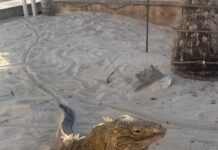
The Sister Islands rock iguana on Little Cayman has been tagged “critically endangered” after the most recent survey taken by the Department of Environment.
The DoE’s Terrestrial Resources Unit, along with an intern and volunteers, estimated a population of 1,786, as of November last year, down from 2,915 recorded in a 2015 survey.
The sharp drop in numbers was blamed on a combination of threats from “habitat loss, invasive mammal predation and mortality from traffic along roads”, according to an article in the latest issue of the DoE publication, Flicker.
Over the last two years, traffic mortality reports indicate at least 40 iguanas annually have been struck and killed by vehicles, the article said, also pointing to accounts by Little Cayman residents indicating a “constant loss of hatchlings to cat predation”.
In addition, reproductive output is being reduced by a high mortality rate among breeding adults and hatchlings.
Bonnie Scott, a rock iguana conservationist and member of the National Trust in Cayman Brac, noted that one iguana that had been recorded in a 2012 survey of the animals was recently run over, saying, “A beautiful road iguana with babies was killed on the Bluff road.”
She said she feared that a large male seen with that female near the road would be the next victim.
Gregory McTaggart, an iguana conservationist on Little Cayman, pointed to the danger posed by feral cats, explaining they had been “an issue for many years, but no action has been taken to address it. There is no official programme to try and control the feral cat population and the government is prevented from doing anything, so the problem has really spiralled out of control in the past couple of years.”
He also noted that road kill was a big problem. Last year, he said 46 rock iguana were killed on the road in Little Cayman, with an additional three such fatalities since the beginning of 2020.
“The National Trust has been working to raise public and motorist awareness on this issue,” he said.
McTaggart explained that the rock iguana is a signature land animal on Little Cayman, adding they are found in Cayman Brac and Little Cayman and nowhere else in the world.
“They are our own, and in my books, that is enough to keep them protected,” he said.
McTaggart said Little Cayman’s rock iguanas contribute to the ecosystem, they disperse seeds and they are critical to the island’s environment. As for Cayman Brac, the Flicker article said the current population of the Sisters Islands rock iguana is unknown but appears to be much smaller than that on Little Cayman. The DoE plans to conduct an assessment of the Brac iguana numbers in November this year.
Scott said she suspects that the rock iguana mating season has started earlier this year and she thinks people needs to be aware and on the lookout for iguanas on the road.
Related Videos