

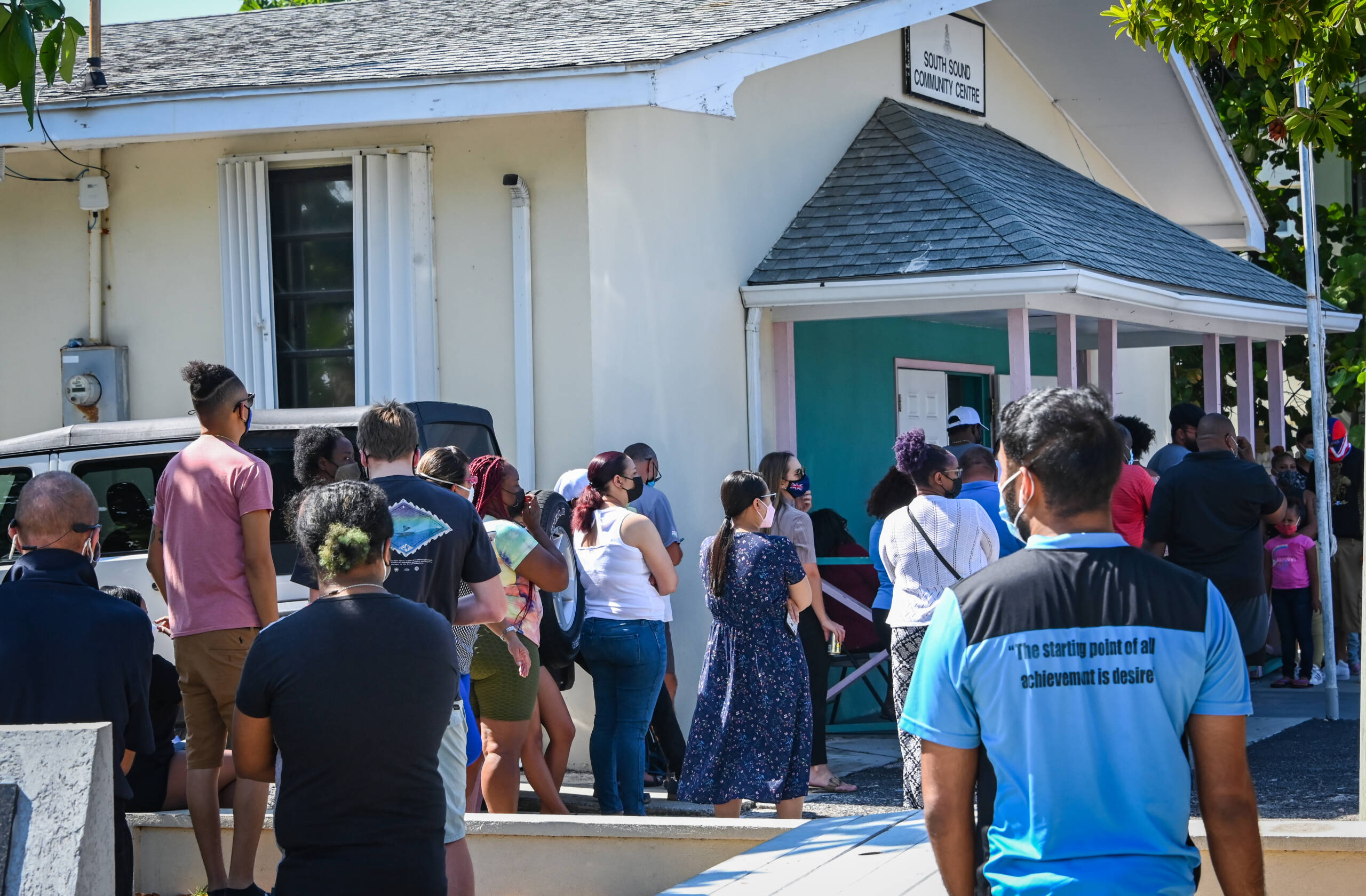
Hundreds of people in the Cayman Islands may have been kept under ‘house arrest’ for longer than was medically necessary or legally justifiable, according to two senior human rights lawyers.
The policy of placing people in quarantine until they can produce a negative PCR test has seen people isolated in their homes for 30 days or longer.
While this approach may have been defensible when there was zero COVID in Cayman, it is becoming increasingly difficult to justify amid an outbreak of community transmission, the legal experts warn in an analysis of the tension between human rights and COVID regulations in the Cayman Compass Issues section.
The United States and the United Kingdom have not required an exit test as a condition of release from isolation after 14 days. Both countries have now reduced the isolation periods significantly for positive cases as the pandemic has extended into a third year.
The US Centers for Disease Control and Prevention caps the period at which people with COVID are likely to be contagious at 10 days from the onset of symptoms – a position supported by research from Harvard Medical School.
However, PCR tests can detect fragments of inactive virus for up to 90 days, according to the UK Health Security Agency, formerly known as Public Health England.
Over the last few months, hundreds of Cayman Islands residents have been in quarantine for longer than 14 days – some for as long as 45 days – because they have been unable to get a negative exit PCR test.
Cayman has adapted its policies in the face of public criticism. As of Wednesday, the quarantine periods have been reduced to 7 days for vaccinated cases and 10 days for those who have not been vaccinated. However, a PCR exit test is still required before release.
Government has wide powers when it comes to curtailing human rights, including placing restriction on liberty, freedom of movement and freedom of association, to prevent the spread of a communicable disease.
But that authority is not absolute, says James Austin-Smith, former chairman of the Cayman Islands Human Rights Commission.

He said isolating COVID cases for long periods might have made sense when the goal was to keep the virus out of Cayman. But now that community spread is entrenched, with more than 5% of the island suffering from the virus on any given day, he believes the policy is legally questionable.
‘Significant restriction on liberty’
Any measures passed by government have to be reasonable, justifiable and proportionate to the threat posed by the pandemic, he said.
“When you start talking about 20, 30, even 40 days in quarantine, you are talking about serious sacrifice,” he said. “It is house arrest essentially for an extended period of time and it is not clear what purpose that serves when COVID is already on the island and there are clearly people out there that have it and are walking around freely.”
He added that any legal challenge to those policies would rest on expert medical evidence.
Quarantine in Cayman
- The issue explained: COVID restrictions and human rights
- Quarantine period reduced for COVID
- Cayman’s isolation woes: In their own words
- Calls to axe exit test amid lengthy quarantine nightmares
- No requirement for employers to pay quarantined workers
- One mum’s story: Surviving quarantine with a toddler
- $1 million set aside for stipends for quarantining families
“I am not a doctor but it is clear that in Cayman we have standards that are considerably more stringent than what has been deemed appropriate by medical experts in other jurisdictions. There is a strong argument that this is a disproportionate interference with the right to liberty.”
Chris Buttler QC, a London-based lawyer with Matrix Chambers, who has brought several Bill of Rights cases in Cayman, believes that holding people in quarantine for longer than the 14 days recommended by world health experts is legally unsustainable.
“My fairly strong view is that this is likely to constitute an unjustified deprivation of liberty,” he said. “The battleground in any legal action would then be around whether the executive could prove that detention beyond 14 days is necessary. There seems to be an international consensus on this figure,” he said, adding he couldn’t see how government could justify a longer period of quarantine.
Buttler believes the initial 14 days would be seen as appropriate by the courts – which have given wide latitude to governments to introduce measures to restrict the spread of COVID.
But he believes government would lose a challenge beyond that, should anyone be sufficiently motivated to bring it.
He said that the extent and duration of quarantine following a positive test under Cayman law differed substantially from other jurisdictions.
Dale Crowley, chair of Cayman’s Human Rights Commission, said that body is currently reviewing current laws and regulations relating to the COVID pandemic.
He said the review was still in progress but would be made public once complete. He declined to comment further at this point.
Related: The issue explained: COVID restrictions and human rights
Related Videos











I was kepted in quarantine 5 weeks! A total disgrace from a government who trampled on my liberty unnecessarily
I can strongly identify with this article and the plight of potential extended house arrest due to the PCR exit testing requirement. We are property owners in GCM and came to visit for the first time in two years earlier this month. I was terribly nervous about my PCR exit test results even after my 10 day isolation (and multiple negative LFTs at home in preparation), and I wondered if I would get to return home to the US to see my family and children. This testing requirement is far too rigid for an “exit” test after longer than standard insolation periods. Further, as I understand the science, PCR tests are likely to stay positive longer for individuals who had stronger cases of COVID including those who are immunocompromised, etc., meaning that people who have been “hit harder” by this terrible virus are the ones who are most likely to be penalized further by this restrictive policy. This MUST change. Keep the isolation period at 7 days if you must, but take away the exit PCR. It’s unfair and unnecessary.
Kudos for this article. I know HSA is trying its best under difficult circumstances. That being said, All the evidence indicates that PCR is not appropriate after the normal period of contagion. The current HSA rules are out of step with the scientific data and out of step with UK’s NHI and US CDC. See the article below.
https://www.cnn.com/2022/01/19/health/pcr-vs-antigen-tests-covid-19-wellness/index.html
What about forced house arrest for people testing NEGATIVE just because they have kids?? How is that not a breach of human rights?
Well I suppose it’s only been two years, so we can’t expect the HRC to have formed a view. I’m sure they’ll have something for us within another year or three.
Come back James, your country needs you!